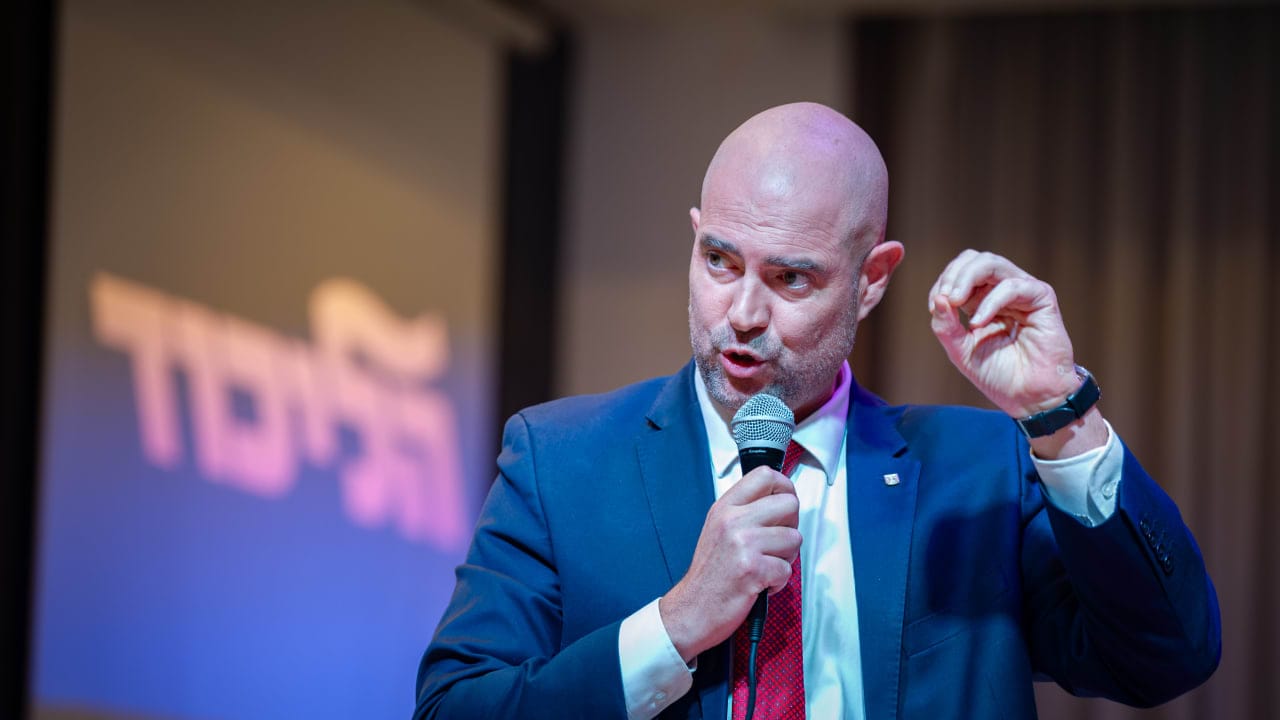
A clear majority is emerging in the Knesset to replace Speaker Amir Ohana (Likud), with 67 MKs who do not support Prime Minister Benjamin Netanyahu compared with 46 who do, raising the question of whether Ohana could delay a vote on his replacement despite a 2020 High Court of Justice ruling against former speaker Yuli Edelstein.
But what happens when an outgoing Knesset speaker refuses to convene the Knesset to elect a new speaker, or delays the decision for political reasons?
A precedent already exists involving former Knesset speaker Yuli Edelstein (Likud) several years ago. The High Court ordered him to convene the Knesset to vote on a new speaker, but Edelstein refused, resigned, and violated the court's ruling.
It should be emphasized that Ohana, a close associate of Netanyahu, has already stated: "The customary time for electing a Knesset speaker is when the government is formed. The exception is if a letter is submitted bearing the signatures of a majority of Knesset members, at least 61 MKs, requesting that a speaker be elected at an earlier date."
In other words, according to Ohana, he will allow a vote on his replacement if 61 signatures are submitted.

"As I have already responded, including publicly, we will respect the members of Knesset," Ohana continued. "If a majority of them request such a discussion, I will schedule it for an earlier date, no later than one week. There will be no desperate clinging to office. The media can stop promoting conspiracy theories. I wish the Knesset and the State of Israel success."
The 2020 precedent: Yuli Edelstein's refusal to hold a vote
This is an appropriate time to revisit the case of former Knesset speaker Yuli Edelstein.
It happened in 2020. Elections for the 23rd Knesset were held on March 2, 2020, and its swearing-in was scheduled for March 16.
Ahead of the swearing-in, several Knesset factions representing a combined 61 MKs approached the Knesset speaker and requested that the parliamentary agenda for the swearing-in include, among other things, a proposal to appoint a permanent Knesset speaker.
Edelstein, however, refused, arguing that "the need of the hour for the State of Israel is a broad unity government."
At the time, negotiations were underway between Likud and Blue and White, led by Benny Gantz, to form a unity government, and there was an expectation that an MK not from Likud would be appointed speaker.
Edelstein argued that "hasty political moves, such as electing a permanent Knesset speaker and passing controversial legislation, are intended to put an end to the possibility of unity that the people want."
Petitions were filed with the High Court by the Movement for Quality Government in Israel, the Blue and White faction, the Labor-Meretz faction, the Yisrael Beytenu faction, and additional parties.
The petitioners argued that the Knesset Speaker had acted under a personal conflict of interest, without authority, and unreasonably. They further claimed that his decision not to include the election of a permanent Knesset speaker on the parliamentary agenda was tainted by improper considerations.
They pointed to Section 2(b) of the Knesset Rules of Procedure, which stipulates that the Knesset speaker must be elected no later than the date on which the Knesset convenes for the purpose of forming a government.
According to the petitioners, that provision establishes the final deadline for electing a permanent speaker.
They stressed that the incumbent speaker, who continued to serve under the principle of parliamentary continuity, was thwarting the will of a majority of MKs, thereby undermining public trust in the branches of government and the principle of separation of powers.
Edelstein responded to the High Court that the matter was "subject to his broad discretion regarding the setting of the Knesset plenum's agenda, and therefore he acted within his authority, reasonably and in accordance with customary practice when he took into account considerations relating to coalition negotiations, particularly against the backdrop of the coronavirus outbreak and the state of emergency in the country."
Likud also maintained that there was no justification for intervening in the discretion exercised by its party member.
During a hearing held on March 22, 2020, the Knesset's legal adviser was inclined to argue that electing a permanent Knesset speaker before the political balance of power and the composition of the future government had become clear could lead to "a constitutional malfunction."
Such a situation, he argued, could make it extremely difficult for the government to function if the permanent Knesset speaker ultimately elected belonged to the opposition. He therefore considered it appropriate to wait a further short period.
High Court: The Knesset is not the government's cheerleading squad
In her ruling, then-Supreme Court president Esther Hayut explained that the general rule is that "the authority to determine the Knesset's agenda and the timing of its debates rests with the Knesset speaker. These matters are distinctly 'internal parliamentary' affairs, and therefore, as a rule, this Court refrains from intervening in them."
In this case, however, the question was whether the circumstances fell within the exceptional category of cases in which there was concern about harm to the "fabric of democratic life" or the foundations of the parliamentary system. After all, Edelstein had effectively prevented the Knesset from convening to replace him.
According to Hayut, "Contrary to Edelstein's position, we believe that given the fact that this is an acting speaker serving by virtue of the principle of continuity, and given that this is a matter that directly concerns him, the discretion granted to him in this context is not broad, but rather extremely limited and narrowly defined."
She wrote that "the flaw in this conduct lies first and foremost in the concern that it amounts to thwarting the will of the voter."
Hayut added, "The Knesset speaker's position that the election of a permanent Knesset speaker is dependent on moves to form a government amounts to putting the cart before the horse. The Knesset is sovereign. The Knesset is not the 'government's cheerleading squad.'"
She also addressed the political deadlock at the time.
"Edelstein justified his refusal by noting, among other things, that the citizens of Israel long for a government to finally be established in Israel after three election campaigns," she wrote.
However, Hayut explained that Edelstein had placed a political consideration concerning the formation of a government at the heart of his refusal.
Ultimately, the court ruled that "the continued refusal to allow a vote in the Knesset plenum on the election of a permanent Knesset speaker undermines the foundations of the democratic process.
It clearly harms the Knesset's status as an independent branch of government, as well as the process of transition of power, and these concerns become all the more significant as the days pass since the swearing-in of the 23rd Knesset."
The other justices joined Hayut's position and ordered Edelstein to convene the Knesset for a vote on his replacement as soon as possible.
Edelstein refused. He decided to resign rather than comply with the High Court's ruling, triggering a major political storm. Behind the scenes, reports said members of his own party pressured him to take that step.
Edelstein's refusal did indeed create a delay, and ultimately agreements were reached on a unity government between Likud and Blue and White.
Initially, Benny Gantz was appointed temporary Knesset speaker, and a permanent speaker was subsequently appointed.
A second High Court ruling: Edelstein violated the court's order
In a subsequent ruling, the High Court determined that Edelstein had violated its order.
"Never before in the history of the state has a government official openly and defiantly refused to comply with a judicial order, stating that his conscience does not allow him to comply with the judgment. This is how Edelstein chose to act," the court ruled.
An arrangement was ultimately reached that enabled the implementation of the previous ruling, led by Amir Peretz, the longest-serving member of Knesset.
Edelstein's political career appears never to have recovered from his refusal to comply with the High Court.
Edelstein, who until then had been a rising force within Likud and had even been discussed as a potential future contender for the party leadership, reached a point where he found himself outside the Knesset following the most recent elections.
This was also due to Netanyahu's efforts to weaken his political rivals and demand absolute loyalty.
Ohana's record on High Court rulings
It should be remembered that compliance with High Court rulings in general is not necessarily a red line for Ohana.
At times, noncompliance appears to have become a political calling card for him.
One example is the High Court's recent decision to hold another round of voting to elect the state comptroller, a decision Ohana effectively stalled, drawing harsh criticism from the High Court.
For the time being, however, Ohana has announced that he will convene the Knesset to vote on his replacement if 61 MKs demand it.