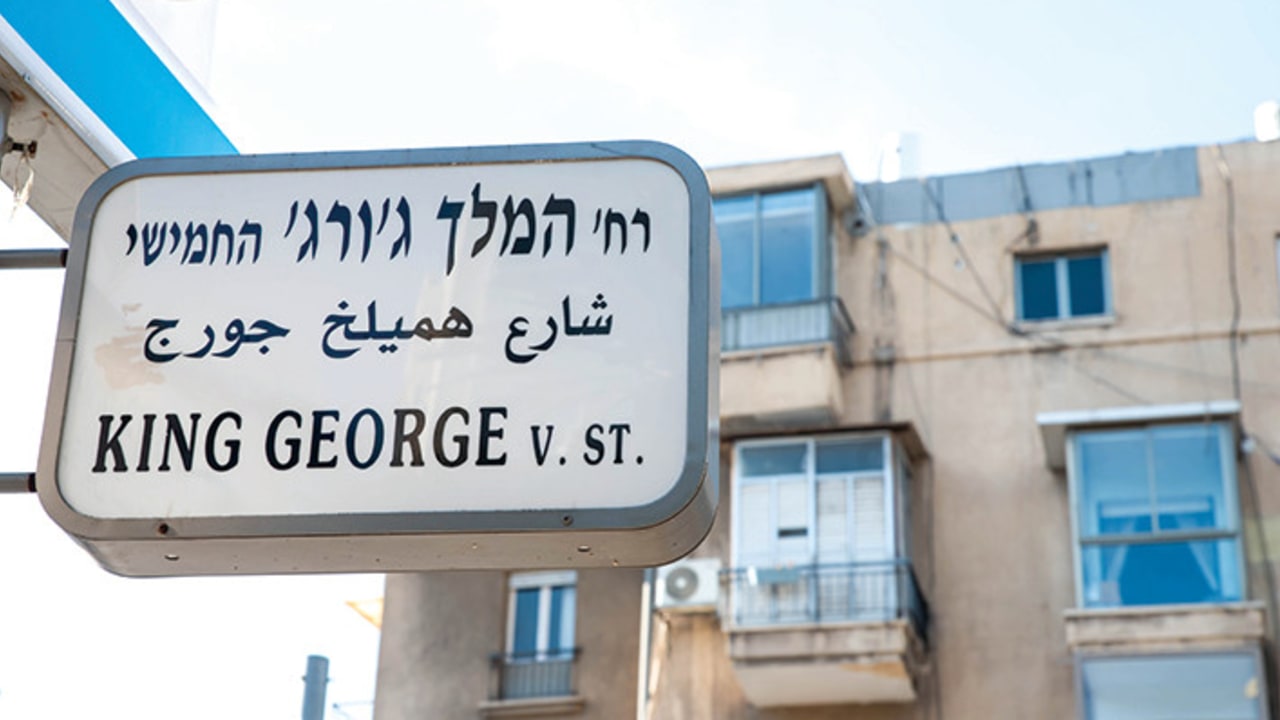
The confrontation with Britain over its intention to advance sanctions and trade restrictions related to settlements is also being reflected at the municipal level in Jerusalem: Deputy Mayor Aryeh King is demanding that the name of King George Street, one of the capital’s main thoroughfares, be removed and replaced with the name “Tabur Haaretz” (“Navel of the Land”).
King submitted the request Wednesday morning to Jerusalem Mayor Moshe Lion, who also serves as chairman of the street naming committee. In his request, he directly linked the initiative to the worsening of British policy toward Israel. According to King, the measures being advanced by London against government policy and Israeli activity in parts of Jerusalem require reconsidering the commemoration of the British monarch in the capital’s public sphere.
The request comes a day after the British government announced its intention to advance a series of measures against settlements in the West Bank. At the center of the plan is a future ban on imports of goods and products manufactured in settlements, alongside new legislation that would grant British ministers the authority to impose targeted sanctions on organizations, companies, and individuals involved in financing, supporting, or building in settlements. The measures will not take effect immediately, as their implementation requires the completion of legal and regulatory procedures expected to take several months.
According to details released after the announcement, the planned import ban applies to physical goods from settlements and not to services. The sanctions mechanism targeting companies, organizations, and individuals is also not a blanket automatic ban, but rather the creation of authority that would allow the British government to impose sanctions on a case-by-case basis. Due to the legal and technical complexity, the measures are not expected to take effect before the Israeli elections, and likely only next year at the earliest. A possible change in Israeli policy during this period could affect the scope of the measures and their practical implementation.
British Foreign Secretary Ed Miliband linked the move to settlement expansion and tenders for construction in E1, which Britain has described as a “red line.” London has stressed that the planned measures are directed at settlements and not at Israel within the Green Line, and that their purpose is to prevent further damage to the possibility of implementing a two-state solution in the future.

The British move has also received broader international backing. In a joint statement, 12 countries, Canada, Denmark, Finland, France, Iceland, Ireland, Norway, Poland, Portugal, Spain, Sweden, and Britain, announced their intention to impose national restrictions, support European restrictions on trade with settlements, or actively consider such measures and additional steps. Britain, France, and Canada explicitly announced that they would advance national measures to ban trade in settlement products.
Against this backdrop, King is seeking to add a symbolic step directly related to Britain’s historic presence in Jerusalem. Instead of the name of King George, he is proposing the name “Tabur Haaretz,” taken from the Book of Ezekiel. According to him, the name reflects both Jerusalem’s status at the heart of the Land of Israel and the street’s location in the center of the capital.
The name King George has been associated with the street for more than 100 years. It was given in 1924 during the British Mandate period in honor of George V, king of Britain from 1910 to 1936. His reign included the British conquest of the Land of Israel from the Ottoman Empire and the beginning of British Mandate rule.
The fact that the name was established under British rule is part of the argument presented by King.
King George's name removed from Haifa street, Beersheba park
In his request, he notes that neither an Israeli government nor a Jewish municipality after the establishment of the state decided to commemorate the king. He also points to changes made elsewhere in Israel: in Haifa, he says, a street bearing King George’s name was renamed King David Street, and in Beersheba his name was removed from a municipal park.
This is not the first time King has sought to use public space naming as a way of conveying a political message. In the past, he proposed name changes following disputes with France and with UNRWA.
The initiative comes as political figures call for retaliatory measures against the British announcement. The crisis between Jerusalem and London has intensified following Britain’s intention to advance the restrictions, even though they have not yet taken effect and the final details of their implementation are still being formulated.
King is now seeking to add a municipal move with declarative significance: removing one of the most prominent remnants of the British Mandate period from Jerusalem’s street names. For the proposal to be implemented, it will need to go through the municipal procedures required for changing street names.
Israel is advancing another retaliatory step against the British move targeting settlements: the Diaspora Affairs and Combating Antisemitism Ministry recommended that the Population and Immigration Authority prevent the entry into Israel of employees and activists from 11 organizations operating in Britain, claiming they promote boycotts and sanctions against Israel. The list includes Oxfam, Palestine Solidarity Campaign, Medical Aid for Palestinians, Save the Children, as well as Palestine Action and Islamic Relief Worldwide, which are designated organizations in Israel.
The move was advanced under the direction of Diaspora Affairs and Combating Antisemitism Minister Amichai Chikli following the British government’s announcement of its intention to promote a ban on trade in products from settlements in Judea and Samaria. Ministry Director-General Avi Cohen Skali sent the recommendation to Amnon Shmueli, head of the Ben-Gurion Airport division at the Population and Immigration Authority, with a copy sent to the authority’s director-general Boaz Yosef.
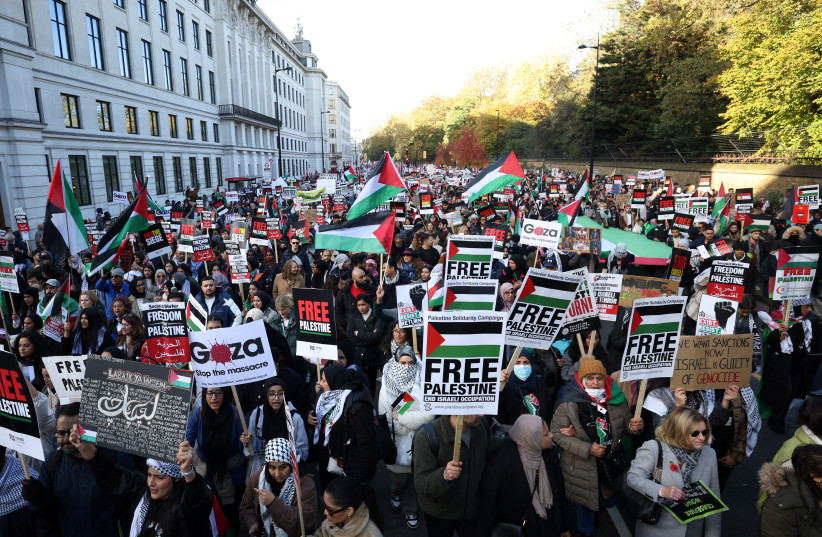
The letter stated that the government and ministry view the British move with severity, and that against this backdrop, the activities of British organizations promoting “boycotts, sanctions, and economic and political measures against the State of Israel” should be examined. The ministry recommended preventing entry by activists belonging to organizations that it claims operate against Israel and harm its legitimacy.
The list compiled by the ministry is divided into three groups: organizations that, according to the document, received direct funding from the British government; organizations that received indirect funding; and organizations that are not funded by the British government.
The first group includes Oxfam, Islamic Relief Worldwide, War on Want UK, and Norwegian Refugee Council. The second includes Save the Children and Medical Aid for Palestinians, while the third includes Palestine Action, Palestine Solidarity Campaign, Friends of Al-Aqsa, Lawyers for Palestinian Human Rights, and Europe Trust.
The emphasis placed by the ministry on funding sources is not incidental. According to the document, several of the groups whose activists the ministry seeks to prevent from entering Israel previously received direct funding from the British government. The letter presents this alongside the organizations’ activities against Israeli policy and within campaigns calling for boycotts and sanctions.
Pro-Palestinian organizations support arms embargo, sanctions on Israel
The ministry details its claims against several organizations. Regarding Oxfam, it states that although the organization presents itself as humanitarian and does not define itself as supporting the global BDS movement, it promotes a ban on goods originating from settlements and calls for an arms embargo and sanctions against Israel. War on Want, according to the document, participates in campaigns against companies operating in Israel, including in the fields of arms sales and settlement trade, and defines Israel as an “apartheid state.”
Save the Children was also included on the list. The document claims that the organization supported an arms embargo on Israel, worked to include the IDF on the UN list of parties violating children’s rights in armed conflicts, and accused Israel of “genocide” and “deliberate starvation.” It also states that the organization’s request was rejected in January by the interministerial team for nongovernmental organizations, based on an alleged connection to Islamic Relief Worldwide.
Regarding Medical Aid for Palestinians, the ministry notes that the organization, which provides healthcare and medical assistance to Palestinians, runs a campaign calling for sanctions and an arms embargo on Israel. According to the letter, MAP called on Britain to suspend arms sales to Israel, including components for F-35 aircraft, and urged London to clarify that it would honor International Criminal Court arrest warrants.
Two organizations receive extensive attention in the letter due to their status. Islamic Relief Worldwide was declared a designated organization in Israel in 2014 based on information that it had funded Hamas. The letter also states that one of its founders, Issam al-Haddad, was linked to the Muslim Brotherhood. Palestine Action, a British organization focused on direct action against the Israeli defense industry, particularly Elbit Systems, was designated as a terrorist organization in Britain in 2025. Regarding both organizations, the letter uses broad language and recommends preventing any employee or activist from entering Israel.
The list also includes Palestine Solidarity Campaign, which the ministry defines as the largest delegitimization organization in Britain and one that openly promotes boycotts as part of the BDS movement; Friends of Al-Aqsa, which it claims plays a central role in promoting boycotts in Britain and whose senior figures participated in the Mavi Marmara flotilla; and Europe Trust, which the ministry describes as one of the main frameworks associated with Muslim Brotherhood activity in Europe.
The ministry also includes Lawyers for Palestinian Human Rights. According to the document, the organization has worked over the years with bodies and individuals that Israel claims are linked to designated organizations, including DCI-Palestine and Khalida Jarrar, who is associated with the Popular Front for the Liberation of Palestine.
The letter states that, regarding some of the organizations, the ministry claims there have been links over the years to entities associated with the Muslim Brotherhood and Islamist networks in Britain and Europe, as well as ties to designated organizations including Hamas and the Popular Front. Their activity promoting boycotts and sanctions, alongside the alleged links attributed to them in the document, forms the basis for the ministry’s recommendation to examine the entry of their representatives and activists into Israel.