
Former Shin Bet (Israel Security Agency) deputy director Israel Hasson called for an investigation into the failures surrounding the October 7, 2023, Hamas massacre, following statements by the then-Prime Minister's military secretary, Maj.-Gen. Avi Gil and then-Shin Bet chief Ronen Bar that contradict Prime Minister Benjamin Netanyahu's accounts of events before and after the attack.
Speaking on 103FM, Hasson addressed the conflicting accounts and questioned how Israel had reached a point where senior security officials and political leaders were publicly disputing responsibility rather than conducting a comprehensive examination of the failures.
"I sat through the Shin Bet's investigation for four and a half hours," Hasson said. "An investigation is measured by whether there are questions that were not asked."
"I told them, 'I salute you. I don't have a single additional question that you haven't asked yourselves, but I'm leaving here without an answer.'"
Hasson pointed to the scale of the October 7 attack and the absence of specific intelligence warning beforehand.
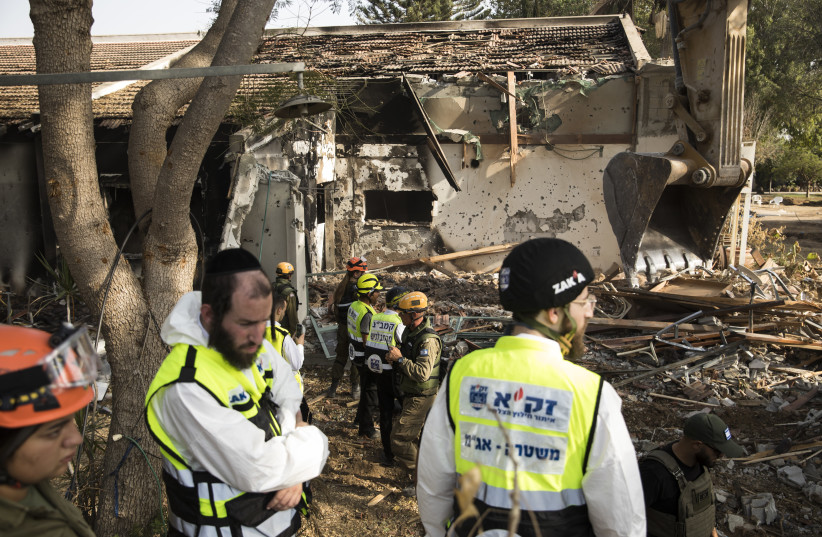
"Three thousand people participated in this attack, and we had no concrete warning," he said.
Former Shin Bet deputy chief explains intelligence available to Netanyahu's military secretary
Hasson emphasized that the prime minister's military secretary has access to a broader intelligence picture than any single intelligence agency possesses at a given moment.
"Avi Gil has the complete intelligence picture, which is not available at every moment within the Shin Bet," he explained.
"There are 15 officers in the military secretariat. All of Israel's intelligence information is available to them. His picture is much more comprehensive and complete."
According to Hasson, the military secretariat is responsible for consolidating intelligence assessments from different agencies and presenting them to the prime minister in an organized manner.
"To avoid a situation where, in quotation marks, everyone is confusing the prime minister, the information goes through a channel that can say: 'This is what the Shin Bet says, this is what Military Intelligence says, this is what the Mossad says, and what another hundred bodies are saying.'"

Hasson says inquiry must establish responsibility for October 7 failures
Hasson expressed frustration over the public disputes surrounding the events of October 7, arguing that a formal investigation is needed to determine where the failures occurred.
"It is so sad that we have reached this point," he said. "It is so sad that we are fighting in public instead of going and investigating this matter."
He said a commission of inquiry might not necessarily uncover information unfamiliar to experienced security officials, but would provide the public with a clearer understanding of the failures and their causes.
"A commission of inquiry probably won't discover something I don't already know," Hasson said.
"But it will show the public where the problem was and what caused it. Conclusions will have to be drawn and corrections made to prevent something like this from happening again."
Hasson cites Agranat Commission on political and military responsibility
Hasson acknowledged that not all intelligence sources can be disclosed to the public, but questioned whether withholding certain information would undermine the ability to establish responsibility.
"It is perfectly legitimate that you and I are not given access to all our intelligence sources," he said. "The question is whether that currently affects the conclusions."
He referred to the Agranat Commission, which investigated the failures surrounding the 1973 Yom Kippur War, and its findings regarding intelligence assessments and political responsibility.
"The Agranat Commission said that when there is intent and capability, you do not wait for a warning," Hasson said.
"They established that. They also established that if the military echelon says one thing, it does not absolve the political echelon of responsibility."
Hasson argued that security decision-makers should prioritize precautionary action rather than wait for definitive intelligence before responding to a potential threat.
"It is better to call off a state of heightened readiness than to start looking for a reason to act," he said.
He also referred to previous recommendations to target Hamas leaders in the years leading up to October 7.
"I know how many times in the five years before 2023 there were demands to strike Hamas leaders," Hasson said.
"There were demands to neutralize them. They said the money was going toward armament. They said everything they said."
Former Shin Bet deputy chief addresses Ronen Bar's lawsuit against Netanyahu
Hasson also addressed the lawsuit filed by former Shin Bet chief Ronen Bar against Netanyahu, describing the dispute as extending beyond the former agency director personally.
"In my view, this is not Ronen Bar filing a lawsuit against the prime minister. This is the Shin Bet filing a lawsuit against the prime minister," Hasson said.
He sharply criticized Netanyahu's allegations against Bar, calling the extremely serious.
"He attacked him at a level that amounted to betrayal," Hasson said.