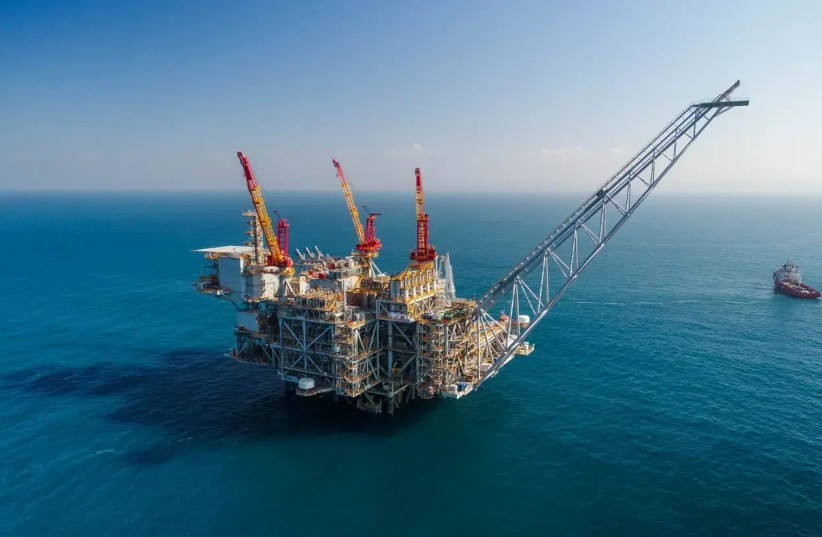
Prime Minister Benjamin Netanyahu visited the Leviathan natural gas platform on Thursday alongside Energy and Infrastructure Minister Eli Cohen, highlighting the role of natural gas as a strategic national asset and a major source of state revenue, according to a statement from the Prime Minister's Office (PMO).
Since the Leviathan gas field began operations in December 2019, the project has generated NIS 32 billion in revenue for the state treasury, the statement said. Cumulative state revenues from Israel's natural gas and oil sector are projected to exceed NIS 350 billion, according to the PMO.
A significant portion of the sector's expected revenue comes from energy export agreements with neighboring countries, particularly Egypt. In December 2025, Israel approved a natural gas export agreement with Egypt worth approximately NIS 112 billion, highlighting the resource's economic and diplomatic significance.
The agreement is expected to generate approximately NIS 58 billion in revenue for the Israeli treasury.
The PMO highlighted the impact of domestic natural gas production on household energy costs, claiming that it has saved Israeli families thousands of shekels annually. According to the statement, energy prices in Israel are more than 20% lower than those in the European Union and other Western countries.
Israel is continuing efforts to identify additional natural gas reserves and expand its energy infrastructure, including to meet growing electricity demand from artificial intelligence data centers.
Leviathan gas field exceeds original production capacity expectations
In May, The Jerusalem Post reported that Israel's largest natural gas field, Leviathan, exceeded its previously announced annual production capacity, reaching 15.8 billion cubic meters (BCM) from earlier projections of 14 BCM, according to partner Ratio Energy.
During Thursday's visit, Netanyahu and Cohen also received a security briefing from the commander of the Israeli Navy's Haifa base on efforts to protect the offshore platform.
The Leviathan gas field was temporarily shut down for more than 30 days following the launch of Operation Roaring Lion against Iran on February 28, amid concerns that the platform could be targeted. Operations resumed in early April.
Idan Eretz/Globes/TNS contributed to this report.