
The word “autism” is derived from the Greek word “autós,” meaning “self,” and a lack of interest in others is considered to be a core deficit of those on the autism spectrum.
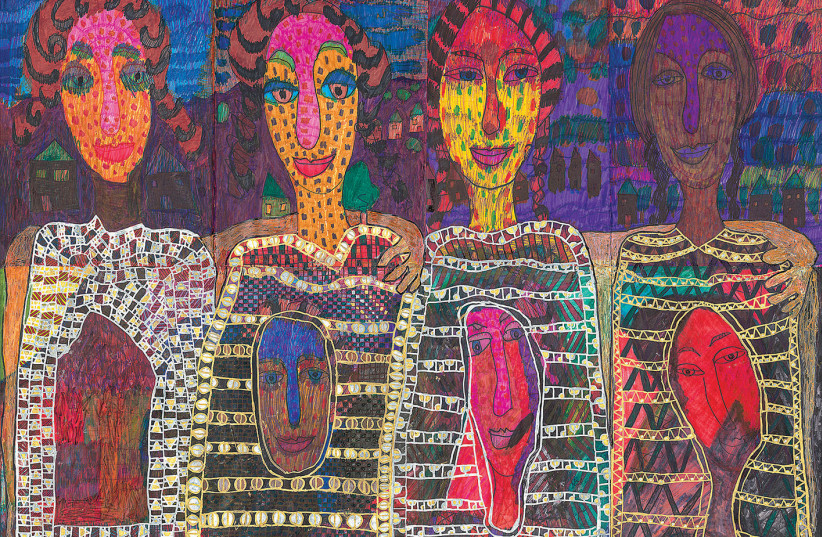
But a new exhibit by artists who live in the central Israel therapeutic village of Kfar Shimon contradicts this assumption, because it features collaborative works created by adult artists on the spectrum. The Feelings In Between exhibition opens on July 8 at the Jerusalem Theatre and will run until August 30.
The pictures, each of which is by between two and five artists, are bright and colorful, and almost indescribably vivid. They are also beautifully composed, often featuring distinct imagery that complements other designs in the picture. As you look at them, the phrase “more than the sum of their parts” may come to mind. Each element in these pictures – which are paintings, drawings, and a combination of the two – is striking. And together, everything on these pages blends into images that are truly dazzling.
The wall text for the exhibit reads, in part: “For artists in general, and particularly for people on the autism spectrum, many of whom rely on personal order, clear boundaries, and familiar space, the act of entering a shared surface and painting alongside another person can be almost counterintuitive. Yet across these sheets of paper, a rare process of influence and quiet, nonverbal communication began to unfold. The act of painting became a space for interaction, taking place in small moments of movement, color choice, or sudden stylistic flexibility. It took on special meaning during periods of rocket sirens as well, when the work was interrupted by the need to go down to the shelter and then return to the canvas.”
As the text indicates, in most cases, the artists worked together on them silently, with no, or very limited, verbal planning of who would draw what. While in a traditional art school, if a teacher gave students an assignment to collaborate on canvases, there might be a certain amount of competition, of jockeying for who would create the most interesting or most central part of a picture and get the most credit and attention. But the artists from Kfar Shimon are not concerned with who covers a larger portion of the surface of a picture or that a picture isn’t only theirs.
“The truth is that it seems to me you can do this only with people like this – it’s as if there is no ego involved,” said Nvo Sevori, the teacher who runs the art workshop at Kfar Shimon, who came up with the idea of encouraging the artists to collaborate.
He also curated the Jerusalem Theatre show.

It’s only fair at this point to note that one of the artists is my son Danny, and that I am as far from an objective observer of the work of the Kfar Shimon artists as is possible. Nevertheless, I am not alone in being impressed by their work. Since Danny moved to Kfar Shimon almost seven years ago, there have been two previous shows of art from the village, one at ArtSpace Tel Aviv in 2024 and the other at Tel Aviv University in 2025.
Before that, there were other shows of their work, including at the President’s Residence. I was impressed by the art I saw in Kfar Shimon when I first visited the village, not only the pictures, but also ceramic flowerpots, a sculpture garden of tiled works, wall murals, wooden toys, and all kinds of art and crafts that decorate almost every open space. The director of Kfar Shimon, Oded Korati, encourages the residents to use art as a means of self-expression as well as occupation.
But when Danny was given the opportunity to move there, I looked at the list of workshops and was sure that he wouldn’t be interested in art, because he had never much liked to draw or paint.
But he did join Sevori’s workshop, where his teacher has worked patiently with him to improve his skills, which in turn has made drawing more enjoyable for him.
While in many places for people with special needs, art teachers try to get them to draw and paint in a generic style, Sevori has encouraged them all to embrace their individuality.
For example, Danny loves ceiling fans and generally chooses to draw them, because they are objects he finds soothing and beautiful. It’s easy for me to determine whether he has worked on a collaborative picture; I just look for the fans. But he has also developed a style where he makes short lines that crisscross, something he never did before, and I can also find that in the pictures he has worked on. While all the artists have strong personal styles and subjects that they return to, their work has undergone subtle but meaningful changes over the years, as they continue to develop under Sevori’s guidance.
Sevori does not require them to collaborate but rather suggests that they work occasionally on these collaborative pictures, often when one of the artists has finished an individual work and is not yet ready to begin a new one. They are kept on the wall in the studio, and the artists can choose to work on them when they are ready.
An artist and musician who has been teaching at Kfar Shimon for well over a decade, he has many years of experience working with people on the spectrum at other places as well, and he has an incredible rapport with his students.
They sit quietly in the studio with him, listening to music and drawing. Occasionally, they will ask a question, or he will offer a suggestion. The collaborative works come together piecemeal and slowly. “There is no real planning. It is some kind of reaction that brings another reaction... more like intuitions, or things that happen along the way,” he said.
He added that they have no problem with working together on a single painting or drawing alongside other artists: “They simply accept it. Actually, it seems to me that they simply enjoy mixing it all in.”
Creating an atmosphere for autistic expression
SEVORI TENDS to downplay his own contribution to his students’ work, but in his low-key way, he has made the essential step of creating an atmosphere where they feel free to express what is on their minds. “I bring the paper. I bring the colors. I learn what comes more easily to them, what materials are easier for them to work with, and I try to make it fun for them. That is all.”
He said he used his own experiences as an artist to encourage his students, and that he feels that creating art is therapeutic for them, as it is for him: “It is like having an hour of fun, where I am with colors, I am not stuck in my own head, and I am doing something. I think that is the best therapy for me. It is wonderful therapy, and I think I am trying to pass that on to them.”
Sevori noted that collaboration is far more common in music. “I also work in music, and in music, there are many collaborations. But in painting, this is unique. It is really very special.” It may be no coincidence that several of the artists are also musicians and perform complex and beautiful jazz improvisations on keyboard. While my son does not play an instrument, he studied piano and is a great lover of many styles of music, something he has in common with many of the other artists.
Dr. Batsheva Ida, the curator of the Jerusalem Theatre galleries [see sidebar for more information about the full range of galleries there], spoke enthusiastically about the Feelings In Between show: “What is unique about the Kfar Shimon drawings is that they are not just geometric, but they actually have a figurative aspect, with human figures and recognizable attributes.
They share with Aboriginal and Maori art and with some autodidactic artists this interest in color as a vehicle for conveying emotion.”
Ida compared the Kfar Shimon works to those of Israeli autodidactic artist Imry Ben-Gera, who she said was influenced by Aboriginal and Maori art and used “colors and dots and geometric forms” as a vehicle for expression. Several of the Kfar Shimon artists often draw dots, swirls, squares, and other shapes.
It was unusual, she said, to “find someone with such a strong sense of color as a vehicle of emotion... The work of art [for these artists] is a mirror of the soul. It has almost a magical impact.”
Like Sevori, Ida feels that the strong interests that inform their paintings, like my son’s feeling for fans and other artists who often draw geometric patterns, indigenous people in colorful dress, and other recurring motifs, enhance their work rather than detracting from it.
“Their natural inclination toward repetition is perfect for an art piece, because viewers are used to seeing artworks and designs that repeat images,” she said.
“When we talk about art, we generally have an artist who studied, who did shows, who developed, who has a whole biography behind him, but we also have the artist who just began on his own, and didn’t learn the sources, and just felt more or less what he was doing.”
Ida said that while the Kfar Shimon works are unusual in many ways, collaborative art has important precedents in art history. “The Surrealists in France and in the United States would very often do a joint picture,” she said, citing works in which, “[Roberto] Matta and André Breton, and four or five different Surrealist artists, would join forces for one work.”
One question that arises is whether, or how much, the artists appreciate it when their works are shown at prestigious galleries and venues. Sevori said he feels that the recognition does make a strong impression on the artists, although they cannot express verbally why it does. “They do feel it when people love it, when people like it, yes, they feel that,” he said.
Ida agrees, adding that the impact goes far beyond the gallery walls. “The artwork becomes not only a finished product, but the process of the art itself has a social factor... For people who are more to themselves, that social factor in the process is a wonderful thing.”
For the families of the artists, the shows come as a pleasant surprise. We were all told by professionals, generally when our children were three years old or younger, that they would never accomplish anything, that they would need constant care, and would take a lot out of our lives.
But it turns out that they do have something to contribute and that people who do not know them take an interest in what they do.
We parents proudly display their works at home, but collectors from around the world have purchased some of their drawings and paintings that were exhibited in recent years.
Parents whose children progress in a more traditional way may not understand what it means when your child is on a different path. That our children are able to connect to people through their artwork is as unexpected as it is encouraging for us.
And there is no question that the recognition means something to the artists. My son, who can talk but who cannot explain why he likes fans so much – if you ask him, he will say, “They’re beautiful” or “They go fast” – was clearly elated during the opening events of the previous exhibits.
When he talks about these art shows, he mentions the names of friends and relatives who came to them, which gave him pleasure and impressed him.
“Will they come to the new show?” he has been asking lately.
“Lots of people will come,” I’ve been telling him.
He smiles.

The Jerusalem Theatre’s galleries present art in the capital
Feelings in Between is one of many exhibits being shown at the Jerusalem Theatre, which is a cultural venue that brings together the arts of the stage and screen, as well as the plastic arts, with original initiatives that express the meeting point between ideas and art.
The exhibition program at the Jerusalem Theatre consists of eight galleries with monthly and bimonthly changing exhibitions of original works of contemporary art, showcasing emerging and new artists in various media – photography, acrylic and oil, pen and ink, watercolor, and prints – alongside gifts and long-term loans of original artworks.
Exhibitions on social and community issues have always been a priority of the Jerusalem Theatre, and director Sharon Abramovitch-Yardeni and curator Dr. Batsheva Ida see the Jerusalem Theatre’s galleries as part of a broader change in the art world, in which museums no longer have the same exclusive authority to determine which artists are “worthy.”
“The museum as an institution that decides whether an artist is worthy or not is changing,” Ida said. “The Jerusalem Theatre is part of the change that many places are going through. The theater has eight galleries, and we show mostly outsider art, autodidactic art, or art that comes from social needs.”
All exhibitions at the Jerusalem Theatre will be on view free of charge to the public, from 4 p.m. to 9:30 p.m. on weekdays, Fridays from 10 a.m. to 2 p.m., and Saturday night, from the opening of the venue, until 9:30 p.m.
To apply for a monthly newsletter of Art Events and Exhibition Openings, and to artists interested in exhibiting at the Theatre, write to curator Dr. Batsheva Ida at: batsheva@jth.org.il
For more information, see jerusalem-theatre.co.il/eng/Exhibitions