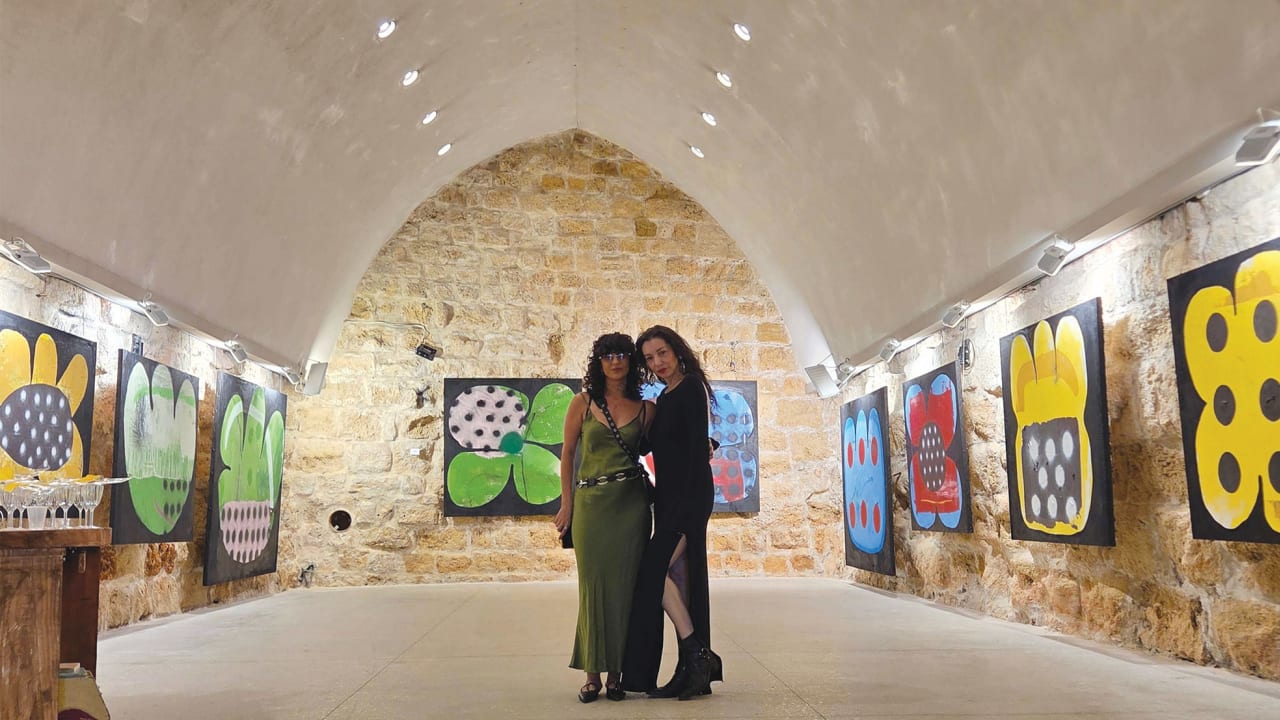
At Mika Contemporary Art Gallery, the Los Angeles-based artist’s first solo exhibition in Israel turns memory, grief, and inherited displacement into a vivid abstract language.
In the stone-vaulted rooms of Mika Contemporary Art Gallery in Jaffa, Sarah Svetlana’s paintings arrive with the force of accumulated memory. Large, brightly colored fields are overlaid with bold, flower-like forms, polka dots, charcoal gestures, and traces of personal history.
The exhibition, What Remains Awake, is Svetlana’s first solo presentation in Israel and, for the artist born in Soviet Belarus and raised in the United States, it is also a return charged with family history, mourning, and a newly urgent question of belonging.
Born in 1985 to a Belarusian Jewish family, Svetlana left the Soviet Union as a child in 1989, shortly before its collapse. Her family, refugees at the time, had a choice between Israel and the US while passing through Rome; they ultimately settled in America.
She now lives and works in the Los Angeles area. That unchosen route to Israel has remained a quiet but persistent presence in her work.

“My work has always revolved around exile, assimilation, finding home,” Svetlana said. “It’s always been about trying to find home physically and within yourself.”
Her first visit to Israel, undertaken alone, coincides with the exhibition and gives the project its emotional center.
Svetlana's return to Israel as a full-circle moment
Svetlana described the journey as a full-circle moment: an opportunity not only to reach a place bound up with her Jewish heritage, but to bring a new body of paintings to the country.
“I’m the first person in my maternal bloodline in almost 2,000 years to come back,” she said. “To bring back basically 10 altars to lay on this soil is really beautiful.”
The timing is inseparable from the period after October 7, 2023. Svetlana said that the rupture she experienced in relationships in the US, alongside the wider atmosphere she encountered, led to a deep depression and temporarily made painting feel impossible.
This exhibition marks her return to the studio after that break. Rather than illustrating a single event, the paintings gather pain, images, memories, and the persistent work of survival into color.
“I take all of that, and I turn it into really beautiful bright colors,” she said. “Even though they come from pain, they all end up as beauty.”
The exhibition’s title names that process. For Svetlana, What Remains Awake is “what’s left after everything burns down” – memory, ash, residue, and the part of the self that persists while the world appears to be asleep.
The gallery’s presentation frames the works as deeply autobiographical without treating autobiography as a fixed archive. Names, dates, colors, household patterns, and fragments of family life emerge and recede.
What cannot be seen directly is held within the painting’s layers.
On raw canvas, Svetlana works with charcoal, acrylic, oil, and spray paint. She writes the names and birth dates of her mother and grandmother into underlayers before covering them with paint.
The act both preserves and obscures: history is present, but never completely recoverable. Her mother’s death a decade ago sharpened that inquiry.
An old, seemingly incidental flower doodle from earlier paintings has evolved into a central structural element in the new series – a dark floral form that she now understands as a frame, or even a home, holding the work together.
The Root, The Heart, The Will
The series unfolds in three movements: The Root, The Heart, and The Will.
In The Root, charcoal and translucent color evoke maternal lineage and the search for an origin. The Heart moves through deep blues and reds, making memory feel close, embodied, and almost tactile.
The Will, marked by radiant yellow, charcoal, and remnants of lived time, turns from the past toward endurance: the decision to remain present and awake.
Curator Ellada Ilana Matatoc, an Israeli who also left the former Soviet sphere as a small child, first encountered Svetlana’s work on Instagram in 2019 while working with Mika Gallery.
The two immediately recognized resonances in the artist’s visual vocabulary, particularly the polka dots that Svetlana associates with Soviet domestic culture: bright, memorable motifs in an environment she recalled as overwhelmingly gray.
A small number of paintings were shown at the gallery then, but the relationship developed gradually through shared background and Matatov’s sustained response to the work.
For Matatov, Svetlana’s self-taught position is part of what gives the paintings their particular directness.
“She is working on the edges of things,” the curator said, describing an artist whose practice is led by emotion and intuition rather than academic convention.
Yet Matatov emphasized that her task was not to impose a theme or tell Svetlana what to make: “I saw her art; I didn’t tell her what to create,” she said. “Whenever I see what she did, I’m giving my interpretation to the theory of her practice.”
That distinction matters in What Remains Awake. The title was chosen by the artist, as were the internal movements of the series.
Matatov’s curatorial work includes the installation, exhibition text, public program, and the practical care surrounding the works, but it proceeds from an effort to make room for Svetlana’s own confidence and language.
“A curator is kind of like a producer,” Matatov said, while also returning to the older meaning of the word: to care for, preserve, and tend to art.
That care is palpable in the installation, where Svetlana’s black-grounded paintings meet the warm limestone walls of the Jaffa gallery.
Their graphic, almost emblematic shapes carry the intimacy of domestic objects and family inscriptions while retaining the freedom of abstract expressionism. The works do not offer a clean resolution to displacement.
Instead, they make a place where fragments can coexist: Belarus and Los Angeles, inherited grief and present-day resilience, private memory and collective feeling.
For Svetlana, simply bringing the paintings across the ocean already counts as a success.
“The moment I shipped those paintings, I felt like I did it,” she said. “I could hear all of my maternal line, all my ancestors cheering for me.”
In Jaffa, What Remains Awake gives that feeling a physical form: 10 works made from what remains, and from the will to continue.
Exhibition details: What Remains Awake, a solo exhibition by Sarah Svetlana, opened September 24, 2026, at Mika Contemporary Art Gallery in Jaffa. Curated by Ellada Ilana Matatov.