
August 9, 2001, was a sultry summer day. A time for families and teens to take to the streets of Jerusalem to celebrate the weeks before returning to school; a time for meet-ups, for shopping, for stopping at local eateries for fun food and good conversation.
It was the 20th of Av, after the mourning period of Tisha B’Av. The unsuspecting families and friends of 15 people did not yet know that their own mourning period was about to begin.
Israel was already in the throes of the Second Intifada, which followed on the heels of the First Intifada, which followed terror attacks in the wake of the signing of the Oslo Accords, which echoed the terror attacks of the 1970s, and earlier, going back many, many decades, long before Israel was declared a state.
But Israelis are irrepressible, and determined that life will go on.
So August 9 was the day that Malki Roth, 15, and her friend and next-door neighbor, Michal Raziel, 16, left their homes in the Ramot neighborhood of Jerusalem and headed for town. After decorating the bedroom of a friend who was due to return later in the day from a family vacation in the US, the girls decided to stop off for a quick lunch at one of their favorite central Jerusalem places before heading to a pre-camp counselors gathering in another part of town. That’s how they came to be at the popular, bustling Sbarro pizzeria just before 2 p.m.

An inconspicuous young journalism student, a guitar case packed with explosives
Meanwhile, Ahlam Tamimi, a 21-year-old Jordanian journalism student who worked evenings as a news reader for an Arab TV station in Ramallah, left the city in the company of 22-year-old Izzedine Suheil el-Masri. Together they took a taxi to the Kalandiya checkpoint north of Jerusalem, where they got out and walked across into Israel.
They looked like a modern 20-something couple, perhaps tourists. The guitar case slung across his shoulder attracted no interest from the Israeli security personnel manning the checkpoint. And no one guessed that the female was the first woman ever admitted to the ranks of Hamas terrorists.
Another taxi brought them to east Jerusalem’s Damascus Gate from where they walked into the heart of Jerusalem, separating at the crowded crossroads of Jaffa Road and King George Avenue.
At 2 p.m., Masri, standing next to Malki and Michal, activated the guitar case, which was packed with 10 kg. of explosives and a significant quantity of nails to enhance the skin-shredding effect. Malki Roth and Michal Raziel were among the dead. Tamimi later boasted that in scouting for a target-rich site in the capital, she was particularly alert to places that attracted children.
Half of the dead were children. Five members of the Schijveschuurder family - both parents and three children - perished.
In addition to Malki, two other American citizens were killed: Shoshana Yehudit Greenbaum, a young wife pregnant with her first child, herself an only child, died on that day. Chana Tova Chaya Nachenberg was severely injured. She was in a coma for almost 22 years and succumbed to her wounds on June 1, 2023. (This citizenship issue became important later.)
In the minutes after the horrific boom, Jerusalem’s cellular phone network collapsed under the pressure of calls. The Roths and many others frantically did what they could to find their children, contact hospitals, search for loved ones.
The victims’ families eventually received the horrifying news. The Roths received theirs from their two older sons who had been brought to the Abu Kabir Forensic Institute by a social worker. The victims were buried the next day; 15 pre-Shabbat funerals. And then the shiva period began.
Tamimi was tracked down and captured by the Shin Bet (Israel Security Agency) and Israeli security forces, and in 2003, an Israeli court sentenced her to 16 consecutive terms of life imprisonment.
She confessed to all charges, smiling throughout the proceedings. The judges recommended she never be eligible for early parole or a pardon.
Arnold Roth wrote in 2021, as a guest columnist in Bari Weiss’s Substack:
“A video clip of her presenting that night’s news bulletin on Al-Istiqlal TV may be the only instance in the annals of television where an atrocity was reported by the perpetrator. Later, Tamimi spoke of how hard it was to suppress the jubilation that the deaths and injuries of Jews - especially Jewish children - aroused within her.”
A religious-Zionist family
Frimet (Moseson) and Arnold Roth made aliyah from Australia in 1988. Frimet, a native New Yorker, says, “Everything [in this case] revolves around the fact that I’m an American citizen and so was Malki.”
She grew up in Queens and met Arnold when he was at Yeshiva University. “He had to go back to Australia shortly after we met because his father became ill. Phone calls were expensive in those days, so it was an aerogram courtship. We became engaged long distance, and we didn’t see each other again until two weeks before the wedding.” They got married in New York and immediately afterward moved to Australia, where they lived for the next 12 years.
Arnold recalls, “On our very first date, she asked me what my plans were for aliyah.”
Arnold was a lawyer in Melbourne and planned to do the same in Israel. “I gave up practicing law after a few years in Jerusalem and shifted my professional focus to running technology companies.” Frimet qualified as an attorney but, with seven children, she says, “I was a stay-at-home mother.”
Malki was child number four, the “filling in the sandwich,” a bright student, active in the Ezra youth movement, vivacious, a talented musician, and involved in volunteer work. The Roths’ youngest daughter, Haya, now 31, has severe disabilities. Frimet says, “She’s basically like a baby.” Haya lives at home.
Frimet gives us a window into the world of who her middle child was.
“Malki was very, very devoted to her youngest sister, and she helped me immensely, even though she was just a child herself. She also loved her in a very, very unusual way.
“She was drawn to helping other disabled people, children, and she would volunteer in all kinds of situations, probably because she had a disabled sister... One summer, she volunteered at the home of a young single mother in our neighborhood who had a very disabled child who subsequently passed away from his syndrome. Malki would go there every day and help the mother take care of the child.
“Nobody told her to do it. She just found out about her and did that. Also in school, there was a class for girls with special needs. The other kids their age didn’t really interact with them.
“But Malki, at break time, would always go over to them and spend time with them and talk to them. She was the only one who did that. That’s the kind of person she was. She was amazing. Very unique.”
The Roths have a caregiver in the daytime hours to care for Haya, and Frimet says, “I take care of her right through the rest of the 24-hour cycle. So it’s very, very draining on me. She needs everything done for her, absolutely everything.”
To deal with their overwhelming pain, and to honor Malki and who she was, they created Keren Malki - the Malki Foundation - which has helped thousands of Israeli families with special-needs children, equipping them with medical equipment and therapies not provided by the healthcare system.
Why was the public not warned of the suspected terror attack?
Frimet Roth tells The Magazine, “A few days after the Sbarro bombing, [then-justice minister] Meir Sheetrit appeared on a news program. I watched and wrote about it in at least one article. It still hurts me terribly. [Frimet published an op-ed on this in The Jerusalem Post on August 8, 2023.]
“He said that on the day of the bombing, in the hours preceding, the government was given intelligence information that a terrorist was on his way into the city and intending to commit a terror attack, a bombing. And they were hunting for him. He said, ‘We did not alert the public.’
“And apparently the hospitals were notified in advance to be prepared. But we, the general public, were kept in the dark.
“I would never have allowed Malki to leave if I had known what the police knew. In similar situations when intelligence was obtained about terrorists, they shut the city down. I think it was Haifa they shut down for some hours, the entire center of the city.
“They learned. But that day, not only didn’t they want to shut down the city, they didn’t want to warn us because there would be panic. It eats me up alive when I think back to what they did and what they failed to do. And he had no compunction about appearing and announcing this to us, telling us that this is what those in power did.
“I’m sure that nobody in their own families were walking the streets that day because they knew.
“There are so many levels to this travesty, this outrageous conduct, right down to the fact that one of those involved in that decision had no hesitation in sharing it afterwards.”
Frimet’s memory is corroborated by two sources. One, by an official briefing by justice minister Meir Sheetrit at the National Media Center, Jerusalem, on April 1, 2002, in which he said: “That same morning, we gave [PA head Yasser]Arafat information about a terrorist who we understood was ready to carry out an attack in the Jerusalem area - we did not know where and when the terrorist would strike, but we asked Arafat to stop him.”
In addition, then-Shas MK Nissim Ze’ev asked in the Knesset in 2004:
“In one sentence, I want to say and remind everyone: in the Sbarro restaurant, when [15] men, women, and children were murdered, the then-mayor of Jerusalem, [Ehud] Olmert, said: ‘I waited to hear the expected explosion, because there were ‘hot warnings’ [immediate security threats].”
“The public did not know there were hot warnings, and I didn’t understand then: If the mayor knows, and the police are searching for the terrorist, why doesn’t the public also have the right to search for the terrorist together with the police? So, it is possible there would be some panic among the public, but it is possible that terror attacks such as these could be prevented. Therefore, Mr. Speaker [of the Knesset], it is perhaps appropriate to rank warnings according to the real situation on the ground.” (The 168th Sitting of the Sixteenth Knesset, Wednesday, 28 Tishrei 5765, October 13, 2004)
I could not find a response, in Hebrew or English, from Olmert that contradicted what Nissim Ze’ev said, and the Magazine did not receive a response from him when I reached out to the Government Press Office. However, according to JTA, Olmert said at that time: “We tried to do everything to prevent it. Unfortunately, this time we were not successful.”
The Schalit deal
Shockingly, Tamimi was among the 1,027 convicted terrorists released by Israel in exchange for Gilad Schalit, an Israeli soldier who had been held hostage by Hamas for five years. It was not the first time Israel had reneged on its proclaimed policy to never release terrorists “with blood on their hands.” That past decision - that had led to the courageous Entebbe rescue - was a distant memory.
Ironically, the terrorists’ release was done under the leadership of Benjamin Netanyahu - the younger brother of the heroic commander Yonatan, who was killed in Entebbe - and a prime minister who, Roth noted in his column on Weiss’s platform, “made his international reputation by authoring a bestseller arguing that deals must never be done with terrorists.”
Another terrorist released in the Schalit deal was Nizar Tamimi, who, together with his cousin Said, had perpetrated the murder and then the burning of the body of Chaim Mizrahi in 1993. It was only six weeks after the signing of the Oslo Accords (as Caroline Glick pointed out in her Post column in 2017). They were both sentenced by Israel to life in prison. Nizar, a cousin of Ahlam Tamimi, became her husband after his release. Said was released in 2013.
In October 2020, Nizar was deported by Jordan to Qatar, which does not have an extradition treaty with the US.
Many terrorists released through the years in deals with the devil returned to terror. Among those most monstrous terrorists released in the Schalit deal was Yahya Sinwar, who masterminded the mega-atrocity of Oct. 7.
Abdallah Barghouti was the bomb-maker who constructed the explosives for the Sbarro horror. He was sentenced by an Israeli court to 67 life sentences in 2004 for his role in this and other terror attacks. So far, Israel has resisted releasing him in the various deals made with terrorists.
While Tamimi was serving her sentence in an Israeli prison, the Center for Near East Policy Research produced a 2007 film titled For the Sake of Allah, created by Shawn Bayer alongside Dr. Ronni Shaked, a fellow at the Harry S. Truman Research Institute and a senior commentator for Yediot Aharonot. The film features an interview with Tamimi inside the prison, where she sits in front of attractive bookshelves. In the footage, she wears a calm half-smile and a white hijab - which she did not wear that Aug. 9 night while reading the news, and probably was not wearing that day that she walked through an Israeli roadblock.
The four-part video is eye-opening and bone-chilling. Tamimi describes (in Arabic, translated to English by Shaked) in minute detail how she got the call to implement the operation, meeting her collaborator, Izzedine el-Masri, in Ramallah. “We just acknowledged one another through eye contact, and from here we started the operation. On Jaffa Street, we started to talk. It was the first time I spoke with him. I interpreted it as his real desire to be a martyr and to meet Allah.
“Izzedine el-Masri asked me just one question: ‘Are there religious Jews in the place where we are going to conduct the attack?’ I said yes, there are religious Jews there, and also other people. I had been to the area before; I knew there was a Jewish religious school near there. He asked how many religious Jews would be there.”
Interviewer: “Why did he ask about religious Jews?” Tamimi: “Because the base of the conflict between the Israelis and the Palestinians is a religious struggle.
“When we came to the place, he looked at my eyes, and I told him, ‘There is no God other than the mighty Allah.’ He went on his way, and I went on my way. I felt sorry for him.... I had just walked with a man, and we had a conversation, and in another minute, he disappeared and ascended to the other world. My emotions and thoughts focused only on Izzedine el-Masri,” she says, still smiling, “and his strong personality, and his vision, and his action.”
Interviewer: “Do you feel sorry?”
Tamimi: “No, absolutely not. Why? For what?”
Muhammad Douglas, who helped plan the bombing, was also arrested, and when asked how the people in his village reacted to the attack, he said to the camera, in English, “The people very, very happy [sic].” This is followed by scenes of elation in his village where children are waving candy as they rejoice.
Douglas, sentenced to 15 life sentences, was also released in the Schalit deal, and was reportedly among the more than 40 terrorists who were deported to Syria, Qatar, or Turkey. According to several sources, Douglas ended up in Qatar.
The film visits the restaurant of Masri’s parents in Jenin, and depicts how, after the bombing, the restaurant became a shrine with a life-sized mural of Masri on one wall, “a popular spot for young Palestinians to visit,” says the narrator.
Masri’s mother says in the film, “Praise Allah, praise Allah, that he was successful in his action. He went with a full conviction to do it. He spent all of his time in the mosque praying, and reading the Koran. He was interested in just religion.”
Religion. For Tamimi and for Masri.
It was never - is never - about territory.
Attempts to prevent her release
As the Schalit deal was being discussed, Frimet Roth wrote endless letters to the Pardons Board to not release Tamimi. Arnold says, “Frimet wrote letters every time, right through the 2000s, as every time there was a mention of a prisoner release, Tamimi would always be mentioned. To no avail.”
About Netanyahu, Arnold has little positive to say. “The Schalit deal was a catastrophe. That’s the exact word that Frimet and I both used in dozens of interviews in the week leading up to it. We had dozens of opportunities to speak with the foreign media in those frantic few days. But not the Israeli media; they had no interest in talking with us, or hearing about Tamimi and why she should never have been put on that list. If Netanyahu walked into the room now, I would walk out…
“I’m fully aware of all the arguments that say he’s the greatest strategic leader we could possibly have, and that may even be true. But the bitterness of his double-talk about deals with the terrorists, the irreparable damage he did to my family... there’s nothing I care to hear from him.”
The letters that never arrived
Tamimi’s release, in addition to causing indescribable anguish to the Sbarro victims’ families, highlighted an additional issue, as she was released not to Yesha (Hebrew acronym for Judea, Samaria, and Gaza), but to Jordan, where she received a welcome afforded to heroes and celebrities.
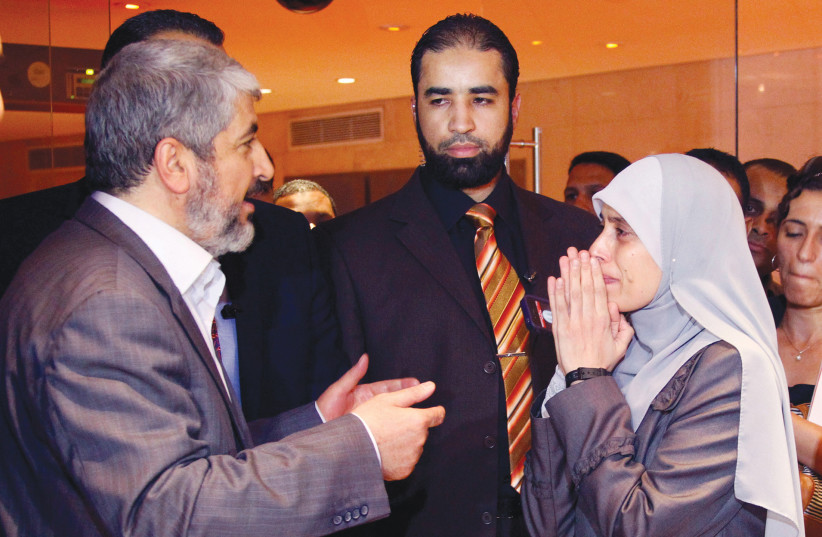
First, she was flown to Egypt, where she was met with great fanfare by Khaled Mashaal, who served as the second chairman of the Hamas political bureau at the time. (Today, he reportedly lives in Qatar.) When she arrived in Jordan, she received a hero’s welcome, including a reception in her honor at the Jordanian Law Courts building. In Jordan, she was given her own television program starting in March 2012 and running for nearly five years, beamed around the world to Arabic-speaking audiences literally everywhere.
Throughout her Jordan years, which continue until today, Tamimi - harbored by Amman and kept safe from US prosecutors - has encouraged terror and admiration for those who do it.
I am surely not the only one who, when confronted with the Tamimi story, wonders, “Where are the men from Munich when we need them?” (Referring to Operation Wrath of God, a covert operation directed by the Mossad to assassinate terrorists involved in the 1972 Munich massacre.)
When I expressed that thought to Arnold Roth, he replied, “With the Eichmann case and other precedents on people’s minds, I’m asked regularly why the Mossad don’t deal with Tamimi’s unjust freedom. But it’s the wrong question. Israel washed its hands of Tamimi the moment she walked free in the 2011 Schalit deal. They’re not interested in the smallest way. They set her free.
“There’s a political price to be paid by Netanyahu, who was the prime minister then and still is now, for doing the deal that led to the freedom of Sinwar and Tamimi and various other savages who went on to do terrible deeds and take lives. He has never communicated with us directly or otherwise, and in our quest for justice, we have zero expectations of him and of those in his circle.
“What we want is to see Tamimi in leg chains being bundled onto a flight from Jordan to the US. [More on that in Part Two of this series.] And, in my opinion, that is Netanyahu’s nightmare.”
On July 15, 2013, the US Department of Justice filed a criminal complaint under seal against Tamimi in the US District Court for the District of Columbia charging her with conspiring to use a weapon of mass destruction against US nationals outside the US, resulting in death. An arrest warrant was also issued under seal. The complaint, affidavit, and warrant were unsealed and made public on March 14, 2017, and at that time, the FBI simultaneously placed her on its Most Wanted Terrorists list. (More on this in Part Two.)
“Netanyahu freed her; he sold the deal to the Israeli public in 2011. I can’t imagine him being willing to pay in political capital terms today for the disasters of 2011 and where they brought us.
“As it happens, Netanyahu was in Melbourne, the city where Malki was born, on the August 2001 day that Malki was murdered, in between his prime ministerships. I was told by friends that he was interviewed there by the Australian media. They asked whether he knew a Melbourne girl was among the dead. He evidently said to the reporters, ‘My heart goes out to the girl’s family,’ meaning us. ‘And when I return to Jerusalem, I will meet with them.’
“Relatives of his wife lived in our neighborhood, and so we were treated over the post-Sbarro years to the sight of Netanyahu turning up in our synagogue, usually on Erev Rosh Hashanah and Erev Pesach. His security people brushed past me. Not that we expected anything different, but he certainly never tried to meet with us. We didn’t hear a word from him then or ever.
“Fast forward to the day in October 2011 that he announced the Schalit deal. In his TV message to the nation, I recall him using that same phrase - that his heart goes out to the families who suffered at the hands of the terrorists he was setting free. ‘And I shall write to all of them,’ he said. He seemed to mean it.
“The Schalit deal went ahead, Tamimi was safely back in the arms and affections of the Jordanians, and Frimet and I noticed, unbelievably, that our letter from the PM hadn’t arrived. We checked with friends who had lost children and loved ones to the terrorists, and their letters had not arrived. We asked. You probably know the answer.
“So, at that point, Frimet started phoning the Prime Minister’s Office.”
Frimet Roth: “And I asked them, ‘Can you tell me where our letter is? Where are the letters?’ A woman in that office told me: ‘Oh, they were sent.’ I said, ‘Well, we didn’t get ours, and nobody we know got theirs.’ In the background, another person, a male voice in English, was whispering: ‘Tell them hundreds of letters were sent. Tell her that.’”
Arnold: “There were several more rounds of phone calls like this. At some point, I got through to the same woman. ‘You’re making this stuff up,’ I said. ‘No,’ she said. ‘We’ve got so many letters to send that we can’t even take them to the post office. The post office is coming to collect them soon.’
“I recall myself saying that she needed to climb down from that tree,” says Arnold. “‘What you’re doing is appalling,’ I said. ‘You need to apologize, to drop the pretense. There were no letters. Why make up silly stories? Think about this and then get back to me with an apology.
“The rest you can guess,” he said to me.
The Magazine reached out to Netanyahu for a response to Arnold Roth’s comments. At the time of this writing, the prime minister had not sent a reply.
Writer’s note: When editor Erica Schachne reached out more than a month ago, asking me to do a story on this topic, neither of us could have imagined the labyrinth of obfuscation, cowardice, and even mental cruelty, with only an occasional glimmer of hope and light, that Arnold and Frimet Roth encountered when dealing with powerful people in Israel, Jordan, and the United States. She has generously agreed that this be a three-part series.
Next week in Part Two - The American saga: As Tamimi was released to Jordan, which has an extradition treaty with the US, her future was now in the hands of America.
Part Three will be about the involvement of American ambassadors to Israel, the American Jewish leadership’s response, and conclusions.
The writer is an award-winning journalist and theater director and the co-founder and editor of WholeFamily.com. Her current theater project is Heroines! Songs & Soliloquies for the Soul with Raise Your Spirits Theatre, about heroic women of Oct. 7.