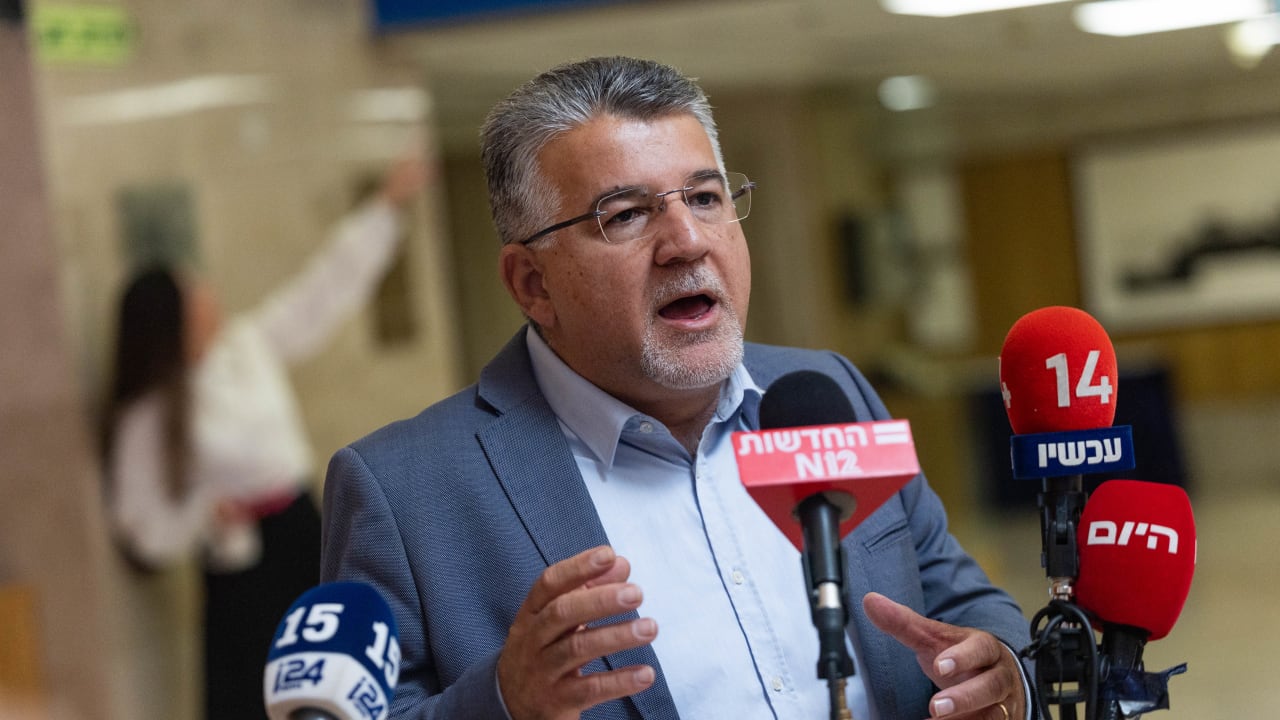
The Supreme Court is set to hear arguments on Thursday over the disqualification of Balad chairman Sami Abu Shehadeh, MK Ofer Cassif, and the Joint List ahead of the October 27 election. Whatever the justices decide, speakers at a briefing on Monday warned, the political campaign surrounding the cases risks frightening Arab voters and making participation in the election feel dangerous.
At the briefing for Israeli and international journalists in Jaffa, organized by the Carmel Forum and Adalah - The Legal Center for Arab Minority Rights in Israel, politicians, academics and legal experts argued that the cases had become tools in a struggle for individual political survival.
The immediate stakes, they said, were not only whether two candidates and a political alliance could compete, but the safety of Arab citizens, their ability to vote without intimidation and the effect of increasingly exclusionary campaign rhetoric on Arab political participation.
The court will hold two hearings before the same nine-justice panel. It will first review the Central Elections Committee’s decision to disqualify Abu Shehadeh, as required before an individual candidate’s disqualification can become final. The justices will then consider Cassif’s disqualification together with an appeal against the decision to bar the Joint List.
The committee voted 19-5, with two abstentions, to disqualify Cassif and 18-5, with one abstention, to bar the Joint List. In Abu Shehadeh’s case, committee representatives voted 30-4 to disqualify him, and committee chairman Justice Noam Sohlberg also voted in favor, bringing the total to 31-4.

Ra'am, Balad barred from running, other parties considered
The committee also barred Ra’am, which is running separately from the Joint List, although that decision is not among the cases currently scheduled for Thursday.
Attorney-General Gali Baharav-Miara opposed the disqualification of Cassif and the Joint List, saying the evidence did not meet the stringent legal threshold. Her position on Abu Shehadeh was more severe: At the committee hearing, her office said the evidence provided a basis for the disqualification request, although its earlier written response stopped short of expressly recommending that he be barred.
The Likud petition against Cassif alleged that his statements and political activity negated Israel as a Jewish and democratic state and supported armed struggle, citing his appeals to international bodies, calls for sanctions and support for releasing Marwan Barghouti. Cassif and Adalah argued that efforts to place political or legal pressure on Israel did not amount to support for armed struggle. Likud’s petition against the Joint List relied on the same two grounds under Section 7A of the Basic Law: The Knesset.
Otzma Yehudit’s application against Abu Shehadeh centered on an article he wrote on October 7, 2023, and that was published the following day. The attorney-general and Sohlberg also treated the article as central to the question of whether he had supported armed struggle.
Abu Shehadeh argued on Monday that the disqualification effort was aimed less at the legal evidence than at preventing Arab turnout from changing the balance between the political blocs.
“Why are they so terrified?” he asked, arguing that high Arab turnout could prevent Prime Minister Benjamin Netanyahu from returning to power.
Asked by The Jerusalem Post what concrete risks they saw between Thursday’s hearings and election day if the Supreme Court overturned the disqualifications, the speakers pointed to voter deterrence and the possibility of physical violence.
Attorney Muhammad Dahleh, a member of the Carmel Forum, warned that the campaign could convince voters that political participation was futile.
“It might deter them,” he said. “It might tell them that your vote is worth nothing. Your candidates are worth nothing.”
Dahleh said the effort had begun by delegitimizing Arab parties and candidates but would extend to their voters and “continue until the day of elections.” He warned that cameras or other monitoring measures at polling stations could frighten Arab voters into staying home.
Parties prohibited from using cameras inside polling stations, cite intimidation
During the April 2019 election, Likud equipped more than 1,000 observers at polling stations in Arab communities with concealed cameras, saying they were intended to prevent fraud. The Central Elections Committee later prohibited parties from systematically using cameras inside polling stations.
Those concerns were also reflected in a public statement signed by about 350 academics, legal professionals and public figures. Titled “The right to vote and be elected belongs to all of us,” it called on the authorities to prevent incitement to racism and violence during the campaign and prepare in advance to stop voters from being harmed, harassed or threatened near polling stations.
Prof. Amalia Sa’ar, a cultural anthropologist at the University of Haifa and one of the statement’s signatories, warned that political intimidation could become physical. She said violence against Palestinians in the West Bank could spread to Arab communities inside Israel before or on election day.
Cassif similarly warned that the campaign could end in physical violence.
“I’m afraid that we are on the brink of a serious - I perish the thought - even deadly violence,” he said.
The legal dispute turns on Section 7A, which permits the disqualification of a candidate or list for denying Israel’s existence as a Jewish and democratic state, inciting racism or supporting the armed struggle of an enemy state or terrorist organization against Israel.
Under Supreme Court precedent, disqualification requires clear, convincing and unequivocal evidence that the prohibited position is a dominant objective reflected in a sustained pattern, rather than an isolated statement.
Prof. Barak Medina of the Hebrew University of Jerusalem’s law faculty stressed on Monday that the provision was preventive, not punitive.
“It’s not an alternative to criminal law,” he said. “It is aimed at preventing risks in the future.”
Medina argued that the evidence did not establish the repeated, clear and unambiguous position required to disqualify either candidate.
Otzma Yehudit’s case against Abu Shehadeh centers on passages in his article describing the Hamas attack as an “important historic event” in military, political and strategic terms and stating that if “small and besieged Gaza” could surprise Israel, other forces could do so more effectively.
Abu Shehadeh has said the article was written before the scale of the massacre became clear, should not have been published, and did not endorse the attack.
“The only practical sentence in that article is that Hamas should get out of the picture and Israel should immediately start peace negotiations with the PLO and the neighboring Arab world to end this conflict,” he said on Monday, adding that he had condemned the attack repeatedly and in several languages.
Abu Shehadeh and Cassif also argued that the legal test would not be applied in a vacuum, saying judges had been subjected to sustained political attacks. Cassif cited a recent AI-generated Religious Zionist Party campaign video depicting Supreme Court President Isaac Amit, Justice Dafna Barak-Erez and Baharav-Miara being dragged away by security personnel.
The party denied that the video incited violence, saying it was intended to depict what it described as the judicial system’s “legal violence” and to promote the government’s proposed judicial changes.
For Sa’ar, the dispute was ultimately larger than the merits of any one article.
“It’s not about the op-ed and who wrote what. It’s never been about that,” she said. “We need to recover political discourse.”
The Supreme Court’s eventual rulings will determine whether Abu Shehadeh, Cassif and the Joint List may run. But the speakers argued that the decisions will not by themselves resolve the broader concern raised on Monday: whether Arab citizens feel able to vote on October 27 without intimidation or fear of violence.