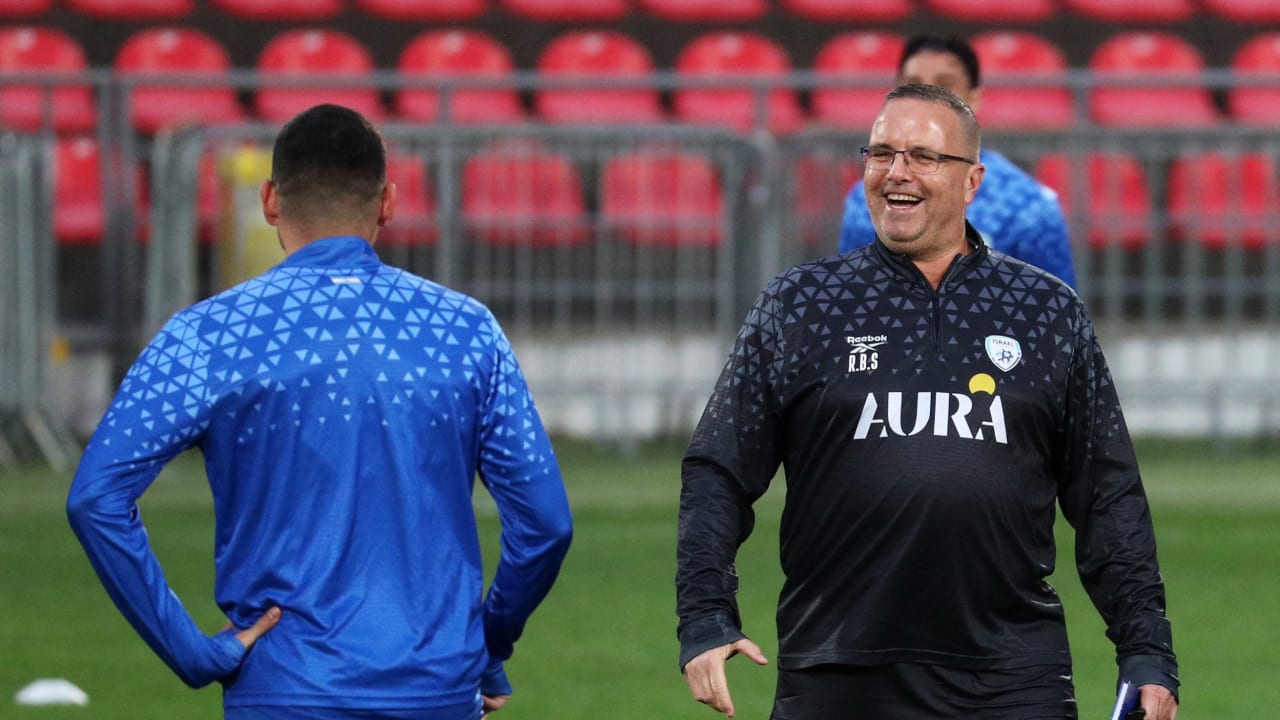
Israel’s 3-0 defeat to Ireland this week was not simply another disappointing result. It was a performance that raised serious questions about the direction of the national team, the preparation of the players and, ultimately, the responsibility of head coach Ran Ben Shimon and the Israel Football Association.
Ben Shimon should have resigned immediately following the defeat. If he was unwilling to step down, IFA chairman Shino Zuaretz should have made the decision for him.
That may sound harsh, but there comes a point when accountability has to mean something.
Ben Shimon failed to prepare his team, both mentally and physically, for a match of enormous significance. He knew what was at stake, not only from a sporting perspective but also given the political climate surrounding the game and the country itself.
Let no one tell you that sports and politics don’t mix. They always do.

The head coach had a responsibility to ensure that his players were fully prepared for the challenge ahead. Instead, Israel looked completely unprepared and delivered a performance that was nothing short of disgraceful.
Ben Shimon himself acknowledged as much.
“We started the game embarrassingly. It was an embarrassment,” he said. “We will need to really take a good, hard look at what went wrong, and although we prepared really well for this match, I have to take the blame for that. We deserve all of the criticism that we will be levied upon us over the next few days. I have to apologize to everyone for this.”
Why was did the team looked so unprepared when the match begun?
Those are powerful words from the coach, but they also raise an obvious question: If Israel was supposedly prepared so well, how could the team look so completely unprepared when the match began?
Captain Eli Dasa, one of the most experienced players in the squad, offered an equally damning assessment.
“There is no good way to explain it. We failed and failed miserably today,” Dasa said. “There’s no need to hide behind anything. It’s an enormous disappointment and I have no other way to describe it. I’ve made 80 appearances for the national team and this is undoubtedly the most painful game.”
Dasa went further, accepting full responsibility on behalf of the players while making clear that he did not believe the coaching staff was at fault for the lack of effort.
“The coaching staff did a fantastic job preparing us and gave us a very good game plan, but we didn’t come out and perform,” he said. “The responsibility lies 100% with the players.”
Manor Solomon was equally blunt.
“I agree that it’s a disgrace. We have no words. We’re all heartbroken,” Solomon said. “We need to look at ourselves, each and every one of us, in the mirror, because we simply didn’t show up today.”
There is certainly plenty of responsibility for the players to accept. International footballers cannot simply blame a coach every time things go wrong. They have to execute, compete and take responsibility on the field.
Responsibility doesn't end there
But the responsibility does not end there.
The coaching staff must also answer for a team that has repeatedly struggled to create consistent scoring opportunities and has been unable to eliminate the fundamental mistakes that have plagued Israel.
After 180 minutes of Nations League action, the blue-and-white have scored just one goal. Where are the goals supposed to come from? Where is the creativity? Where is the organization? Where is the plan when things go wrong?
And why was Dor Peretz, arguably Israel’s best player and leading scorer, left on the bench before being introduced at halftime?
Those are legitimate questions for the coaching staff, not merely the players.
Ben Shimon spoke confidently about finishing first or second in the group. After losing the opening two matches, however, Israel now faces the very real possibility of finishing last.
The issue is not simply that Israel lost. Teams lose.
The issue is how Israel has lost, and the fact that many of the same problems continue to appear without any meaningful evidence that they are being corrected.
Years ago, when Andi Herzog was Israel’s head coach, he delivered an infamous postgame assessment following another disappointing European qualifying campaign.
“We always say that this is good, but we always concede three goals,” Herzog said. “We are not professional enough.”
He continued: “We are always talking about qualification and then we make mistakes. That’s not possible. We always talk about something we dream about, but we have to do the decisive things on the field.”
Herzog’s words remain painfully relevant today.
Years later, Israel is still making the same mistakes, struggling with the fundamentals of the game and failing to translate its ambitions into results.
The players must take responsibility, but so must the head coach and his staff. Nothing will change until everyone involved is held accountable.
Unfortunately, accountability has become a familiar problem in Israeli football. When things go wrong, responsibility is too often shifted elsewhere rather than accepted by those in charge. The national team cannot afford to continue operating that way.
If Ben Shimon does not resign, the IFA must make the decision for him.
He should not be on the sidelines for Thursday’s match against Kosovo or the subsequent meeting with Ireland in Serbia. After two consecutive defeats and such a disastrous performance, the federation must seriously reconsider its direction.
There are plenty of potential replacements, both Israeli and foreign. Barak Itzhaki, who led Beitar Jerusalem over the past couple of years, is among the domestic candidates who could be considered. There are also numerous other coaches who could take over and attempt to turn things around.
The IFA cannot afford to sit back and hope the situation somehow improves.
Ben Shimon failed to deliver during World Cup qualifying, and Israel has now opened its Nations League campaign with two defeats. The results and performances demand a serious response.
With Euro 2028 qualifying set to begin in March 2027, the IFA still has time to make a change and give the national team a fresh start. A new coach would have an opportunity to address the team’s shortcomings, correct its persistent mistakes and build a squad capable of competing at the international level.
Ben Shimon’s record as Israel’s head coach stands at eight wins, 11 losses and three draws, a 36.4% winning percentage. For a national team with aspirations of reaching a major tournament, those numbers raise serious questions about the current direction of the program.
The IFA desperately wants Israel to qualify for a major tournament for the first time since the 1970 World Cup.
But simply talking about that ambition will not make it happen.
At some point, ambition has to be matched by action.
The national team belongs to the people of Israel. The supporters deserve a team that competes with pride, commitment and determination, regardless of the circumstances. They deserve players who fight for the shirt and a coaching staff that prepares them to meet the challenges ahead.
Losing is part of sports. Sometimes even the best teams come up short.
But failing to show up, failing to compete and repeating the same mistakes without learning from them is something entirely different.
The question facing the IFA is no longer simply how Israel can recover from one disappointing defeat.
It is whether those in charge are willing to accept responsibility and make the difficult decisions necessary to ensure that this kind of performance does not become the norm.
The time for excuses is over.
The time for accountability is now.
See more Israeli sports coverage at www.sportsrabbi.com/en