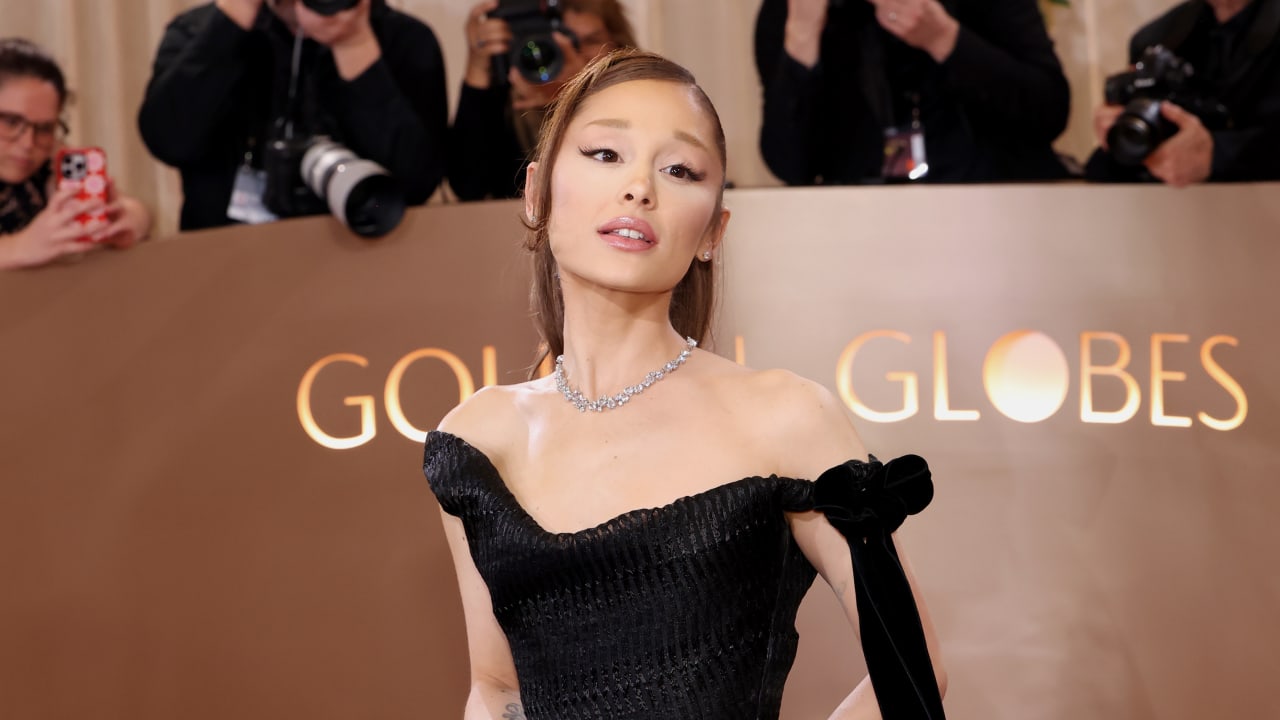
There are moments when time seems to fold in on itself. You are standing in a vast arena, surrounded by tens of thousands of people, and suddenly you are also the girl you once were: the one who fell in love, the one who broke, the one who experienced loss. Every version of you is standing there, facing the same voice that has accompanied you for years.
That is roughly what happened to me when Ariana Grande walked onto the stage in London.
I am 29, so I hesitate a little before calling myself a "fan." To me, the word immediately conjures up posters on the wall and blind admiration for someone you do not actually know.
With Grande, it goes deeper. Her music was there during beautiful periods and difficult ones, through love, confusion, happiness and change, and during a period when grief and loss became painfully familiar. Over time, I understood that some music plays in the background of your life, while some becomes part of your biography.
Anyone who knows Grande only through her enormous hits and seemingly impossible voice may miss what lies behind the polished pop: songs about self-worth, healing, independence, and the ability to take what hurt you and understand what it left behind.
At times, she sings about manifesting what you want and believing that you deserve good things. Elsewhere, she looks back at painful relationships with gratitude for what they taught her. In other songs, she celebrates friendship, ambition and the freedom to want more without apologizing for it.
Every song does not need to be a life lesson. Still, there is something beautiful about girls and boys growing up with lyrics that remind them they do not need to wait for somebody else to complete them, and that the things that broke them can eventually become part of their strength.
Grande does not preach. She tells her own story and leaves enough room for other people to put theirs inside it.
Ariana Grande's Eternal Sunshine Tour in London
I thought I understood how deeply her music affected me. Then I heard her sing in front of me.
The Eternal Sunshine Tour was a massive and meticulously constructed pop production: 41 shows in all, ending with 10 nights at London's The O2. There were dancers, choreography, enormous screens, lighting and costumes, all executed at the highest level.
The moments that stayed with me most were the ones when almost all of it disappeared.
The lights went down. The staging stopped being the center of attention. Grande was almost alone, singing or speaking to the audience, with nothing left to distract from the voice or the person behind it.
That was when I understood what it was about her.
You could spend hours discussing Grande's vocal ability. For me, what makes her extraordinary is how much emotion she can carry through that voice. At her best, her voice bypasses the intellect and lands somewhere far less protected. For a few minutes, the closest word I could find for what I felt was weightlessness.
Then she spoke to the audience, and something happened that I had not expected.
The relationship between an artist and an audience is fundamentally one-sided. We know so much about her; she knows almost nothing about us. Yet when Grande spoke about the roughly 15 years in which she and her fans had been part of one another's lives, and thanked them for their love and investment, I felt for a moment that she understood the size of the space she occupies in the lives of the people standing in front of her.
You could see it throughout the arena.
Fans arrived in outfits recreating music videos and different periods of her career, complete with carefully constructed makeup and accessories. Others flew in from other countries simply to be there. According to The O2, 35% of ticket purchasers for Grande's 10-show London residency came from overseas.
She noticed. She thanked people for the costumes, the makeup, the messages and the effort. Inside a gigantic pop machine, the audience suddenly felt like something more personal than numbers in an arena.
Manchester, Mac Miller and the scrutiny around Grande
That sensitivity is difficult to separate from Grande's own life.
The 2017 Manchester Arena bombing, carried out after one of her concerts and killing 22 people, and the death of Mac Miller, her former boyfriend and someone who had been deeply important in her life, were among the devastating events she confronted while still young.
Grande has spoken over the years about grief, anxiety and PTSD. Her ability to take something intensely personal and painful and turn it into music allows other people to find themselves inside it.
Perhaps that is why the way people have spoken about her in recent years bothers me so much.
"I hope she gets back to herself." "What happened to her?" Comments about her weight and about how she used to look.
Suddenly, everyone seems to be a doctor, psychologist or close personal friend, as though a handful of photographs online gives us access to the mental and physical health of a woman we do not know.
It is exhausting.
I do not know whether Ariana Grande is healthy because I watched her onstage for one evening. A person who saw a paparazzi photograph of her cannot know from that photograph that she is unhealthy.
I can say what I saw: a woman who appeared present, strong and funny, who engaged constantly with the crowd and who, above all, seemed happy to be back onstage.
That should be enough.
People can miss the Ariana Grande of another period. They can dislike her music. We can also stop treating a woman's body as a public project on which everyone is entitled to issue a report.
Everyone thinks they have figured out what she is going through.
We do not know.
Maybe it is time to leave her alone.
Artists4Ceasefire and the politics around Ariana Grande
Politics is also impossible to leave outside the room, especially as an Israeli in 2026.
Grande is a signatory to Artists4Ceasefire and has supported calls for a ceasefire and humanitarian aid for Gaza. The group's letter also calls for the release of the hostages and condemns the killing of Palestinian and Israeli civilians.
I know that for some readers, that sentence alone will be enough to dismiss everything I have written until now.
I do not.
I do not have to agree with every position an artist holds to recognize what their work has done for me. I love Ariana because, for years, she has managed to make me feel something. At certain moments, her music gave a name to an emotion I could not articulate myself.
She does not know where I was when I first heard a particular song, which album was playing in the background during a period of grief, or why a line she wrote years ago can still hit exactly the right nerve.
For a few minutes that evening, though, as she stood in front of the crowd and thanked them for all the years, the love and the effort, I felt that distance shrink a little.
Perhaps that is the magic of music.
At 29, I traveled to London to fulfill something I could reasonably call a childhood dream. Standing there, however, I did not feel that I had become a child again.
When the lights went down and Grande stood there singing, I felt that every version of myself her music had encountered over the years had arrived in that arena with me: the one who fell in love, the one who broke, the one who lost someone, the one who did not always know what she was doing, the one who was happy, the one who needed somebody else to put her feelings into words, and the one who now understands that everything she went through, the good, the bad and the difficult, helped shape who she became.
Suddenly, I understood why that voice touches me so deeply.
I flew to London to see Ariana Grande and to see, onstage, the voice that had accompanied me on the way to becoming who I am.