


The recent war involving Iran, the United States, and Israel accelerated a process through which Pakistan has shifted from a peripheral actor to one of growing strategic importance in the Middle East.
During the conflict, Pakistan sought not only to respond to events but also to shape them through mediation efforts and by fulfilling its security commitments to Saudi Arabia.
Earlier regional crises, including the June 2025 confrontation with Iran and the September 2025 Israeli strike in Qatar, had already drawn Pakistan into deeper regional involvement, both bilaterally with Saudi Arabia and as part of an emerging political framework that includes Turkey and Egypt.
Pakistan as a mediator
At the center of Pakistan’s evolving role was its emergence as a mediator between Iran and the United States. Islamabad played an important role in promoting a ceasefire and hosted talks aimed at extending it and facilitating a broader understanding between Washington and Tehran.
This role stemmed less from diplomatic tradition than from a unique combination of circumstances: working relations with both sides, the absence of US military bases on its territory, geographic proximity to the conflict, and the fact that it had not been directly targeted by Iran.
Pakistan’s mediation efforts were driven by several considerations. It sought to preserve stability along its 909-km. border with Iran and avoid being drawn into another regional conflict while already facing tensions with Afghanistan.
Islamabad was also mindful of Iran’s influence among Pakistan’s sizable Shi’ite population, as well as the economic risks that prolonged instability in the Gulf could pose to a country heavily dependent on Gulf financial assistance and remittances.
Another motivation was Pakistan’s close relationship with Saudi Arabia. As Iran targeted Saudi territory during the war, Islamabad sought to shorten the conflict and reduce pressure on Riyadh. Mediation also allowed Pakistan to avoid being forced into an explicit choice between Iran and Saudi Arabia despite its security commitments to the kingdom. Pakistani officials publicly reiterated that commitment while maintaining dialogue with Tehran, signaling the limits of Pakistani support for Iran without severing relations altogether.
Pakistan as a security provider
Throughout the war, Saudi Arabia was targeted by Iranian missiles and UAVs. Although Pakistan maintained a cautious stance during the fighting, it ultimately fulfilled its security commitments after the ceasefire took effect on April 8, 2026. Three days later, Saudi Arabia announced the arrival of Pakistani fighter aircraft and military personnel at King Abdulaziz Air Base. Reports later indicated that Islamabad deployed roughly 8,000 troops, along with air defense assets and UAV capabilities.
This deployment reflected a long-standing security relationship. For decades, Pakistan has trained Saudi forces and maintained a military presence in the kingdom in advisory, training, and security roles. The relationship is rooted in mutual interests: Saudi Arabia gains access to a large and experienced Muslim military partner, while Pakistan benefits from economic support, regional influence, and a privileged position in the Gulf.
The partnership also reflects Saudi Arabia’s enduring security concerns. Despite substantial investments in advanced Western weaponry, the kingdom continues to face challenges in manpower, operational experience, and deterrence vis-à-vis Iran.
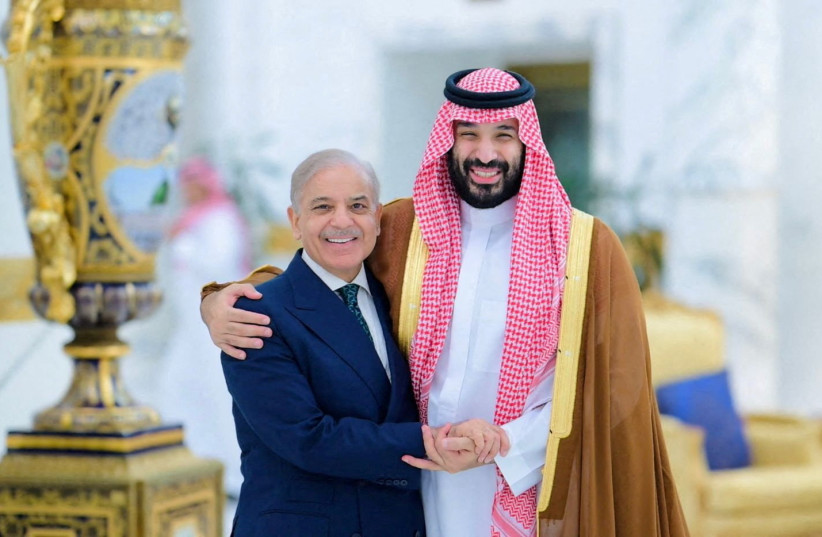
These concerns helped drive the September 2025 security agreement signed by Crown Prince Mohammed bin Salman and Pakistani Prime Minister Shehbaz Sharif. Reportedly modeled on NATO’s Article 5, the agreement formalized a relationship that had existed for decades, although its practical implementation mechanisms remain unclear.
The nuclear dimension remains particularly sensitive. Saudi Arabia provided financial support to Pakistan during the development of its nuclear program, leading some in Riyadh to view the relationship as a form of long-term strategic insurance.
While there is no indication of an automatic Pakistani commitment under all circumstances, the deployment of forces during the war demonstrated the continuing relevance of the partnership and Saudi Arabia’s desire to diversify its security relationships beyond reliance on the United States.
The timing of the deployment – roughly six weeks after Iranian attacks began – suggests Islamabad was attempting to balance its mediation efforts with its obligations to Riyadh. The move served both as reassurance to Saudi Arabia and as a signal to Tehran against further escalation.
A potential diplomatic quartet
Pakistan’s mediation efforts and military deployment should also be viewed within a broader regional context. Gulf states are increasingly seeking to diversify their partnerships and reduce dependence on the United States. Within this environment, Pakistan has become part of a loose political framework involving Saudi Arabia, Turkey, and Egypt.
Throughout the war, diplomatic coordination among these countries intensified. Yet it would be premature to describe this grouping as an alliance. There are no multilateral defense commitments among its members, and significant political differences remain – particularly between Turkey and both Egypt and Saudi Arabia. Moreover, Gulf leaders were reportedly disappointed by Egypt’s cautious posture during the conflict with Iran.
In many respects, this emerging framework resembles the ad hoc regional alignments that appeared after the Arab Spring: pragmatic, circumstance-driven, and lacking a durable institutional foundation. Consequently, it does not yet represent a fundamental transformation of the regional order, though it is a development that merits close observation.
Growing regional relevance
In an era of prolonged instability and shifting regional alignments, Pakistan is emerging as an increasingly important actor in Middle Eastern politics. Its dual role as mediator and security partner reflects both its growing regional relevance and Saudi Arabia’s search for alternative security arrangements.
The relationship between Riyadh and Islamabad has become a significant pillar of Saudi national security and exemplifies the emergence of parallel regional security networks that do not depend exclusively on the United States.
From an Israeli perspective, deeper cooperation among Pakistan, Saudi Arabia, Turkey, and Egypt could prove problematic if it evolves into a more cohesive political bloc with a stronger anti-Israel orientation. Such a development could pull Saudi Arabia closer to states that are openly critical of Israel and further complicate future prospects for Saudi-Israeli normalization.■
Yoel Guzansky is a senior fellow at Tel Aviv University’s Institute for National Security Studies and has served on the National Security Council in the Prime Minister’s Office.