

When Ido Kander first got back into running, it wasn’t his normal 5 km. or 10 km., or anything that would have registered in his old life as a serious workout. It was 50 m. down the corridor of a rehabilitation ward.
Kander, a reservist soldier, had always been a serious runner, at one point training for a marathon with five or six workouts a week.
Then came the Israel-Hamas War in Gaza.
In November 2023, Kander was gravely wounded in an explosion in Beit Hanoun that killed four of his fellow soldiers and injured five others. Kander’s shoulder was broken, and shrapnel tore through his leg, severing a major artery and requiring a vascular bypass.
He was evacuated by helicopter to Jerusalem’s Shaare Zedek Medical Center, where he underwent emergency surgeries. For a day and a half, he was sedated and ventilated. When he woke up, he was told what had happened to him, and to his friends.
After three weeks, he was transferred to Sheba Medical Center, where he spent 154 days in the rehabilitation center. For the first two months, he was confined to a wheelchair, unable to move one of his feet.
“In the beginning, you don’t think about any kind of exercise beyond physical therapy,” Kander recalled in an interview with The Jerusalem Report. “It’s not really on the agenda. You are just trying to regain the most basic abilities.”
Those early months were focused on the independence he once took completely for granted: getting up, moving, showering, and managing ordinary tasks that had suddenly become difficult.
“Sport came much later,” he said.
After the surgeries
For thousands of wounded soldiers and security personnel in Israel, that “later” has become one of the central questions of rehabilitation: What happens after the surgeries, after the hospital room, after the first steps? How does a person begin to live inside a body forever changed by war?
Since the Hamas-led terrorist attacks on October 7, 2023, there is one community that has grown exponentially: the disabled.
Israel’s rehabilitation system has absorbed tens of thousands of additional wounded, many of them young reservists who were yanked from civilian lives into combat and then returned, not to their old lives, but to a completely new reality.
Alongside physical injuries and loss of function, some are also coping with PTSD and other psychological wounds that may be harder to see but no less defining.
The Zahal Disabled Veterans Organization (ZDVO) was founded in 1949 and remains the only organization legally responsible for representing those wounded and disabled while serving in defense of the state.
Through its regional districts and Beit Halochem centers, it provides support ranging from medical and psychological care to social programs, career guidance, and sports rehabilitation.
“For the past two and a half years, we have been operating under an entirely new reality,” said ZDVO chairman, Edan Kleiman, an attorney.
A former Givati Brigade combat soldier, Kleiman was wounded during an operation in Khan Yunis by a bullet that penetrated his chest and left him wheelchair-bound.
“The number of injured entering the rehabilitation system has increased dramatically,” he said.

The challenge, Kleiman continued, is not only physical. Many of the newly wounded are not only learning to walk, move, or function again; they are trying to understand who they are now.
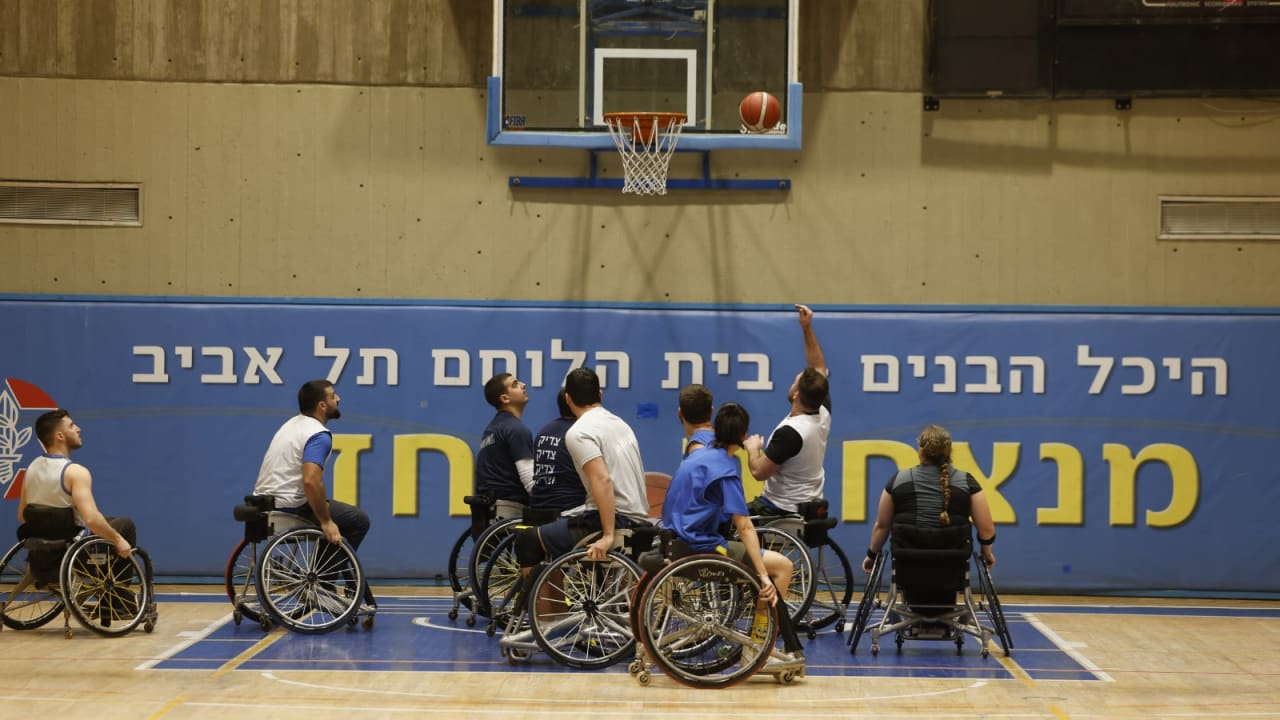
“Sports are about far more than physical recovery,” he explained. “They restore confidence, purpose, discipline, and a sense of belonging. For many wounded veterans, stepping back onto a court, into a pool, or onto a playing field is the moment they begin reclaiming their lives.”
Sweating from effort
For Kander, that process began reluctantly, when fellow soldiers from ZDVO encouraged him to start biking. Before his injury, his world had been running, soccer, and other high-intensity sports. Cycling was not in his wheelhouse.
“At first, I was completely against it,” he recalled. “But once I understood that even with my injuries, this was the way to exert myself, to push my body; there was no going back.”
That first moment stayed with him.
“Suddenly, I was sweating from the effort,” Kander said. “It was something I hadn’t experienced for months. I had forgotten how good that could feel.”
The hardest part, he admitted, was not the physical pain, but the knowledge that this was not a temporary injury from which he would simply recover and resume his old life. He had been injured before – a dislocated shoulder, a broken ankle – the kind of injuries that eventually allow an athlete to feel more or less like himself or herself again.
“There are some things that will never fully heal,” Kander said. “With these kinds of injuries, the body doesn’t go back to being what it was.”
“It’s not fun,” he added. “And it’s definitely not easy. But the sooner you accept that this is fact, the greater the chance that you will succeed in the end.”
For some, sport remains part of rehabilitation; for others, it becomes something more: a team, a race, a competitive goal, even the possibility of representing Israel internationally.
What began in the early weeks of the war as an effort to bring adaptive sports to wounded soldiers has since developed into programs aimed at identifying those with Paralympic potential – including Kander – and supporting them toward possible qualification for the 2028 Paralympic Games in Los Angeles.
“Competitive sports fundamentally change how wounded veterans see themselves,” Kleiman said. “Instead of defining themselves through their injuries, they begin to see themselves again as athletes, teammates, competitors, and individuals with goals and ambitions.”
Fighting for victory
But the power of sport is not limited to those who reach an elite level.
“Sometimes, the greatest victory is not winning a medal,” ZDVO’s Kleiman said. “It is simply finding the courage to return to the field and refuse to give up on life.”
Kander found that courage partly in the other wounded soldiers around him at Sheba and Beit Halochem, ZDVO’s rehabilitation and sports center.

“There were so many people there in my situation,” he recounted. “They understood my challenges. And when they would say to me, ‘Come on, let’s try,’ I knew I simply did not have the option of giving up on myself.”
After cycling, he slowly began to return to running, eventually building up to the 5 km race he completed this past February as part of the Tel Aviv Marathon’s “Victory of Spirit” division. But Kander, ever the competitor, did not dwell long on the satisfaction of crossing the finish line. His thoughts immediately turned toward his next goal.
“The moment I accomplish something, the only thing I think about is the next achievement,” he said. “I cross the finish line, and I am already asking myself, ‘Okay, what do I need to do to run 10 km?’”
These days, he has set his sights on an Olympic-distance triathlon, learning to swim properly for the first time and working out twice a day. Swimming strains his shoulder. Running aggravates his upper leg injuries; biking, the lower part. The body itself has become a map of reminders. But he continues to persevere.
Perhaps the most powerful moment in Kander’s recovery did not happen at a formal race at all. It happened back in the rehabilitation corridor.
About a year and a half after his injury, Kander ran those first 50 m – “no more than 15 seconds,” he recalled – back and forth in the ward. When he finished, he was utterly exhausted.
“I was broken,” he described. “I just sat there. I couldn’t move.”
Then another wounded soldier, sitting in a wheelchair, came over to him.
“He said to me, ‘Wait, you can run? Maybe I’ll be able to run too,’” Kander recalled. “And then I understood that just seeing me run down the hallway had given him hope.”
That hope is at the heart of the new partnership between ZDVO and this year’s Maccabiah Games, which kicks off July 1. Disabled veterans and members of the organization will take part in the Games as athletes and volunteers. The opening ceremony in Jerusalem is set to include a special wheelchair performance honoring Israel’s wounded veterans.
“For the ZDVO, the Maccabiah is much more than a sporting event,” Kleiman told the Report. “It is a symbol of recovery, determination, and the ability to move forward even after life-changing injury and trauma.”
Both men are careful not to romanticize the process.
“Rehabilitation is not a straight line,” Kander pointed out.
Some people arrive from the battlefield and do not want to speak to anyone. Others are ready to push. In time, many begin to “get on the wave,” as he puts it. There are setbacks and low points, which is exactly when the community around them can help pull them forward.
“I think sport is an inseparable part of mental health,” Kander asserted. “When you feel comfortable inside your body, your soul is healed as well.”■