
Beaufort Castle, whose name comes from the French beau fort, “beautiful fortress,” is a well-known Lebanese landmark. It was a key objective when Israel invaded Lebanon in 1982. It became an IDF post and was chronicled in the 2007 film Beaufort, based on a 2005 novel.
The fortress dominates the area around it. It is part of Lebanon’s Nabatiya Governorate. It was recently captured again by Israel. This time it was taken from Hezbollah.
Beaufort is only a few kilometers from the Israeli border, but retaking the area was not undertaken in the early days of the conflict with Hezbollah.
Journalists recently visited Beaufort with the IDF. The numerous accounts paint a picture of an area that was utilized by Hezbollah.
The terrorist organization, with Iranian funding and support, tunneled underground. Hezbollah’s tunnel system included operating rooms and numerous weapons. The tunnel system extends beneath the ridge the castle was built on.
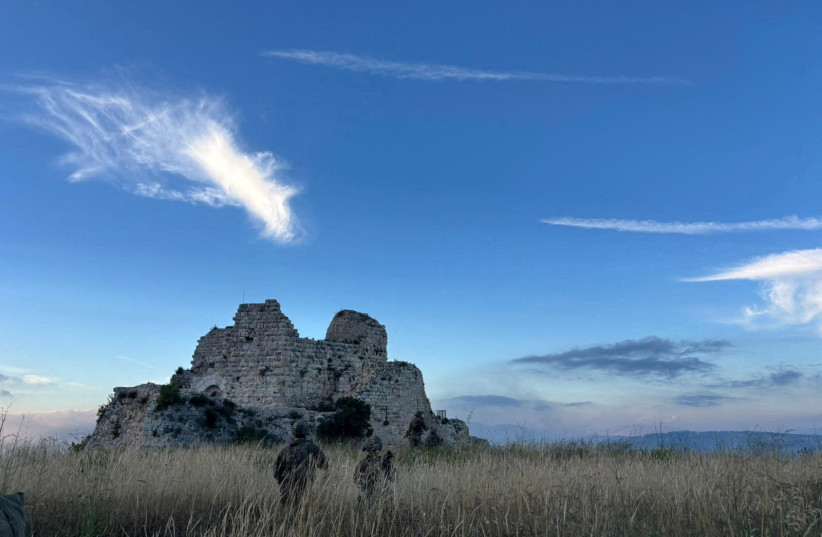
In essence, though, Hezbollah used this area for the same reason the Crusaders did: It was a strategic location that dominated the area around it.
What was found in the tunnels near the castle appears to indicate a large engineering project and a significant investment. Reports also indicate this system of tunnels would have taken many years to complete. The tunnels had to be cut into rock, not dug out from the sand, as in Gaza. This was complex.
What does the story of Beaufort teach us?
The site is a symbol, and it has been for decades. It’s a symbol of the wider challenge of southern Lebanon. Why was it taken in 1982? Because it was already being used by terrorists.
Lebanon has failed to secure this area for decades. In 1982, the excuse was that the country had fallen into civil war in 1976, and the terrorists had exploited this. At the time, Palestinian terrorist groups were the threat. After 1982, the threat became Hezbollah.
The Lebanese state, however, was supposed to be rebuilt after the Taif Agreement in 1989 that ended the civil war. When Israel left southern Lebanon in 2000, chronicled in the 2007 film, the Lebanese government was supposed to return. A key part of Lebanon’s return was supposed to be linked to the UNIFIL deployment in southern Lebanon.
UNIFIL was created in 1978 after Israel’s Litani operation against terrorism in southern Lebanon. At the time it was established, UNIFIL’s mission basically was to monitor the Israeli withdrawal and help Lebanon reestablish its authority.
What happened? We know what happened. UNIFIL has never been able to do anything of substance in southern Lebanon.
It had many opportunities. You can find maps of the UNIFIL deployment online. For instance, an August 2024 map shows how UNIFIL carpeted southern Lebanon with various posts.
One could be forgiven for looking at the map and imagining that it was a robust force. There are symbols for dozens of units, and there is even a naval component.
There are little symbols for military headquarters and forces from Tanzania, Italy, Indonesia, Sri Lanka, India, Nepal, Korea, Ghana, Malaysia, Ireland, Poland, Spain, and other countries.
One might be deceived, because if you looked at a plan for Operation Overlord, the codename for the Allied invasion of France in 1944, the plans of Overlord look less complex than the UNIFIL deployment. But Overlord actually accomplished something.
For all the dozens of unit symbols on the map of UNIFIL’s deployment, it doesn’t seem to have accomplished anything at all.
In fact, it may have been counterproductive, because the illusion of UNIFIL meant that the international community could pretend Hezbollah wasn’t a problem. Hezbollah exploited the presence of UNIFIL to entrench itself deeper into southern Lebanon.
The Lebanese government also used the presence of UNIFIL to avoid its obligations. In essence, the cover of UNIFIL enabled Hezbollah to grow exponentially.
Without the umbrella of excuses provided by the United Nations, Hezbollah might have had to be more reticent, and everyone couldn’t have turned to UNIFIL as an excuse to do nothing over recent decades.
What was accomplished by the presence of UNIFIL? It didn’t reduce Hezbollah’s presence. Even though UNIFIL’s deployment was very robust in 2024, Hezbollah was attacking Israel every day.
That illustrates how UNIFIL didn’t do anything. If there had been no UN presence in Lebanon, would Hezbollah have been stronger? That is unlikely.
What does Beaufort Castle have to do with this? Beaufort doesn’t appear to be in the UNIFIL zone, since it is situated to the north of the Litani River. The villages on the other side were in the UN zone, for example, Taybeh, Kafr Kela, and Deir Mimas.
According to the 2024 deployment, the UN had a post north of Kafr Kela and another just west of the village. It also had another post near Taybeh. These posts included a battalion boundary that separated Spain’s units from those of Indonesia. The battalion boundary is south of Beaufort, which would have looked down on these UN areas.
Lebanon dragging its feet didn't help, it ruined their lives
One might have thought that if the UN wasn’t responsible for the castle and the ridge it sits on, then maybe the Lebanese Armed Forces (LAF) would have had a post there.
Essentially, if the Crusaders chose this area to overlook the region around it, then maybe the LAF would want to deploy there? There is a tourist site there, so maybe it would be wise to protect it? But no. The LAF also didn’t bother to make sure Hezbollah didn’t control this area.
Herein lies the whole symbol of Lebanon in microcosm: a strategic and historic fortress; a well-known site; an area that had already been contested between Israel and terrorist groups since 1982.
And yet, neither UNIFIL nor the Lebanese government could prevent Hezbollah, with Iranian regime backing, from blasting tunnels into the area. Decades of work carried out by Hezbollah – with all sorts of weapons and machinery – and nothing was done.
Since the day after the October 7 massacre in 2023, when Hezbollah began attacking Israel, it used this area to carry out numerous strikes.
Today, Lebanon is being asked to send its forces into several small pilot zones in southern Lebanon. It is being asked to do the most basic thing a state does: control its own territory.
It isn’t like Hezbollah was running away from UNIFIL and the LAF in some complex cat-and-mouse game. It was blasting tunnels into mountains under a major fortress that everyone knew about. This wasn’t in some hidden swamp somewhere that no one can find on a map.
The question now is whether Lebanon can finally step up and control its own territory. The Lebanese people have suffered from the failure of UNIFIL and Lebanon to do their jobs. Numerous villages have now been destroyed.
All the foot-dragging didn’t help the Lebanese; it ruined their lives. There is now an opportunity to avoid entering another cycle that began decades ago in the 1970s.
Will we have Beaufort redux again? Or will this be the end of it?