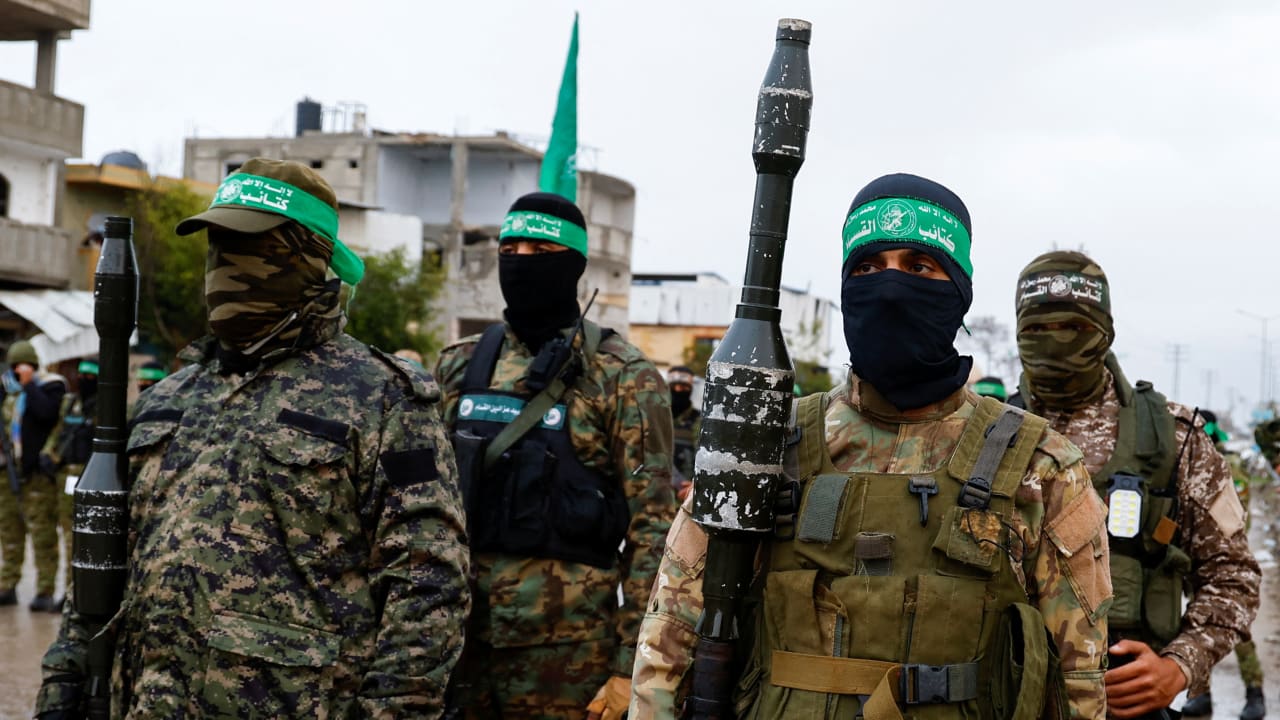
The disarmament plan announced by the Board of Peace and approved by Hamas "will not be implemented," a Palestinian source in Gaza affiliated with Israeli-backed militias told The Jerusalem Post.
For Hamas, handing over its weapons would be a suicidal step. "If there are no weapons, there is no Hamas," the source told the Post over the weekend.
According to him, those in Gaza who have suffered under Hamas oppression are waiting for a chance to take revenge, which is one reason why Hamas believes it must keep its weapons. "Families, clans, and even ordinary people who were targeted by Hamas are waiting to settle scores with the organization, no matter how long it takes," he said.
"People who were tortured, abused, or whose relatives were killed by Hamas will never forgive and never forget. Today, they cannot fight Hamas because the organization is armed. But even if it takes five or 10 years, people will seek to hold Hamas members accountable," he continued. "Hamas is aware of this threat, and that's why they need their weapons to protect themselves and cannot afford to disarm."
Ghazi Hamad, a member of Hamas's Political Bureau, told Arab media outlets that the organization agreed to store weapons with the Palestinian technocratic committee, known as the National Committee for the Administration of Gaza (NCAG), the transitional body tasked with managing post-war Gaza under the mandate of US President Donald Trump's Board of Peace.

Hamas agreement to deal is 'empty talk'
Hamad, who has been part of Hamas's negotiating delegation in Cairo, said that the agreement is a comprehensive package, not limited to weapons, and stressed that Hamas will fulfill its obligations only if Israel meets its commitments, pointing to Israeli withdrawal. "The issue of collecting weapons is a Palestinian matter. Israel will have no role in it," he stressed.
Hamad claimed that the agreed formula was intended to "save the people of Gaza from more destruction, war, and displacement."
The agreement stipulates that heavy weapons, including manufacturing sites, tunnels, and warehouses, will be collected and stored by the NCAG. At the same time, individual arms will be regulated under Palestinian law and regulations.
The militia-affiliated Gaza source dismissed Hamas's apparent acceptance of the deal as "empty talk", arguing that the terror group is simply trying to buy time and ensure its own survival. "The agreement is meaningless; it will not happen," he claimed. "They have almost no heavy weapons left."
"Hamas cares only about Hamas," he continued. They will not comply with the demand for full disarmament because they want to stay in power. For Hamas, not having weapons means risking its existence. They know that the moment they lose their grip, they will not be able to return to power," he added.
However, some Palestinians expressed cautious optimism, suggesting the agreement may be a good sign that could move post-war Gaza arrangements in the right direction and help break the current stalemate.
"Hamas realizes now that there is no hope for it to remain in power in Gaza," one Palestinian resident from Gaza City told the Post.
"At least at this stage, I think Hamas is serious about storing the weapons," he said.
"But it will not be easy for Hamas to relinquish its ideology and it may eventually try to regain control," he added. "This depends on to what extent the other partners, the technocratic committee, and the players entering Gaza can restrain Hamas and prevent it from reclaiming authority."
Disarming Israeli-backed militias in Gaza sends 'troubling messages'
A key demand from Hamas, stipulated in article 10 of the plan, calls for the dissolution of armed groups in Gaza, referring to Israeli-backed militias set up in the strip to combat the terror organization.
"Weapons of the militias shall be decommissioned and stored under NCAG authority according to an agreed-upon timetable. Members of those militias shall not be integrated in the security and police services," the agreement read.
"We came to fight Hamas," the Gaza militia-affiliated figure said. "Our problem is with Hamas, not with anyone else. If it truly gives up its weapons, stops ruling Gaza, and there is real change, then maybe we can be part of the arrangements of the new deal. But as long as Hamas remains, even with only rifles, we will continue to fight it. What matters is what happens on the ground," he asserted.
The Gaza resident argued that dissolving the Israeli-backed militias, as required by the agreement, sends a troubling message to anyone considering future cooperation with Israeli security agencies.
"If these groups are disbanded now, it will be difficult for the Israelis to find people willing to work with them," he claimed, in comments to the Post. "Those who worked with Israel or supported it would now be exposed to reprisals by Hamas because they are seen as traitors. Also, in the eyes of the people, they are unwelcome."
From the very beginning, he said, these armed groups have had no respect among the Palestinian public. "People in Gaza do not see them as legitimate, and they lack popular support. So, in the end, both sides will turn their backs on them, and that could also damage Israel's ability to recruit people; they will think twice before taking that risk for fear of being abandoned," the resident said.
The militia source, however, rejected that claim. "Israel will never abandon us. It will continue to support us," he said, pointing to Israel's past support for members of the South Lebanon Army as proof. "We believe Israel will protect us; our safety is guaranteed," he said.