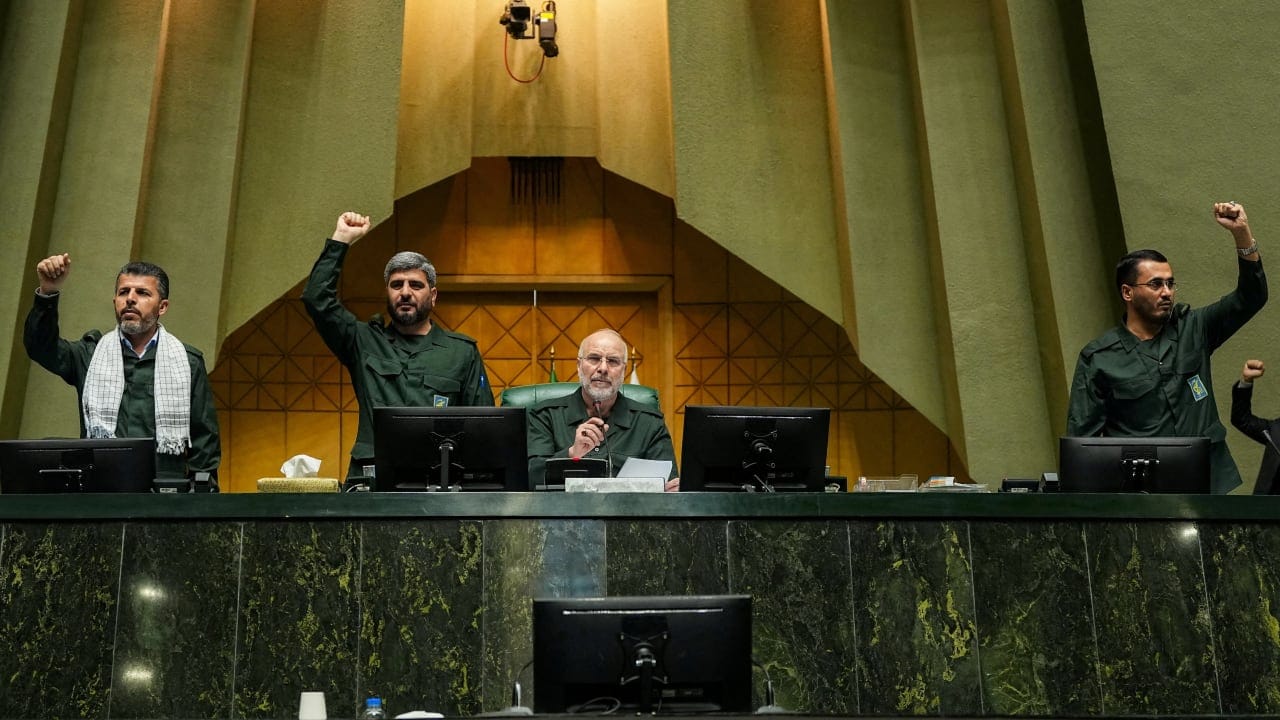
Iran's Parliament Speaker Mohammad Bagher Ghalibaf posted on Twitter/X Sunday morning, saying: "The era of one-sided deals is OVER. We told you: keep your word or pay the price. Reality is knocking."
Ghalibaf issued this message as Iran's Islamic Revolutionary Guard Corps said that its aerospace forces carried out a heavy attack on US aircraft carrier support and refueling platforms in the port of Duqm, in Oman, in the third stage of its response to what it called US military 'aggression.'
The IRGC added that the operation targeted logistical support centers for US naval vessels
Child injured in Qatar as Iranian attacks rattle region
A series of attacks and security alerts was reported across the Middle East on Sunday, according to regional officials and state media.
![[FILE PHOTO] Smoke Rises after reported Iranian missile attacks, as seen from Doha, Qatar, March 1.](https://images.jpost.com/image/upload/f_auto,fl_lossy/c_fill,g_faces:center,h_537,w_822/712078)
Three people, including a child, were injured by falling shrapnel following Iranian attacks, Qatar’s Interior Ministry said.
Shortly afterward, the Khondab region in central Iran came under attack, a local official told Iranian state media.
Oman’s state news agency later reported that sites in the Musandam Governorate had been targeted by drones.
The Jordanian military said three missiles launched from Iran fell inside Jordanian territory, according to the country’s state news agency. No casualties were reported.
Amid the developments, Iranian Foreign Minister Abbas Araghchi discussed the regional situation with Pakistan’s deputy foreign minister during a phone call, Iran’s Tasnim News Agency reported.
Sirens were subsequently activated in Bahrain, the country’s Interior Ministry said.
US says it struck 140 Iranian military targets Saturday
US forces completed a third round of strikes this week against Iran, the Central Command said late on Saturday in a post on X.
They hit approximately 140 Iranian military targets on Saturday, the Central Command said, and added that the targets included Iranian missile and drone sites, naval capabilities, ammunition storage facilities, communication networks, and coastal surveillance locations.
During three nights of strikes this week, US forces have struck more than 300 targets, the military added in its statement.
The Central Command said the strikes on Saturday were in response to the attack on a commercial ship in the Strait of Hormuz. "Commercial vessel transits through the vital international maritime corridor continue," it added.
US strikes came hours after Iran said it closed the strait after firing a warning shot that struck a vessel traveling on an unapproved route. It warned that any retaliation over the incident would be met with a "severe response."
US Central Command identified the vessel as the M/V GFS Galaxy, a Cyprus-flagged container ship, saying it suffered significant engine-room damage and that a civilian crew member was missing.
US strikes Iran, Tehran says Strait of Hormuz closed, Gulf states hit
A series of attacks between the US and Iran over the past several days led US President Donald Trump to declare the end of a ceasefire meant to halt the fighting that the US and Israel began on February 28, though Trump has left the door open to continued negotiations.
Iran said it closed the strait after firing a warning shot that struck a vessel traveling on an unapproved route. It warned that any retaliation over the incident would be met with a "severe response."
US Central Command, however, said commercial vessels continue to transit through the waterway that carried one-fifth of the world's oil and LNG shipments before the war.