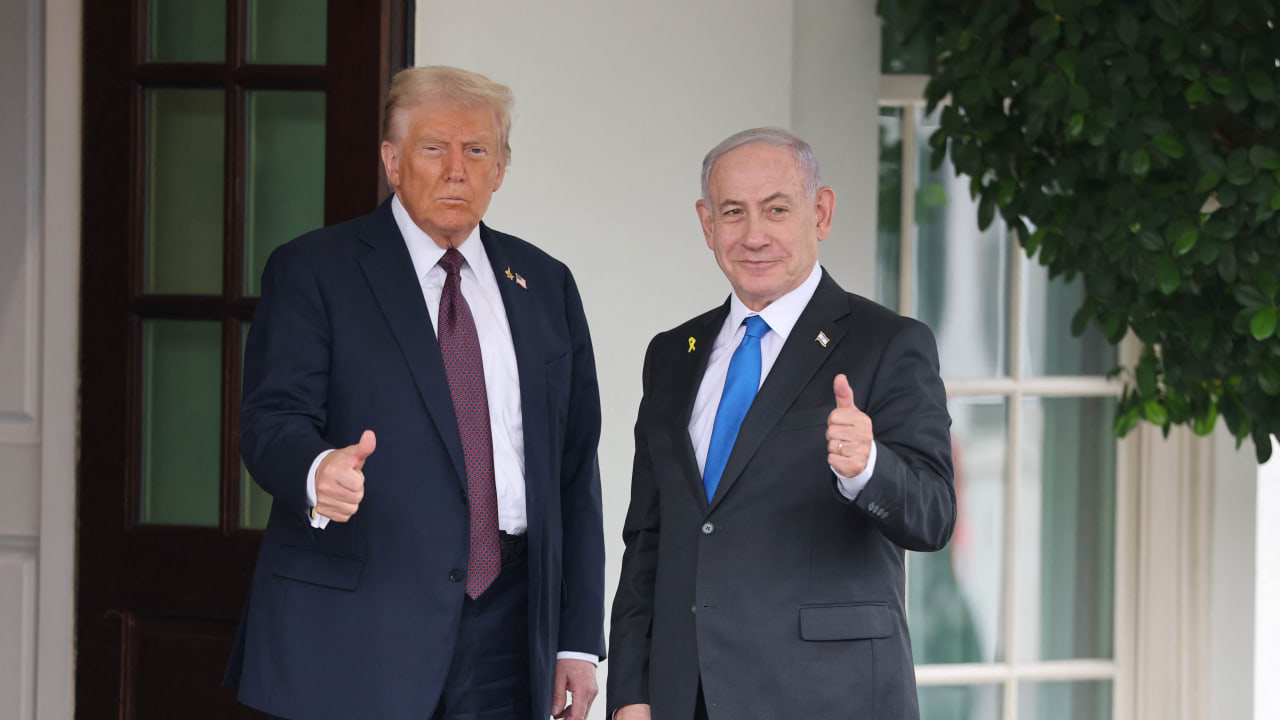
American humorist Will Rogers famously said, “I never met a man I didn’t like.” Prime Minister Benjamin Netanyahu has never met an American president he didn’t piss off.
The Israeli leader is a bipartisan offender, not an asset for a leader and a country bleeding friends right and left and doing little to stanch the flow.
Netanyahu has based much of his political career on his ability to effectively manage US-Israel relations, but that has since turned into a bad joke as he hitched the nation’s security along with his own political future to a volatile, angry, and woefully ignorant president.
Wrath directed at the prime minister has been fed by a perception of indifference toward the enormous civilian death toll in the Israel-Hamas War and the reports that the IDF and security forces are not only enablers of settler pogroms against West Bank Palestinians but sometimes even participants.
Netanyahu has been a frequent target of President Donald Trump’s wrath, which has intensified in the four months since they partnered to wage war against Iran.

Trump isn’t the first president to find the overbearing Bibi unbearable. Former US president Joe Biden has called him “a f***ing liar” and “son of a bitch,” according to journalist Bob Woodward.
After Bibi lectured Bill Clinton about history, aides present said the president grumbled, “Who the f*** does he think he is? Who’s the f***ing superpower here?”
During the presidency of George HW Bush, Bibi was banned from the State Department for saying US foreign policy was “based on lies and distortions.”
In 2015, he blindsided former US president Barack Obama by partnering with House Republicans and American Israel Public Affairs Committee (AIPAC) in their failed campaign to block Obama’s signature Iran nuclear deal.
Trump later tore up the deal and then went to war, resulting in what may be an even weaker outcome.
A long history of clashing with US presidents
Trump not only curses Bibi in private, but he calls reporters to repeat it for publication.
As negotiations progressed last week, Israel bombed Beirut, angering the Iranians and the US president.
“Why did Bibi have to do a f***ing attack? I was so pissed off. I let him know. He has no f***ing judgment. I let him know that,” he told Axios’s Barak Ravid.
On another occasion, he told Ravid that he’d yelled at Bibi, “You’re f***ing crazy. You’d be in prison if it weren’t for me. I’m saving your ass. Everybody hates you now. Everybody hates Israel because of this.”
Israelis and their country’s American friends should be alarmed by Trump saying, “If there wasn’t me, there would be no Israel.”
Bibi has put Israel in a weak position with little choice but to follow Trump’s lead.
He has squandered Israel’s powerful bipartisan congressional base that could stand up to presidents. AIPAC has become a pariah in many Capitol Hill offices, particularly on the Democratic side.
Netanyahu can moan and groan about the deal and try to test the limits of US and Iranian tolerance, but the price could be prohibitive. He doesn’t have the cards he once held.
The prime minister, aged 76, is running for a seventh term this year.
The war is popular in Israel and so is Trump, and Bibi must tread a fine line between the two. One lesson of this war has been that with Trump’s administration, when Israel thinks it is an equal partner, it can get slapped down, sometimes very publicly.
And when the fighting stops, and Congress and voters begin asking what went wrong, you know which direction White House fingers will point.
The United States and Israel launched this war on February 28 by decapitating Iran’s leadership.
Their proclaimed lofty but shifting goals included regime change, unconditional surrender, liberation of the Iranian people, destruction of the ballistic missile threat, removal of the entire nuclear program, destruction of the Iranian navy and air force, and ending support for Tehran’s terror proxies.
It didn’t take long for cracks to appear. Bibi was dead serious about his goals; Trump was flexible. On Sunday he admitted, “I never cared about regime change.”
He was just hoping for another quickie like Venezuela so he could fly off to Stockholm for his long-overdue Nobel Peace Prize. Neither expected Iran to outsmart them by closing the Strait of Hormuz and retaliating against America’s allies in the Gulf.
The war may have been popular in Israel, but in the United States, it was turning into a political and economic crisis for Republicans who feared it could cost them control of Congress in November.
The Iranians don’t have to face voters. They could absorb more costs – material and political – than Trump, whose goal quickly became finding a way out that would let him declare victory and go home.
Trump made it clear his Israeli partner was junior, at best.
“If I tell him to do something, he does it,” he boasted to the BBC. Bibi “won’t have any choice” in negotiations because “I call all the shots. He doesn’t call the shots,” he told the Financial Times.
Iran has said that although Israel is not part of the deal, it expects Washington to make it halt its war against Hezbollah in Lebanon, setting up another test for Washington-Jerusalem relations.
Trump was so anxious for a deal that barely a day went by that he didn’t announce one was imminent.
He’d threaten massive bombing only to back down at the last minute, saying talks were promising, even when they weren’t. That strategy defined his nickname, TACO: Trump always chickens out.
In a conversation with The New York Times, Trump praised Presidents Xi Jinping of China and Vladimir V. Putin of Russia for their help. He called Bibi “a very difficult guy” who “should be very thankful” to him because “if Iran had a nuclear weapon, Israel wouldn’t be around for two hours.”
Trump’s biggest boast, that he won the regime’s written assurance that it has no intention to build or acquire a nuclear weapon, is old news. Fifty-six years old, to be exact.
Iran ratified the Nuclear Non-proliferation Treaty in 1970, which included that pledge.
Then in 2003, Supreme Leader Ayatollah Ali Khamenei issued a fatwa forbidding the production of nuclear weapons. And Iran put it in writing again in 2015 when it signed the Obama nuclear agreement, which Trump tore up three years later.
Now he has one of his own and wants us to think he just invented the wheel.
Trump’s Iran deal includes doing what he bitterly attacked Obama for: lifting some sanctions and releasing billions of frozen Iranian funds to bolster its failing economy.
Trump will use the same rationale of helping post-war reconstruction, economic revival, and humanitarian interests.
The Memorandum of Understanding, expected to be signed on Friday in Switzerland, is not a peace deal; it is just an agreement to start talking about Iran’s nuclear program while they return to the pre-war status quo. Israel won’t be in the room.
In the face of last year’s brutal crackdown by Tehran, Trump called on millions of Iranians to “keep protesting” and declared the “hour of your freedom is at hand.” Promises made, promises broken.
The writer is a Washington-based journalist, consultant, lobbyist, and former legislative director at the American Israel Public Affairs Committee.