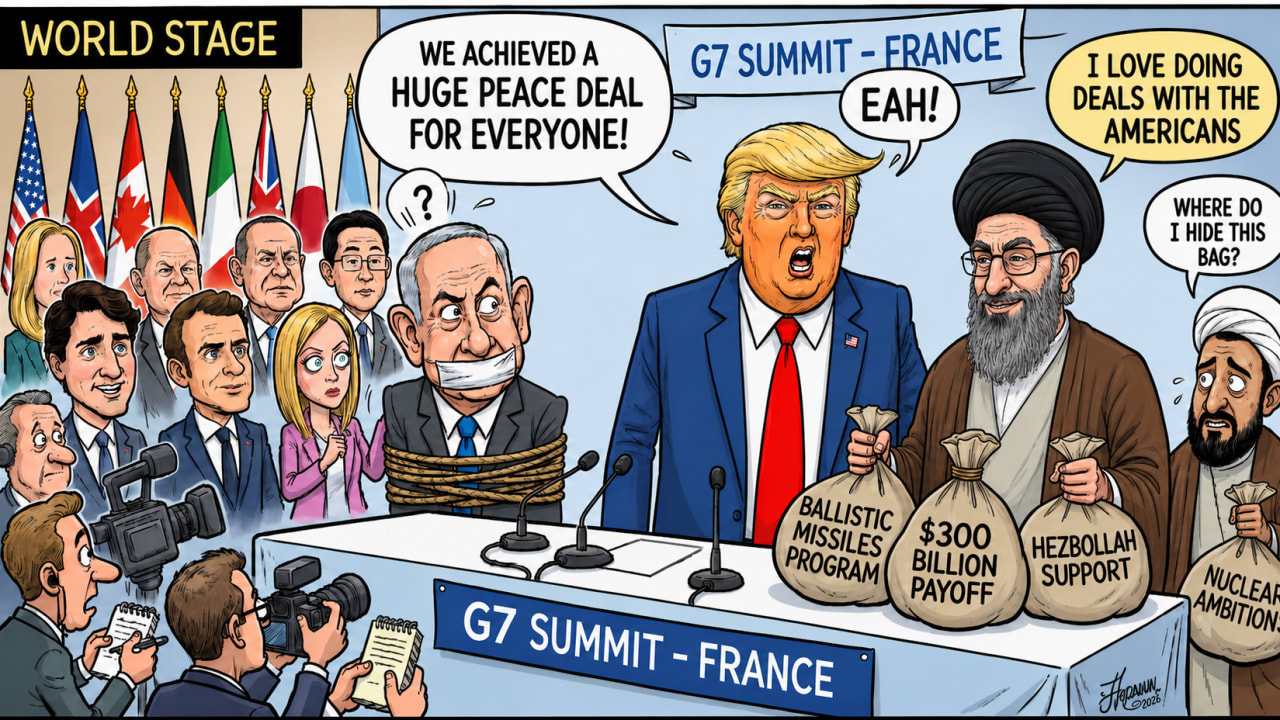
For decades, Israel and the United States have proudly described their relationship as one built on shared values, shared interests, and shared threats.
The relationship survived political disagreements, military conflicts, and changing administrations because it rests upon something deeper than temporary policy alignment: mutual respect between two sovereign democracies.
Yet recent developments surrounding American negotiations with Iran raise an uncomfortable question that many Israelis are increasingly asking:
Can a nation remain fully sovereign if another country, even its closest ally, expects it to comply with agreements it neither negotiated nor approved?
The issue is not whether the United States has the right to pursue diplomatic engagement with Iran. Every sovereign nation has that right. Nor is the issue whether Israel and America should occasionally disagree. Healthy alliances are built to withstand disagreements.
The issue is whether Israel’s security decisions are gradually being subordinated to American political calculations.
Recent media reports suggest that Washington has negotiated understandings with Tehran without meaningful Israeli participation and has subsequently expected Israel to conform to arrangements whose details remain unclear.
If true, this represents more than a diplomatic disagreement. It raises fundamental questions about sovereignty itself.

The irony is difficult to ignore.
When the United States concluded that Iran’s nuclear ambitions represented a threat to global stability, it was prepared to project military power halfway around the world. American leaders justified such actions under the universally accepted principle that nations have the right, and indeed the obligation, to protect themselves and their citizens from emerging existential threats.
Israel shares that assessment regarding Iran.
Israel has lived under direct Iranian threats for decades. It has absorbed attacks from Iranian proxies. It has watched Hezbollah accumulate one of the world’s largest missile arsenals along its northern border. It has endured October 7 and understands perhaps better than any nation the catastrophic consequences of underestimating declared enemies.
Yet Israel increasingly finds itself being told that while America can act decisively to defend its interests, Israel must exercise restraint when defending its own.
This contradiction is becoming increasingly difficult to explain.
Hezbollah transformed southern Lebanon into military zone
For months, international attention has focused on Israeli military actions while often overlooking the strategic reality that created them. Hezbollah did not suddenly emerge as a threat after October 7. For years, it systematically transformed southern Lebanon into a heavily fortified military zone under Iranian direction.
The organization’s objective was never hidden.
Just as Hamas prepared for years to launch its assault from Gaza, Hezbollah developed its own plans for a future northern invasion. The difference was primarily one of timing, not intent.
Yet much of the current international conversation treats Israeli operations as though they exist in a vacuum, disconnected from the years of missile deployments, terrorist infrastructure, and openly stated objectives that preceded them.
This inversion of cause and effect has become increasingly common.
The aggressor becomes the victim.
The defender becomes the cause of destabilization.
The nation responding to threats becomes the nation accused of creating them.
Perhaps most concerning is the emerging rhetoric suggesting that Israel itself has become an obstacle to regional stability.
Only months ago, Israel was widely praised for standing shoulder to shoulder with the United States against Iranian aggression. Today, some commentators portray Israel as an inconvenient partner whose insistence on security complicates broader diplomatic ambitions.
This is a dangerous narrative.
Not because it harms Israel politically, but because it misunderstands the nature of deterrence itself.
History repeatedly demonstrates that peace agreements unsupported by credible deterrence rarely produce lasting stability. They merely postpone future confrontations under less favorable conditions.
The challenge is not whether Iran signs agreements.
The challenge is whether Iran changes behavior.
A regime may agree not to pursue nuclear weapons while continuing to expand ballistic missile programs.
It may pledge restraint while continuing to finance proxy organizations across the Middle East.
It may participate in negotiations while simultaneously strengthening the very networks that destabilize the region.
A focus on a single threat while ignoring the broader ecosystem of threats can create a dangerous illusion of progress.
Consider a simple analogy.
Imagine concerned parents informing a school administration about a troubled student with a history of violence and access to dangerous weapons at home. The administration assures everyone that it will ensure the student never brings a firearm onto school grounds.
The following week, the student arrives with a large knife and attacks classmates.
Technically, the promise was fulfilled.
No firearm entered the school.
Yet the danger remained.
The threat was never solely the weapon. The threat was the individual and the environment that enabled the violence.
The same logic applies to Iran.
If policymakers focus exclusively on preventing a nuclear weapon while ignoring ballistic missile development, proxy warfare, regional destabilization, and global terror financing, they risk solving only part of the problem while leaving the larger threat architecture intact.
This is why Israel’s concerns cannot simply be dismissed as impatience, stubbornness, or opposition to diplomacy.
Israel’s concerns emerge from geography.
From experience.
And from the reality that Israeli citizens, not American policymakers, will live with the consequences if deterrence fails.
The broader question extends beyond Iran.
It concerns the future of alliances in the democratic world.
Strong alliances are not built when one partner dictates terms to another. They are built when both partners recognize each other’s sovereign right to make decisions regarding national survival.
The United States would never accept another country determining its military red lines.
Nor should Israel.
Friendship does not require obedience.
Partnership does not require submission.
Alliance does not require surrendering sovereignty.
The greatest strength of the US-Israel relationship has always been that it united two independent democracies pursuing common objectives while retaining the freedom to protect their own interests.
That principle should not change simply because one partner is larger than the other.
Israel does not seek confrontation with America.
Nor should America seek confrontation with Israel.
Both nations benefit enormously from strategic cooperation.
Both face common adversaries.
Both remain committed to a safer and more stable Middle East.
But genuine partnership requires honesty.
And the honest conversation that must now take place is whether current policies are strengthening Israel’s security or merely managing threats temporarily while transferring long-term risks to future generations.
For decades, American leaders have repeated a simple pledge: Iran will not obtain a nuclear weapon.
That remains an important objective.
But nuclear weapons are not the only instruments through which regimes threaten regional and global stability.
The ultimate question is not whether Iran acquires a bomb.
The ultimate question is whether the broader threat posed by Iran and its proxies is being reduced, or simply repackaged.
Sovereignty without conquest is possible.
Alliances without domination are possible.
But only when allies remember that protecting a friend should never require diminishing that friend’s right to defend itself.
The writer is a global strategist and a strategic adviser at the Jerusalem Center for Security and Foreign Affairs. He can be reached at globalstrategist2020@gmail.com.