
It’s giving me a headache. That’s my answer to those asking, “What do you think of ‘The Deal’?” It’s a headache in the literal and figurative sense.
When the full Memorandum of Understanding between the US and the Islamic Republic of Iran was signed and published on Wednesday, I doubt I was the only one tempted to add question marks and exclamation points to the text.
There is meant to be a 60-day period after the signing of the MoU in which a final deal should be drawn up focusing on such issues as Iran’s nuclear enrichment and stockpiles of uranium. Even before these issues are resolved – if they are resolved – the strategic Strait of Hormuz will reopen to shipping and the US blockade of Iranian ports will be lifted, giving Iran money, oxygen, and a reward for simply returning to the negotiating table. The last factor is a mistake that the West has also made repeatedly with the Palestinians.
Most peace deals can be made to sound good. It’s all a matter of spin – and interpretation. The Farsi and English versions literally might not be on the same page. The devil lies in the details. When it comes to the Iranian regime, those details could be devilish indeed
I feel dizzy at the thought of Iranian centrifuges, oil wells, and armament programs picking up speed. The leaders who congratulated the deal are probably looking at the future business opportunities. But while money makes the world go round, it can also cause it to spin out of control. The influx of money to Iran boosts its available funds for its terrorist proxies while simultaneously diverting attention and funding from places like Sudan and Yemen, where Muslims murder Muslims with little international intervention.
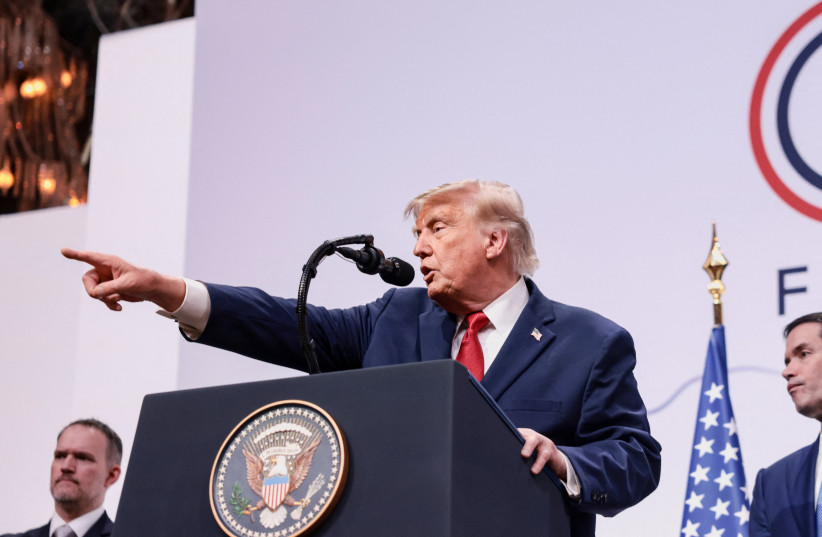
President Macron raises issue of Iranian ballistic missiles at G7
Surprisingly, it was French President Emmanuel Macron – hosting the G7 Summit in Paris this week – who raised the matter of Iran’s ballistic missiles rather than concentrating on its nuclear program. Macron is aware that these missiles can threaten his own country and Europe, not just the Jewish state. With typical double standards, however, even though Israel met the French government’s demands to display only defensive weapons systems at this week’s Eurosatory arms exhibition in Paris, Israeli defense industry pavilions were boarded up at the last minute.
Any eventual deal will affect not only the Strait of Hormuz but, beyond that, in the Red Sea, where Iran’s Houthi proxies have long carried out acts of piracy and terror. In this context, it was interesting to note that by chance Abdirahman Mohamed Abdullahi, the president of Somaliland, a Muslim republic across from Yemen’s shores, came to Jerusalem this week to open an embassy and meet Israeli leaders.
The MoU and deal had one interesting side-effect – it united the opposition and coalition against the reported terms, although each camp had a different take on who is to blame. Although US President Donald Trump received cross-party praise for acts like moving the US embassy to Jerusalem and drawing up the Abraham Accords in his first term in office, and for supporting Israel’s strikes on Iran in this term, this week’s announcement was seen as destroying many of those achievements.
President Barack Obama’s disastrous 2015 Joint Comprehensive Plan of Action continues to haunt us. One meme doing the rounds on social media shows Trump peeking at Obama’s paper in an exam-room setting with the words “How to deal with Iran” written on the blackboard.
As with the “ceasefire” Trump imposed on Israel and Iran after last year’s war, my first question was: Does this agreement include Iran’s proxies, particularly Hezbollah and the Houthis? If Iran continues to attack Israel (and the Gulf states) via its partners in crime, then its victory will be almost complete – its goals delayed rather than destroyed. Like most Israelis, I would welcome an end to rocket and drone attacks, but this agreement doesn’t make me feel safe.
Although Israel, together with the US, made some impressive progress in reducing the number of Iranian ballistic missiles and damaging its nuclear facilities, these can be restored over time.
The deterrence factor has been struck a serious blow by the MoU. And spare a thought for those poor Iranians brave enough to stand up to the murderous regime, encouraged by Trump’s promise of help on the way. They have been thrown under the proverbial bus with Trump driving erratically at the wheel. Similarly, those opposed to Hezbollah’s grip over Lebanon have been seriously undermined.
Clearly, the relationship between Prime Minister Benjamin Netanyahu and Trump has sustained a hit, although it has known its ups and downs in the past. Each must act as they see best for their own country (and, like all politicians, they keep their personal interests in mind).
Interests don’t always align, even among allies. But it’s not only allies who are watching. Beyond the eyes of the Abraham Accords partners and possible future partners, there is a different axis taking a keen interest in these events. Russia, China, and North Korea will also be looking for flaws and weaknesses to exploit. The fact that Pakistan served an absurdly elevated role as a mediator will no doubt be a cause of concern to India.
As chance would have it, after news of the MoU broke this week, I attended Asia Day at the Hebrew University of Jerusalem, my alma mater, where I earned a degree in international relations and Chinese studies many wars and peace accords ago.
One of the attractions was the screening of a clip of the Taiwanese documentary A Chip Odyssey and the panel discussion afterward. Patty Lin, director of the Taiwan Trade and Innovation Center in Tel Aviv, noted the relevance of the movie about Taiwan’s semiconductor industry to Israel as the “Start-up Nation.” Chen-Wei Ku, first secretary of the Taipei Economic and Cultural Office in Israel, said that Taiwan had been actively involved in helping Israeli communities hit during the October 7, 2023, Hamas-led mega-atrocity and subsequent war “because friends help each other.” She said that Taiwan could also learn a lot about social resilience from Israel.
The movie shows the development of Taiwan’s semiconductor industry – essential to the world in the AI era and “a matter of national security” for Taiwan. The dedication and passion of the early developers were hard to miss. The industry was a gamble made necessary when US aid to Taiwan (the Republic of China) ended in 1975. The need was reinforced when the island was ousted from the United Nations and replaced by the People’s Republic of China, which doesn’t recognize Taiwan’s independence.
One refrain in the movie particularly resonated. Minister of economic affairs Sun Yun-suan told the group of young engineers who were sent to the US to learn about the technology that would transform Taiwan into a powerhouse: “We must succeed. Failure is not an option.”
Nothing in the Iranian regime’s behavior or rhetoric indicates that it has come to terms with Israel’s existence or changed its jihadist ideology.
Any final deal depends not only on the wording of the clauses but on compliance and enforcement. Trusting your partner not to cheat is not enough, especially given past experience with Iran. Israel cannot afford to return to the situation it was in pre-October 7, 2023, when it didn’t take the threats along its borders seriously enough.
Preventing the terrorist regime in Tehran from realizing its nuclear ambitions and attaining huge quantities of ballistic missiles is of global importance. US Vice President JD Vance declared the agreement would “fundamentally transform the Middle East for the next 50 years.” He seems to think this would be in the positive sense. The deal might be “historic,” but what history will make of it remains to be seen.