
The following is a letter I received from Rabbi Netanel Kaszovitz, rabbi of the Auckland Hebrew Congregation in New Zealand:
“Shalom, Sivan. You recently published a story about a small Jewish village that consisted of ten families. Every morning, there was a minyan in the village because a man from each family felt responsible to ensure that there would be a minyan that day. But then another family moved to the village - family #11 - and the next morning, there was no minyan. Everyone felt less responsibility towards the community.
“This past Pesach, we experienced in our community the very opposite situation. Even though we have a small community, there is a minyan, thank God, every Shabbat. But on the last day of Pesach, there was a huge rainstorm. I was worried that there wouldn’t be a minyan that day.
“Arnold is a 101-year-old member of our community. In just a few weeks, we will be celebrating his 102nd birthday. On the last day of Pesach, he woke up, noticed the weather outside, and said to his wife: “I’m worried that there won’t be a minyan today because of the weather.” So, he walked in the rain to join our minyan.
“When he arrived at shul, he told me why he had come that morning, and I was amazed and moved. Over the course of the prayer service, more and more people kept coming. Apparently, many had been worried about the weather, so they had decided to come - specifically that day - to ensure that there would be a minyan.
“My wish is that each one of us should always feel as if he or she is the 'tenth person for the minyan' - important, precious, and special!’
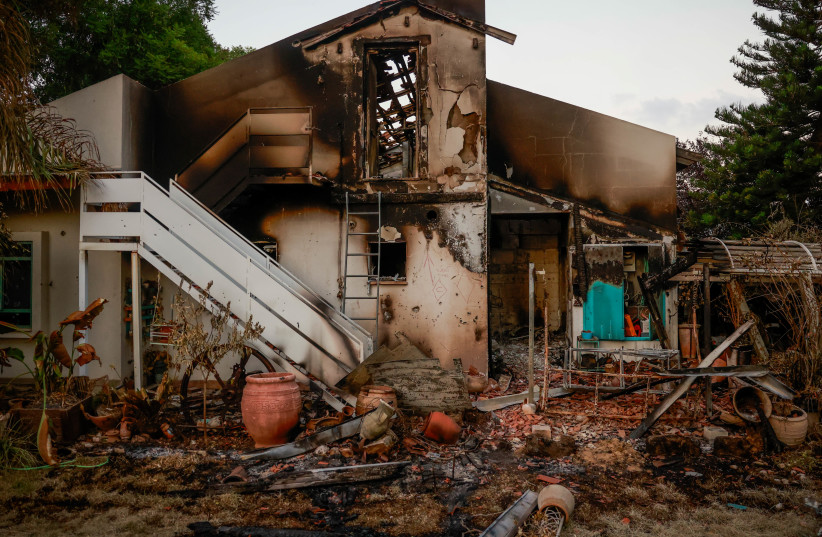
Have you heard about these ceremonies?
These days, in Kibbutz Be’eri, the homes damaged on October 7 are being torn down. But these demolitions are not only acts of clearing away ruins. They have become ceremonies of memory, grief, faith, and rebuilding.
Take Eli Sharabi. He came to see the place where his wife, Lianne, and his daughters, Noiya and Yahel, were murdered.
“It was important for me to be here,” he said as the demolition began. “We are the Jewish people. We have a very special DNA - the DNA of rebuilding. I think that precisely in order to honor those who fell, I must move forward and build a life of action and meaning.”
Not far away, the home of Rachel Fricker was also demolished.
“A million emotions are mixed together,” she said as she watched the walls come down. “For twelve and a half hours, the terrorists were inside this house with me.”
Rachel arrived with rabbis and friends. “I recited Birkat Hagomel, the blessing said after surviving danger. I said Mizmor Letodah, a psalm of thanksgiving, and we raised a glass - to the home that was, and to the home that will yet be built.”
She shared another striking story. Not long ago, a rabbi asked to take ashes from her house for his son’s wedding, in keeping with the custom of placing ashes on the groom’s head as a remembrance of destruction. When he entered the house, he saw a fox. For those familiar with the story, it immediately called to mind Rabbi Akiva, who saw a fox emerging from the ruins of the Temple and understood it as a sign that the place would one day be rebuilt.
“It was a sign for me, too,” Rachel said.
After the ceremony, she returned to her caravilla in Hatzerim “with a feeling of peace, of closure.” Rachel, who also manages the Be’eri synagogue, added that a new, large synagogue is soon to be built in the center of the kibbutz.
Then there is Avida Bachar, who managed Be’eri’s agriculture. On that morning, he lost his wife, Dana, his son, Carmel, and his leg.
“This was a home of life,” he said, standing opposite the tractor that had come to demolish his house. “You meet a woman, build a family, build a life - and in one second, everything is destroyed. But when you look at things from above, you say to yourself: We must build life and family again.”
Since October 7, Avida has carried with him everywhere what he calls his “crying towel.” He used it often at the ceremony, especially when his friends stood beside him and sang Shir LaMa’alot, A Song of Ascents, moments before the demolition began.
He also wanted to convey two messages: a firm security message to the outside - “I woke up. Gaza must cease to exist” - and a message of unity within: “For the first time, I got to know my people, and I am awed by their strength.”
Eli, Rachel, Avida - thank you for these words. They, too, are part of the rebuilding.
Parashat Korach: The root of the dispute
Outside of Israel, the portion of Korach is read this week. Korach became synonymous with dispute. He rebels against the leadership of Moshe and Aharon and seeks to replace them. What happened to him? And what sometimes happens to us as well?
Our sages explain: There is a “dispute for the sake of Heaven,” one that is important to navigate. But there is also a “dispute that is not for the sake of Heaven,” such as the one initiated by Korach, which is rooted in ego, a grasping for honor, and other ulterior motives.
In essence, Korach’s dispute was based on a quarrel he had with himself. He felt discouraged and detached, and consequently failed to discover his own unique place and mission in life. The commentators explain that his wife was likewise frustrated with her situation, and she kept filling Korach’s mind with poisonous thoughts: You deserve more; you should be like Moshe and Aharon; you aren’t appreciated enough.
I encourage you to examine your interpersonal relationships, at home and at work, to determine whether you aren’t stirring up controversy in your surroundings because, at the root of it all, you are dissatisfied with yourself.
We write the headlines
What is this morning’s main headline? That depends on us.
In the parashah that is read this week in Israel, Chukat, we are told of the passing of Miriam the Prophetess. In his book, Rabbi Avigdor Nebenzahl recalls one moment from Miriam’s life: the entire nation waited for her for a full week, until she recovered from tzara’at. And here is his explanation:
“Many years earlier, when Moshe Rabbeinu was in the basket on the Nile, his sister Miriam waited for him for a short time and watched over him. In that merit, she later merited that the entire nation would wait for her for a whole week. Every minute of kindness counts, and so does every second of a good deed.
“We must understand this enormous power. We must understand who we are. Every small action of ours can change the world. We do not see it, but up Above, it is reported with excitement, every small gesture of warmth, every smile, every expression of interest in a new neighbor - it all counts. It all matters.
“If we acquire for ourselves the clear, absolute, and unequivocal knowledge that every good deed we do becomes a main headline in Heaven, it will help us to truly take control of the way we live.”
Translated by Yehoshua Siskin and Janine Muller Sherr
Want to read more by Sivan Rahav Meir? Google The Daily Thought or visit sivanrahavmeir.com