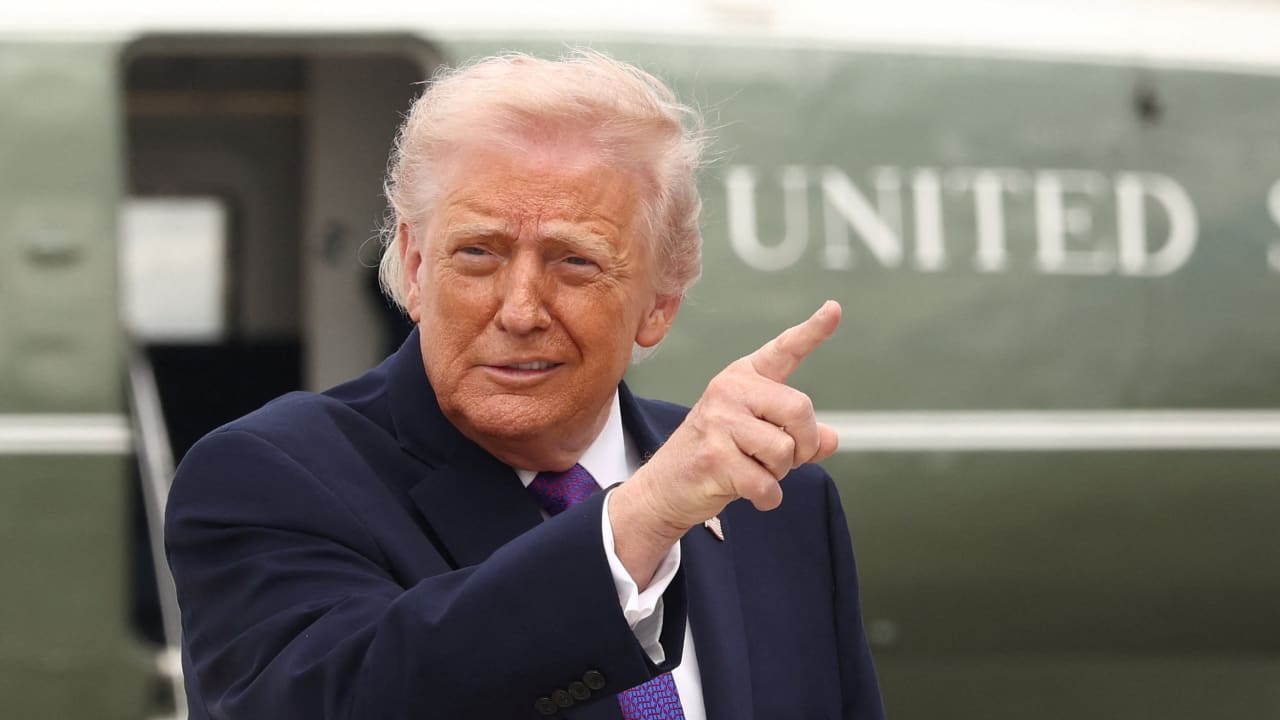
Over the past few days, Israelis have watched US President Donald Trump’s actions with shock, anxiety, and a growing sense of betrayal, wondering: has the American president, who until recently enjoyed record-high approval ratings here, truly turned his back on his most loyal ally so bluntly?
In America and Europe, meanwhile, observers are reacting with an astonishment of their own to the Israeli response: Did you really think you could harness an unpredictable and volatile figure like Trump indefinitely? Did you honestly not see this coming?
As journalists, this is the point where we must admit our failures: this is, first and foremost, a crisis that got lost in translation. Almost three years after October 7, the internal Israeli discourse is so raw and visceral that it has become almost entirely detached from the conversation in the West.
We need to admit the truth: as news editors, we know our readers are traumatized. It is incredibly difficult to make readers, sitting with their families in a bomb shelter after yet another barrage of Iranian missiles, understand, or even care, how the world currently views our ongoing conflict.
But the fact that Israelis are uninterested in hearing how the world sees them does not stop the discussion taking place outside of Israel. Today, the man in the White House is best known for “The Art of the Deal.”

This is not merely a book title; it is a worldview. This is how he and his inner circle approach big problems. Washington’s operating premise is that every conflict is solvable, given sufficient incentives for all sides.
World's view on Israel's problems
The world views our problems as a multi-piece puzzle that can be “cracked”: envoys like Steve Witkoff and Jared Kushner hop from one front to another, closing “deals.”
When the expectation in America and Europe is for a “deal” that will finally quiet the recurring crises of the Middle East, it is clear why Israel is perceived as a stubborn, problematic actor.
Since the October 7 massacre, the Israeli media discourse has been the exact mirror image of this transactional mindset, which in Israel is now associated with the discredited pre-October 7 “conception.”
The prevailing Israeli sentiment today is a deep disdain for any initiative that might be perceived as “rational” or “naive” in the “jungle of the Middle East.”
In-depth polls by research institutes and major political parties gearing up for election campaigns all point to the same diagnosis: the vast majority of Israelis have lost all faith in “arrangements” and the idea that security can be bought through economic and political incentives.
Following the trauma of October 7, the other side is perceived as driven by irredeemable fundamentalist ideology, and any outreach is seen as an act of naivety that will ultimately lead to another disaster.
For the community, it is far easier to look at Israel right now and see a country that has seemingly lost control, unable to restrain itself from within. As Vice President JD Vance said of Israeli critics of a ceasefire: “They offer endless conflict and want it to go on until every bomb drops or every Iranian is dead.”
This is exactly the point that was lost in translation: the world looks at Israel and sees a society stuck in the conflicts of the past, while Israelis look out at the world and see detached leaders trying to solve 21st-century problems using 20th-century agreements.
This gap is revealed not only regarding Trump or Iran. Over the past two years, it has appeared at almost every intersection between Israeli and Western discourse.
One of the most popular topics in the Israeli media in recent years has been the coverage, exaggerated in most cases, of how Western countries are dealing with the terrorist threats of radical Islamist groups.
Alongside genuine concern, there is also a certain grim satisfaction in watching others confront dangers Israelis believe they have been warning about for years.
This is the modern “Cassandra Complex”: Israelis feel like reluctant prophets, offering the world a dire warning of what is to come, yet no one is willing to listen to them or believe them.
This week, this gap blew up in Israelis’ faces, and far too many were surprised. The global discourse barely penetrates the protective shell of most media consumers in Israel, but it dictates the geopolitical reality on the ground.
In our journalistic heshbon nefesh (soul-searching), this issue must take center stage. Just as it is our duty to accurately report on Israel to the outside world, Israelis must also be exposed to the discourse about them taking place in the offices that determine the geopolitical fate of the entire region.
The US and Europe often prefer to view us through a pathological lens, as a traumatized society in need of a responsible adult to impose order. This absolves them of the need for genuine strategic introspection.
But we, too, must ensure that Henry Kissinger’s famous cliché that “Israel has no foreign policy, only domestic politics” remains just an amusing historical anecdote and does not become our political reality. In Trump’s world, those who choose to close their eyes eventually pay the price.
The writer is a journalist, head of the news department and digital editor-in-chief at Maariv.