
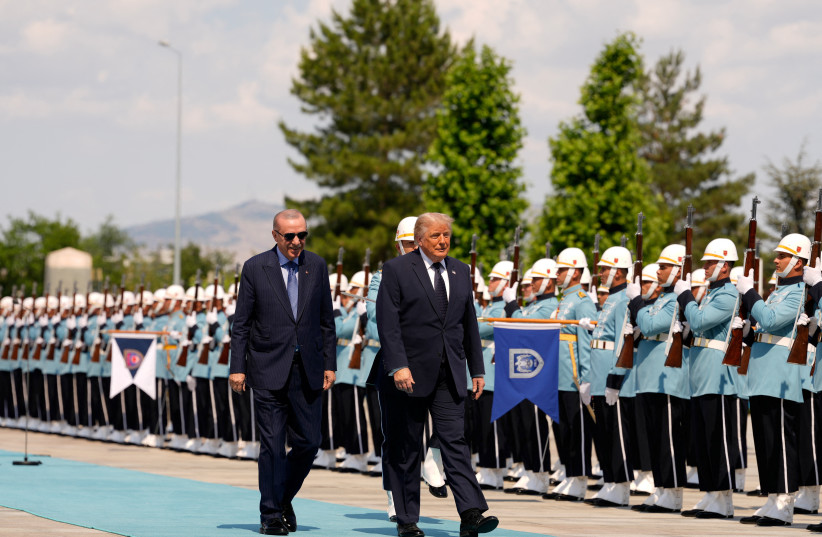
US President Donald Trump’s remarks on the sidelines of the NATO Summit in Ankara may represent one of the most consequential shifts in America’s strategic language toward the Islamic Shiite regime since 1979.
By warning that any new Iranian attack would trigger an even more devastating response – and by describing the regime as a “cancer” that must be removed – Trump signaled something far more significant than political theater. In the language of national security, such terminology is rarely accidental. It often reflects a deeper redefinition of the threat itself.
For more than four decades, US policy toward the Islamic Republic has revolved around containment and deterrence. The assumption was that Tehran’s behavior could be managed, constrained, or made more costly. Trump’s remarks suggest a different premise: the problem is no longer merely the regime’s behavior, but the system itself. The objective is no longer simply to contain the crisis, but to remove its source.
This shift matters because it aligns with the Islamic Republic’s own record. For decades, hostility toward the United States, the destruction of Israel, the expansion of terrorist proxy militias, and the export of instability have formed the backbone of Tehran’s regional strategy.
Billions of dollars that belonged to the Iranian people were diverted to missiles, proxy warfare, and ideological expansion instead of national development. The result has been a Middle East shaped by perpetual crisis, while Iran itself has been weakened by corruption, inflation, capital flight, and strategic exhaustion.
If Trump’s words evolve into policy, the region may be entering a new strategic era. Not one of endless management, but one of surgical disruption of the machinery that has sustained one of the most destabilizing ideological systems of the modern age.
The doctrine of perpetual conflict
To understand the significance of this moment, one must first understand what the Islamic Republic has become. After the Iran-Iraq War and especially after Ali Khamenei consolidated power in 1989, the regime abandoned the logic of national reconstruction in favor of an ideological project built on export, confrontation, and survival through crisis.
Tehran did not merely seek influence; it sought to transform itself into the center of a transnational terrorist axis stretching across Lebanon, Iraq, Syria, Yemen, Gaza, and beyond.
The IRGC and the Quds Force were not peripheral institutions in this design. They were the architecture of it. Through them, the regime built proxy networks, armed militias, political arms, and terrorist structures designed to extend Iranian power while keeping the system insulated from direct accountability. This was not an accidental drift in foreign policy. It was the doctrine itself.
At home, the cost has been catastrophic. Iran’s national wealth was redirected toward missiles, the nuclear program, external operations, and ideological warfare. The Iranian middle class was hollowed out. Infrastructure decayed. Inflation became chronic.
The younger generation inherited not prosperity, but stagnation. A country that could have been one of the most advanced economies in the region was instead turned into a captive of revolutionary militarism.
That is why describing the Shi’ite mullahs’ regime in Iran as a “cancer” is more than a rhetorical flourish. It is a strategic diagnosis. The problem is not confined to a single leader, a single ministry, or a single negotiation track. The problem is a system that reproduces instability as a condition of its own survival.
Why “surgery” changes the frame
What makes Trump’s language so important is not only its force but its implication. In strategic terms, once a threat is described as a cancer, the goal is no longer to manage symptoms. The goal is to remove the source before the disease spreads further. Applied to the Middle East, that means the conversation shifts from deterrence to dismantlement.
That does not necessarily mean full-scale war or occupation. It does mean a coordinated strategy that combines political pressure, intelligence operations, economic isolation, cyber capabilities, and targeted military force when necessary. The purpose would not be to inflict damage for its own sake. It would be to deny the regime the ability to regenerate.
This distinction matters. Limited strikes can degrade capabilities, but they rarely change the underlying structure. The Islamic Republic has spent decades learning how to absorb pressure, adapt, and rebuild.
It has survived sanctions, negotiations, covert action, and diplomatic openings because its survival apparatus is layered: ideology, coercion, proxies, revenue streams, and propaganda all reinforce one another.
If a new doctrine is indeed emerging in Washington, its target must therefore be the entire ecosystem of regime survival, not merely one component of it. A true strategic surgery would seek to dismantle the apparatus that produces terrorism, regional destabilization, and anti-American confrontation.
The danger of the vacuum
History also warns against strategic romanticism. Removing a malign system without preparing for the day after can create chaos, fragmentation, and new extremist threats. Iraq after Saddam Hussein and Libya after Muammar Gaddafi are the clearest examples. A regime can fall faster than a state can be rebuilt.
This is why any serious strategy must distinguish between removing a threat and creating a vacuum. The Islamic Republic is not just a government. It is a dense web of military, intelligence, economic, and ideological institutions. The IRGC, Basij, state-linked financial networks, propaganda organs, and regional proxies function as a single organism. Destroy one limb and the others may still regenerate the body.
For that reason, the idea of surgery only makes sense if it is paired with a political horizon. The goal cannot be revenge. The goal must be transition. That transition would need to be rooted in national sovereignty, institutional continuity, and a framework that allows the Iranian people to reclaim their future without replacing one form of extremism with another.
The most important distinction, then, is not between hard and soft power. It is between regime destruction and national reconstruction. One creates ruins. The other creates a future.
Iran is not the regime
This distinction must be stated clearly: Iran is not the Islamic Republic. The greatest victim of the regime’s ideology has not been America, Israel, or even the region at large. It has been the Iranian people. Their wealth was siphoned into proxy wars. Their future was subordinated to revolutionary ambition. Their homeland was transformed into a fortress of resentment rather than a nation of progress.
That is why any serious analysis of this moment must be morally precise. The target is not a nation. The target is a system that has spent nearly half a century converting national resources into regional conflict and domestic despair. To confuse the two is to surrender the moral argument before the strategic one even begins.
The patriotic Iranian people have repeatedly shown that they want a different future. They want dignity, normalcy, prosperity, and national sovereignty. They do not want another extremist project or separatists or Islamic Marxism cult. They do not want perpetual war. They do not want their country to remain the hostage of revolutionary mythology.
If Washington is now moving toward a different doctrine, it should understand that the success of such a doctrine will not be measured only by airstrikes, sanctions, or speeches. It will be measured by whether the regime loses its ability to reproduce terror and instability, and whether Iran can eventually re-emerge as a responsible state rather than an ideological weapon.
A strategic turning point
If Trump’s remarks are the beginning of a new American foreign policy doctrine, then the Middle East may be approaching its most significant geopolitical realignment since the end of the Cold War. For nearly five decades, containment failed to stop the Islamic Republic from exporting violence, advancing missile capabilities, deepening proxy warfare, and destabilizing neighboring states.
Negotiations did not change the regime’s nature. Ceasefires did not soften its doctrine. Diplomatic openings were repeatedly used as cover for restoration and not reform. That is why the language of “cancer” is so consequential. It suggests that some threats are not meant to be managed forever. They are meant to be removed before they spread further.
Still, surgery must be guided by clarity. It must distinguish Iran from the Islamic Republic. It must confront the regime’s coercive infrastructure without mistaking the nation for the ideology that captured it. And it must recognize that the ultimate test is not simply whether the system is weakened, but whether a stable and sovereign Iran can emerge in its place.
If that happens, this moment may indeed be remembered as the start of something much larger than a policy shift. It may be remembered as the beginning of the greatest strategic surgery the Middle East has seen in generations.
The cancer has been named. The surgery must follow.
The writer is a Middle East political analyst. His latest book, Tehran’s Dictator, examines the theocratic era of Ali Khamenei (1989-2026). @EQFard