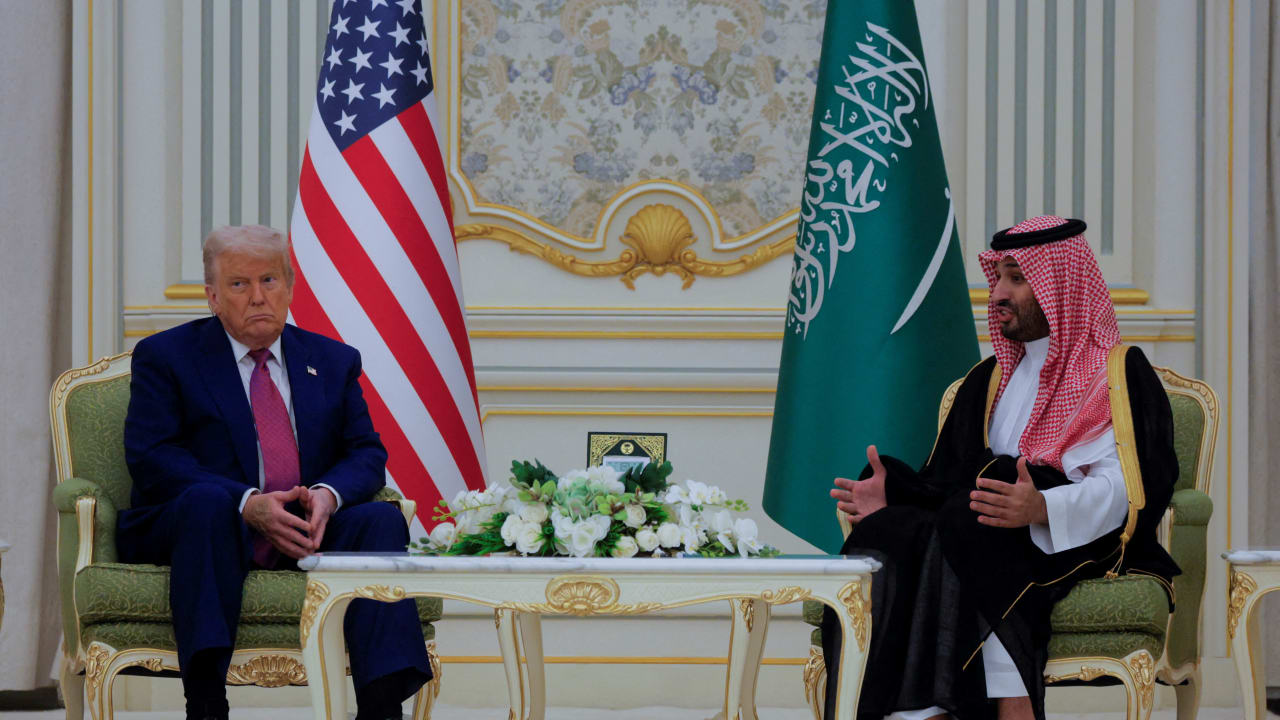
It was on Wednesday, July 22, that a new Saudi civil nuclear agreement was signed between the US and Saudi Arabia.
First reports indicated that the agreement assured Saudi Arabia of a 30-year cooperation with the US on civil nuclear development, with no reference to the requirements laid down in the past by the US as essential to such a deal, such as joining the Abraham Accords or a ban on enriching uranium domestically.
Within 24 hours, US President Donald Trump had posted clarifications on both issues on his Truth Social platform. He endorsed the nuclear agreement – which, incidentally, still requires a 90-day congressional review, and could face opposition – but, he wrote, it “is totally subject to Saudi Arabia joining the very respected and successful Abraham Accords.”
Prime Minister Benjamin Netanyahu said that Saudi Arabia joining these accords “would be an historic leap forward for peace in the Middle East.”
Since no international inspection process had been built into the deal, there were immediate fears that Saudi Arabia would be able to enrich uranium, leading eventually to a nuclear weapons program.
Trump was intent on quashing that assumption as well.
“The Civil Nuclear Deal,” he wrote, adding in parentheses, “(there will be no enrichment of material!) … pertains only to non-military use such as the ones that Iran and UAE (and others) already have.”
Little attention has been paid to how the new arrangement will impact the ambitious plan, launched by Crown Prince Mohammed bin Salman (MBS) in April 2016, aimed at revitalizing the kingdom – Saudi Vision 2030.
The Kingdom of Saudi Arabia is less than 100 years old. It was only in 1932 that Abdulaziz Ibn Saud emerged from many years of political and military struggle against the Ottoman Empire and other local chieftains, and was able to name the area he had conquered “Saudi Arabia,” proclaiming himself its monarch.
No doubt MBS had an eye on the eventual centenary celebrations in 2032 of the monarchy and the kingdom, which is why he launched the Saudi Vision 2030 program.
If it succeeds, by the centenary year, Saudi Arabia will have been transformed from virtual total dependence on oil revenues into a modern, liberalized, thriving society, its prosperity underpinned by flourishing industrial, financial, economic, and commercial sectors.
When first announced, Saudi Vision 2030 envisaged, among hundreds of initiatives, privatizing entire sectors of the economy, cutting subsidies, courting investors at home and abroad, streamlining government services, and going public with the national oil company, Saudi Aramco, the world’s largest oil producer and most profitable company.
This last step was achieved in 2019, when Aramco’s initial public offering (IPO) raised $29.4 billion, the largest in history.
Yet it was only 1.5% of the company that was sold to the public; the Saudi state and its sovereign wealth fund, the Public Investment Fund, still own 98.5% of Aramco.
A key objective of the program is to achieve economic diversification not by diminishing oil production, but by reducing the kingdom’s dependency on oil.
Ten years after the launch of Vision 2030, in April 2026, the government published a new progress report. It revealed a rapid expansion and diversification of non-oil economic activity, employment, investment, and government revenue sources.
The report stated that by the end of 2025, non-oil GDP contributed 55% to the economy – the first time that non-oil sectors had made up a clear majority of the kingdom’s real economic output.
To reduce the kingdom’s dependence on oil, Saudi Arabia is also investing heavily in renewable energy projects. The kingdom has become the fastest-growing renewables market outside China.
What is Saudi Vision 2030?
Saudi Vision 2030 includes nearly 50 large-scale construction and development projects aimed at transforming the nation’s infrastructure.
A cornerstone of the program is Neom, a $500b. futuristic city situated in the northwest of Saudi Arabia. Envisioned as a hub for innovation and sustainability, it aims to incorporate smart city technologies and renewable energy sources.
Recent reports indicated that Neom is facing significant financial challenges, with rising costs and delays leading to concerns about the project’s feasibility. This is one obvious area where Israeli hi-tech know-how, under an Abraham Accords umbrella, could help the development.
The Red Sea Project is an initiative focused on developing a luxury tourist destination along Saudi Arabia’s west coast. With environmental conservation built into the concept, it features resorts across an archipelago of pristine islands and inland sites.
When all phases are completed, it will comprise 50 resorts offering 8,000 hotel rooms in addition to more than 1,000 residential properties.
Saudi Arabia hosts millions of Muslims each year on their Hajj pilgrimage to the holy city of Mecca, but inside an Abraham Accords partnership, Israeli expertise in global, as opposed to Islamic, tourism could be of invaluable assistance in realizing the project.
Positioned near Riyadh, Qiddiya is envisioned as a vast entertainment city, encompassing theme parks, sports facilities, and cultural venues. It aims to become a major tourist destination, contributing to the diversification of the economy.
The construction of a variety of parks and performing arts centers is underway. Sports stadiums and other projects are forging ahead, with several attractions planned to open well before 2030.
Recently announced, the Mukaab is set to be the largest building in the world, featuring a unique cube-shaped design. It is part of the New Murabba development in Riyadh and aims to offer a mix of residential, commercial, and entertainment spaces. Construction has commenced, with the first phase expected to be completed by 2030.
Ever since the idea of Saudi Arabia joining the Abraham Accords was mooted, their perquisite has been a clear path to Palestinian sovereignty. They may decide that the third phase of Trump’s 20-point peace plan for Gaza provides that assurance.
Now, a multi-billion-dollar US-partnered investment program in civil nuclear development is to be added to the immensely challenging program already underway.
It presages a partnership for the long term, allowing US companies to help Saudi Arabia not only develop a civilian nuclear power program but also realize MBS’s ambitious Vision 2030 project.
Whoever leads the US in 2032 will certainly merit a seat of honor at Saudi Arabia’s centenary celebrations.
The writer, a former senior civil servant, is the Middle East correspondent for Eurasia Review. Follow him at: www:a-mid-east-journal.blogspot.com