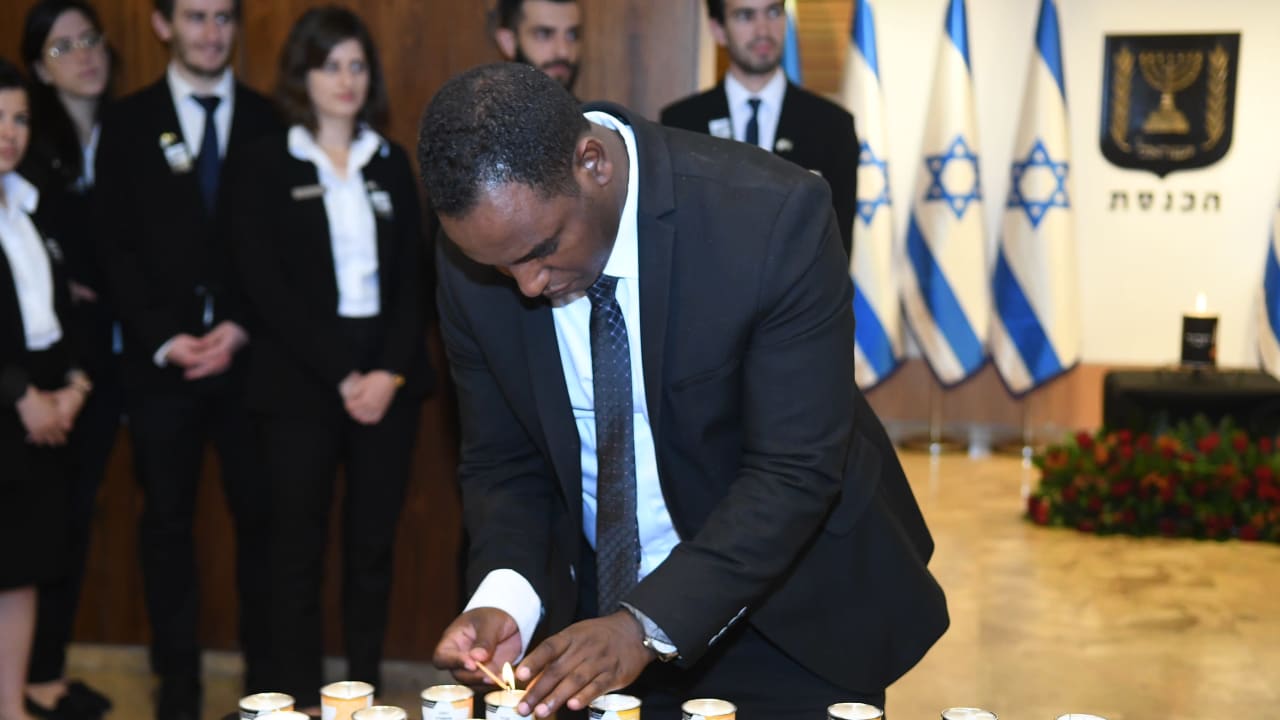
For decades, Ethiopian Israelis have been told to integrate patiently, vote loyally, serve courageously, and accept whatever political position established parties decide to offer them. But democracy is not an immigration office where citizens wait quietly for someone to call their number, and on Tuesday, Gadi Yevarkan offered a different answer: If the existing table has too little room for Ethiopian-Israeli leadership, build a new table and invite all of Israel to sit around it.
Yevarkan, a former member of the Knesset and former deputy minister of public security, launched his new Beit Yisrael party before a large audience in Petah Tikva. His official Knesset record confirms that he has already served inside Israel’s national institutions. Now he is attempting something more difficult: constructing an independent political movement.
I do not know whether Beit Yisrael will cross Israel’s electoral threshold. I do not know how many seats it might receive or whether it will become a significant force in the next Knesset. But something larger than Yevarkan’s personal future occurred in Petah Tikva. An Ethiopian-born Israeli leader stopped asking established parties where they might place him and began asking Israelis whether they would follow him.
That is a democratic breakthrough.
For years, Ethiopian Israelis have entered existing parties only to discover that inclusion and power are different things. Parties celebrate Sigd, praise the courage of Ethiopian soldiers, and display photographs from Operations Moses and Solomon. Yet Ethiopian-Israeli candidates are frequently placed where they have little chance of entering the Knesset or advancing into senior national leadership.
The usual expectation is clear: Join someone else’s movement, deliver your community’s votes, and be grateful for the position you receive.
Beit Yisrael challenges that expectation. Its message is not simply, “Give Ethiopian Israelis representation.” It is: “Ethiopian Israelis can organize a national political force, compete for votes, negotiate in coalition politics, and help determine how public resources are distributed.” That is not separatism. It is democracy.
Political independence for Ethiopian Israelis
Israel’s political system already contains parties built around religious communities, ideological movements, immigrant populations, and distinct social interests. Ethiopian Israelis have the same democratic right to organize. Political independence should not be considered dangerous only when black citizens attempt it.
The more important question is whether Beit Yisrael can become more than an Ethiopian-Israeli protest party. Yevarkan says that it is open to everyone. That ambition must become visible in its leadership, candidates, and policies.
The Ethiopian-Israeli community alone may not provide enough votes to carry a new party into the Knesset. Beit Yisrael must therefore build a wider coalition among Israelis who feel economically ignored, geographically marginalized, or politically taken for granted.
It should speak seriously about national security, equal military or civilian service, the cost of living, education, public safety, social mobility, and the neglect of Israel’s geographic periphery. It should address discrimination without reducing Ethiopian Israelis to permanent victims.
Its message should be one of responsibility: We served this country; we helped build it, and we are prepared to help govern it. The party will also need leaders whose records demonstrate competence beyond electoral politics. One outstanding example is Dr. Nigist Mengesha.
Born near Gondar, Mengesha worked as a social worker in Ethiopia before making aliyah in 1984. She earned a bachelor’s degree in social work from Bar-Ilan University, a master’s degree from the Hebrew University of Jerusalem, and a doctorate from the University of Sussex. Her research examined educational mediation for Ethiopian students in Israeli schools.
She co-founded the FIDEL Association, which created educational and social programs for Ethiopian Israelis, and served as director-general of the Ethiopian National Project. She worked with the Welfare and Social Affairs Ministry, graduated from the Mandel School for Educational Leadership, and led a municipal education department. She also represented Israel at the 2001 UN conference against racism in Durban, and has received significant recognition for her educational leadership.
Beit Yisrael, or another serious national party, should offer her a realistic position on its electoral slate. She should not be recruited merely because she is an Ethiopian-Israeli woman, but rather because decades of educational, municipal, and community leadership have prepared her for national service. Mengesha’s record could also make her a compelling future candidate for the presidency of Israel. That possibility should not sound revolutionary. It should sound overdue.
Imagine what her leadership would communicate to Israelis and the world: A black African Jewish woman, brought to Israel through aliyah, educated in Israeli and international universities, and entrusted with representing the Jewish state.
Such an image would be powerful, but it would not be manufactured public relations. It would express a historical truth. Israel is not a white European colonial project. The Jewish people are a diverse and ancient people whose communities preserved their connections to Jerusalem across Europe, Africa, Asia, and the Middle East. Israel must stop pretending that qualified Ethiopian-Israeli leaders do not exist. They do. What has been missing is a political structure that is willing to trust us with power.
Beit Yisrael must now prove that it is such a structure. It should publish a serious platform, establish transparent internal rules, recruit women and young leaders, welcome Israelis from beyond the Ethiopian community, and explain precisely how it would use parliamentary power.
It must also avoid the temptation to become merely a bargaining instrument that disappears after securing appointments for a few individuals. Its success should be measured by whether it advances better schools, safer neighborhoods, economic opportunity, fair policing, completed family reunification, and genuine access to national leadership.
One can agree with Yevarkan or disagree with him. One can support Beit Yisrael or vote for another party. But the importance of this moment should be recognized. Ethiopian Israelis are no longer willing merely to be integrated into someone else’s political vision. They are claiming the democratic right to present a vision of their own, not only for Ethiopian Israelis, but for the entire country.
For years, we asked for a place at the table. Gadi Yevarkan has begun building another one. Now the Israeli public will decide who is prepared to sit with us.
The writer is a former New York City Supreme Court detective, an investigator and educator in conflict resolution and restorative peace, and a moral diplomacy expert. His upcoming book, Moral Diplomacy for a Broken World, is inspired by the late Rabbi Jonathan Sacks.