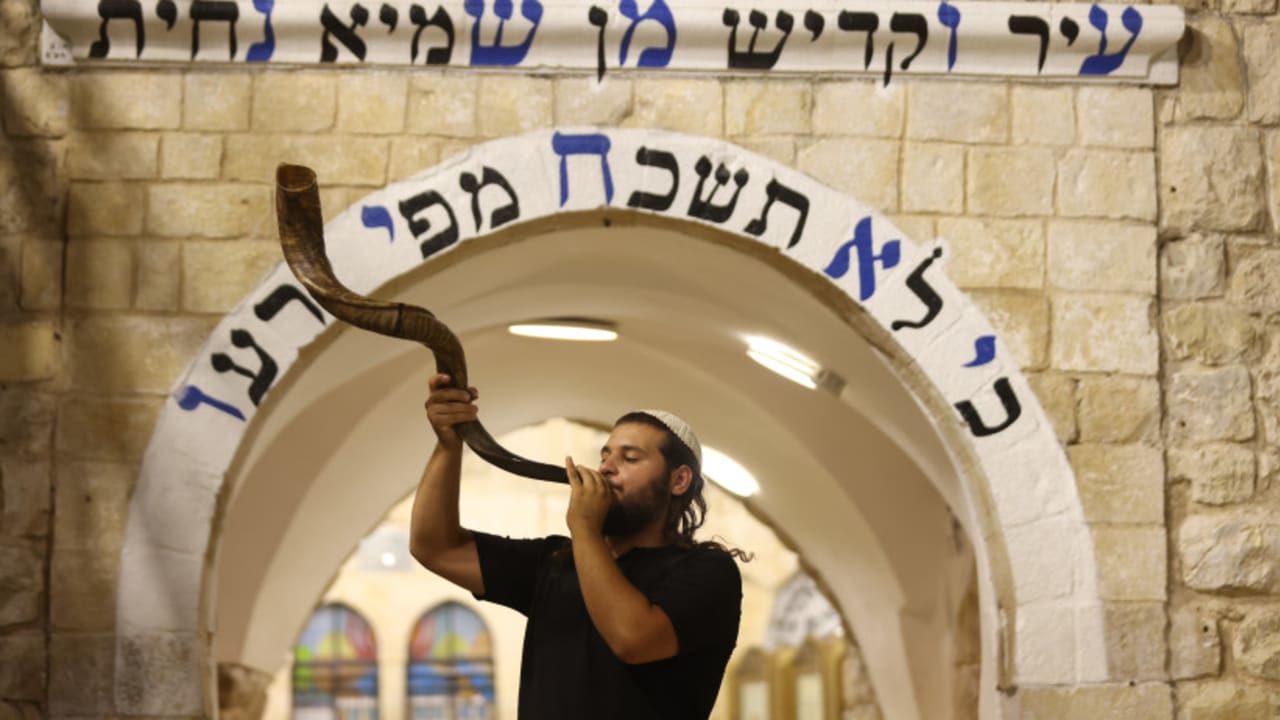
As we approach the upcoming Days of Awe, Rosh Hashanah and Yom Kippur 5787, 2026, I find myself reflecting on the prayer of Unetaneh Tokef, the stirring and poetic liturgy we collectively recite during the Mussaf service:
On Rosh Hashanah it is written, and on Yom Kippur it is sealed: Who shall live, and who shall die. Who by water and who by fire. Who by famine and who by thirst. Who shall have rest, and who shall wander. Who shall be humbled, and who shall be exalted.
There are few passages in our prayer services that confront us so starkly with the uncertainty and unpredictability of human life. Unetaneh Tokef refuses to allow us to hide behind familiarity and comfort. In those short, searing lines, the illusions of certainty fall away. We stand before God vulnerable, humbled, and at God’s mercy. We confront our fragile state as human beings. We acknowledge how much is beyond our control, and we submit ourselves to God’s will.
While the prayer might leave us with a sense of trepidation, it also provides us with resolve and opportunity: U’teshuvah, u’tefillah, u’tzedakah – repentance, prayer, and charity – are the powers we possess to earn another year of life.
These are not abstractions from another time and place. They are guideposts that illuminate for us how to live our lives today. And their message is reinforced by the sound of the shofar.

The blast of the shofar is not a single note. Instead, we hear three distinct sounds: Tekiah, a whole sound. Shevarim, a broken sound. Teruah, a whimpering cry. These sounds, heard in succession, are gathered together into one unmistakable call.
We do not hear the voice of the shofar in solitude. An entire community stands together, on the same day, in the same room, awakened from the same slumber, summoned by the same ancient sound.
For me, this is a fundamental meaning of the Days of Awe. They begin with private reflection, examining our own actions, our own relationships, and our own responsibilities. But they cannot end there. Ultimately, we choose to stand together before God as one people, bound by one history, one destiny, and one eternal covenant.
This year has been particularly trying for the Jewish community, here in Detroit and around the world.
We have witnessed antisemitism creep from the margins of society toward its center – on our campuses, in our halls of government and on our very own streets. We have watched ancient hatred find new language and new audiences. We have felt, at times, that some of the allies we had counted upon chose to keep their distance and remain silent.
But what has touched me most deeply is something I will carry with me long after this year’s end.
Throughout this difficult year, I have witnessed the Jewish people step forward for one another with kindness and love. I have seen Jews reaching across communities and across continents to help their Jewish brethren.
I have seen individuals and organizations forge relationships that strengthen our community and uplift those around us. I have seen Jewish schools and day care centers, synagogues and Federations, community centers and campus Hillels, social service agencies and senior centers refuse to wait for someone else to come to their rescue, instead joining together to protect themselves and one another.
I saw this spirit of shared responsibility in Montreal, where 440 trained volunteers and a federation command center helped secure the Jewish institutions of their community. I saw it in Washington, where more than 400 community leaders from 41 states came together to advocate on Capitol Hill for the safety and security of Jewish life across America.
I have seen it in the extraordinary generosity of the North American Federation system, helping bring comfort, aid, and security to families and communities rebuilding their lives in Israel since October 7. And I have seen it in the foresight of the Israeli government, committing to help strengthen Jewish education throughout the Diaspora.
And in West Bloomfield, Michigan, we felt that same spirit deeply when the courageous Detroit community came together to support our brothers and sisters at Temple Israel during one of the darkest moments we have faced. The kindness, courage, and love shown by every facet of the Jewish community shone a powerful light that reminded us that when one part of our community is threatened, we all feel the pain, and we all share the responsibility to respond.
I have seen the Jewish people uplift Torah, uplift one another, and build strength and resolve together. That word – together – is not sentimental. It is vital. And it is sacred.
When our ancestors listened for the first time to the sound of the shofar at Mount Sinai, preparing to receive the Torah and enter into our eternal covenant with God, they stood as our sages described, k’ish echad b’lev echad – as one person with one heart.
Not because every Jew thought the same way. Not because every Jew saw the world the same way. And certainly not because disagreement had completely faded away.
Unity is not the absence of disagreement
We must remember that unity is not the absence of disagreement. Unity is the recognition that what binds us together is greater than what divides us. It is the understanding that despite our differences, despite the forces that attempt to pull us apart, we remain k’ish echad b’lev echad – one people, with one heart.
Rosh Hashanah is the birthday of the world. Throughout the prayer service, we are asked to imagine the world as the Almighty intended it to be: whole, just, unified, loving, and at peace, and we accept upon ourselves to proclaim God as King of the universe.
From Rosh Hashanah through Yom Kippur, we measure the distance between that vision and the world as it actually is. And we acknowledge that distance with complete honesty and humility – recognizing where we have fallen short, while trusting that our sincere prayers will be heard and accepted.
Repentance is always possible. For one person. For one community. And for an entire people.
This year, I pray that we meet this moment with clarity, faith, and resolve: that we remain clear-eyed about the threats confronting us, without allowing that reality to turn into fracture; that we remain vigilant without becoming fearful; and that we defend ourselves without forgetting who we are, what we stand for, and how deeply connected we are to one another.
In the end, we are one people. We serve the same God, who stands with us, who wants the best for us, and who asks us to become better – more compassionate, more kind, more loving, more unified and less afraid.
May every member of the Jewish people be written and sealed for a year of life, health, blessing and peace. May the prayers we offer during these sacred days not remain only words upon our lips, but deeply embedded in our hearts, resulting in commitments we will live by each and every day.
Shana Tova u’metukah. May you and your loved ones be inscribed and sealed for a good and sweet new year.
The writer is the chair of the Jewish Federations of North America (JFNA).