
Israel has a strategic concentration problem.
For decades, the country has depended overwhelmingly on the United States and Europe for the diplomatic, military, and industrial relationships essential to its security. Those relationships remain vital. But recent events have exposed the danger of relying too heavily on a small group of Western partners.
Britain and other Western governments have recently imposed sanctions connected to Israeli activity in Judea and Samaria, while a growing number of countries have restricted or halted arms exports to Israel – posing a far more consequential threat to Israel’s security.
Even the United States proved susceptible to such pressure: During the Israel-Hamas War, the Biden administration withheld a shipment of heavy bombs. Support for Israel has fallen sharply among Democrats and younger Americans and is weakening even among younger Republicans.
Israel cannot know who will occupy the White House in five or 10 years, much less what Western politics will look like in 20. National security cannot rest on the assumption that today’s political alignments will endure.
The answer isn’t to turn away from America or Europe. It is to diversify.
Israel has already demonstrated that this can be done. Its transformation of relations with India into a major strategic, technological, and defense partnership is one of the great successes of Israeli foreign policy. The next phase of diversification should look further into the Indo-Pacific. And no country there offers more untapped potential than Japan.
Japan is the world’s fourth-largest economy, a technological and industrial powerhouse and a close American ally. Yet Israel’s relationship with Tokyo remains remarkably underdeveloped relative to what the two countries could offer each other. More importantly, Japan itself is changing.
China, a nuclear-armed North Korea and an increasingly aggressive Russia are forcing Japan to rethink its postwar reliance on American protection. Tokyo now describes China’s military activities as its greatest strategic challenge.
Japan has responded with the largest defense buildup in modern Japanese history. Its defense budget is approaching JPY 9 trillion (roughly $60 billion), and its priorities include long-range missiles, drones, autonomous systems, cyber capabilities, sensors, artificial intelligence, and more resilient military supply chains.
Japan increasingly needs what Israel is unusually good at producing. Israel has spent decades developing missile and air defenses, unmanned and counter-drone systems, electronic warfare, cyber defenses, sensors, and battlefield AI – often under operational conditions requiring rapid adaptation.
But the opportunity is much bigger than selling Israeli weapons to Japan. Israel develops sophisticated technologies quickly; Japan can manufacture them reliably and at scale. Its industrial capacity, capital, and dependable supply chains make the countries natural candidates for co-development and co-production.
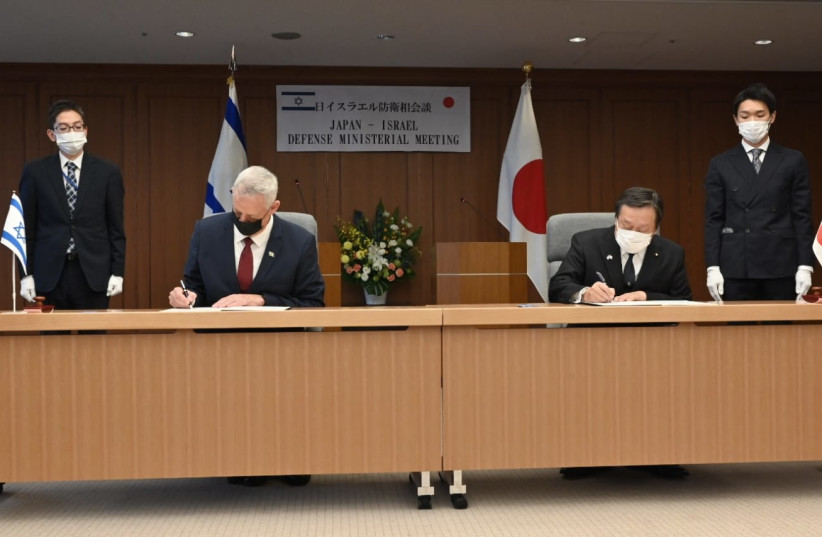
The foundation already exists. Israel and Japan have a defense-cooperation framework covering equipment and technology, and this summer they held their 11th strategic consultation, addressing both the Middle East and Indo-Pacific.
Japan is already moving in this direction with other partners, expanding defense-industrial, technology and supply-chain cooperation with Australia and European countries. A deeper partnership with Israel would therefore fit a model Tokyo is already pursuing.
Israel already has a model for such a transformation: India. Israel-India defense relations began primarily as a buyer-seller relationship. They have developed into a broad defense-industrial partnership encompassing R&D, manufacturing, AI, cybersecurity, and advanced defense technology.
A 2025 defense memorandum explicitly promotes co-development and co-production, and in 2026 the countries elevated their relationship to a “Special Strategic Partnership,” pledging to expand joint development, production, and technology transfer.
Israel, Japan both face threats, challenges
Israel and Japan don’t face identical threats. But the states challenging them increasingly cooperate with one another. The old distinction between Middle Eastern and Indo-Pacific security is eroding as Russia, China, Iran and North Korea deepen their military and strategic cooperation. America’s allies need stronger links across regions, too.
More broadly, Israel needs to stop viewing Asia primarily as an export market and start treating the Indo-Pacific as a central arena of its foreign policy. Modern wars are decided not only by who possesses the best weapons on the first day, but by who can obtain semiconductors and critical components, protect supply chains, and sustain production on the hundredth day. Recent Western restrictions on arms exports to Israel have demonstrated how quickly economic dependencies can become strategic vulnerabilities.
Deeper ties with Japan could give Israel greater economic and strategic resilience while anchoring it more firmly in the emerging security architecture of the Indo-Pacific.
Historically, Japan had a powerful reason for keeping Israel at arm’s length: its dependence on Arab oil made close ties with Jerusalem potentially costly. That calculation has changed. Japan remains dependent on Gulf energy, but the Abraham Accords demonstrated that close relations with Israel and major Arab states are no longer mutually exclusive. Tokyo’s deep relationships with Saudi Arabia and the UAE can increasingly complement rather than constrain closer ties with Israel.
Israel should make Japan a strategic priority. The two countries could elevate their existing politico-military dialogue, establish a standing defense-industrial agenda, pursue joint R&D and co-production, and integrate maintenance, sustainment, and critical supply chains. They could also launch a trilateral economic-security dialogue with India focused on trusted technologies, strategic industries, and defense production.
Israel spent its first 75 years looking predominantly west for strategic depth. Its partnership with India has already shown the potential of looking east. In an era of uncertain alliances, interconnected threats, and Asian rearmament, Israel’s greatest untapped strategic opportunity is Japan.
The writer teaches political risk at Johns Hopkins University’s School of Advanced International Studies and writes about and works on fragile states and political transitions.