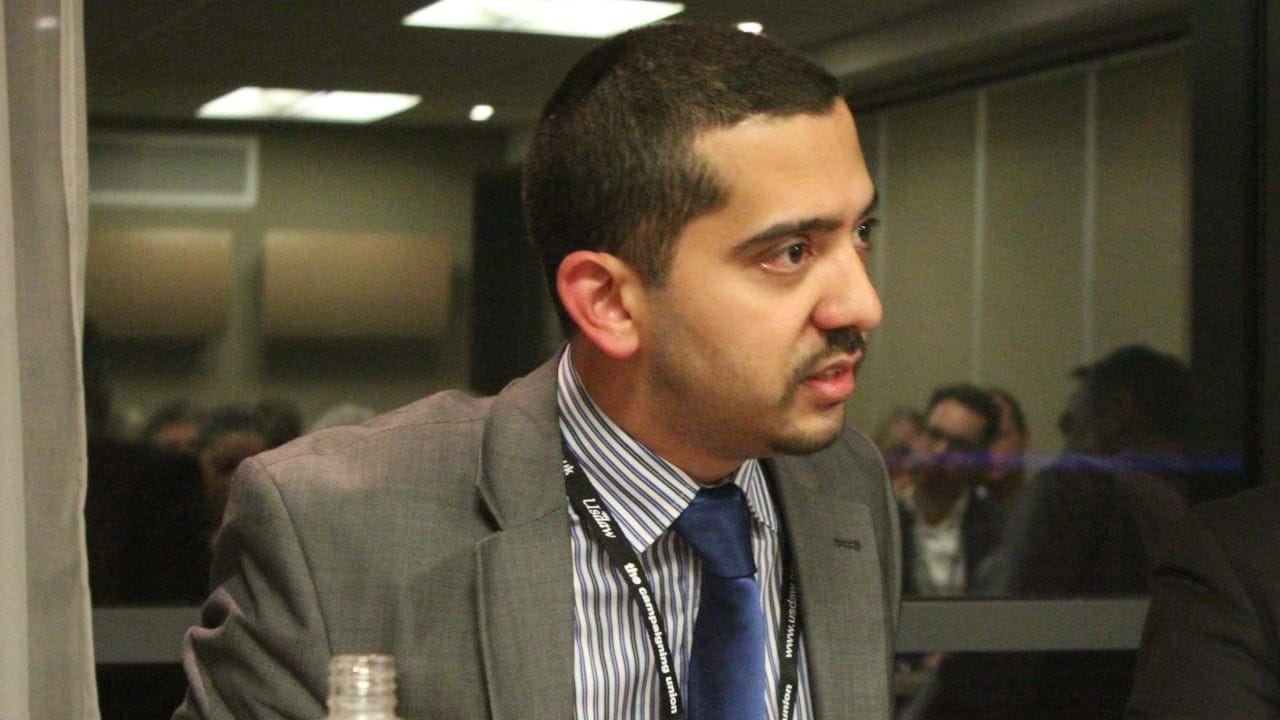
“He just keeps digging his hole... Hypocrite,” Mehdi Hasan posted this week, accusing Ed Sheeran of staying conveniently silent on Gaza after speaking up for Ukraine.
The comparison itself is telling: Ukraine is an unprovoked invasion by a foreign power; Gaza is a defensive war Israel didn’t start, against a terrorist organization that murdered 1,200 people in around eight hours during the October 7 massacre. Treating the two as interchangeable moral tests is already a distortion. But set that aside – by Hasan’s own hypocrisy standard, no one has more to answer for than he does.
Let’s start with the record. In 2009, years before he became a cable news fixture, Hasan gave a series of speeches comparing non-Muslims to “animals” and linking homosexuality to “sexual deviance.” He apologized in 2019, calling it “dumb offensive ranty stuff” from his twenties. He turned 30 a few months later, but sure, people change.
The pattern of minimizing bigotry when it’s politically or ideologically convenient never really stopped. A decade later, in 2019, when Rep. Ilhan Omar’s 2012 tweet resurfaced – “Israel has hypnotized the world, may Allah awaken the people and help them see the evil doings of Israel” – Hasan defended her on air, saying she’d “maybe unwittingly echoed tropes” and insisting she hadn’t said anything about Jews.
That’s a generous read of language that does exactly what classic antisemitism has done for ages: cast Jews as secretly controlling perception itself, “hypnotizing” the world into not seeing supposed “evil.”

The mind-control framing isn’t incidental – it’s the mechanism explaining why the “evil” goes unpunished, the whole function this conspiracy theory genre has served for centuries. A sitting member of Congress reaching for it got recast by Hasan as an innocent slip. He has never extended that charity to Israel or its defenders.
The Israel-Hamas War exposed the pattern at scale. In October 2023, Hasan implied Israel was responsible for the explosion at Gaza’s Al Ahli hospital. American intelligence would soon confirm the blast came from a misfired Palestinian Islamic Jihad rocket, exactly as Israel said within hours. Hasan never corrected the record or apologized for amplifying the accusation while it was doing maximum damage.
There’s also a credibility problem that should have ended his career as a serious journalist rather than launched a media company. In 2024, Hasan appeared in a video with Greta Thunberg and others reading tributes to alleged Palestinian journalists killed in Gaza. One of the men he eulogized, Hamza al-Dahdouh, was identified by the IDF – using documents recovered from Gaza command centers – as a dual-hatted Palestinian Islamic Jihad operative, not merely a journalist caught in crossfire. Hasan, who claims a brand based on “evidence-based” journalism and grilling guests over sourcing, didn’t apply that scrutiny to who he chose to memorialize.
Worse still is the line that should have put to rest any claim that Hasan’s commentary is principled anti-war advocacy rather than a singular fixation on Israel. Responding to journalist Eli Lake, Hasan argued the “Gaza genocide” was in some ways worse than prior genocides, including Rwanda and, in his words, even the Holocaust, because the perpetrators of those atrocities were eventually “shunned” and “de-radicalised,” while Israelis, in his telling, are not. He deleted the post after immediate, widespread backlash – Piers Morgan among those, asked if he’d “lost his mind. Yet Hasan never withdrew the argument, saying only he’d phrased it “clumsily.”
The comparison wasn’t just inflammatory – it was intellectually and morally bankrupt. Hasan’s casualty figure comes from Gaza’s Hamas-run Health Ministry, a tyrannical party to the conflict whose methodology has drawn significant scrutiny. Even at face value, it doesn’t distinguish civilians from combatants, nor separate deaths from Israeli strikes, Palestinian rocket misfires, and Hamas’s own executions and purges. Before the war, this ministry counted roughly 9,000 natural deaths a year – a figure the wartime total doesn’t appear to exclude.
Based on that rightfully disputed figure, Hasan placed Israel’s conduct alongside, and beyond, history’s most infamous genocides: the Holocaust, where six million Jews were exterminated in under four years, and Rwanda, where roughly 800,000 Tutsi were murdered in about one hundred days – invoking humanity’s worst crimes in service of a political argument.
Here’s where Hasan’s hypocrisy becomes structural, not incidental. Hasan spent eight years, from 2012 to 2020, as a paid presenter for Al Jazeera English – a network wholly owned and funded by the Qatari government.
Qatar's relation with Hamas
Qatar is not a bystander here. It has hosted and financially supported Hamas’s political leadership in Doha for years and maintains one of the region’s worst records on labor rights, press freedom, religious freedom, and treatment of migrant workers, documented extensively around the 2022 World Cup.
To his credit, Hasan has occasionally pushed Chinese officials on the Uyghurs and prodded Gulf autocrats in the abstract – but those moments prove the rule: a handful of segments across a 15-year career, dwarfed by the near-nightly, career-defining fixation he’s built around Israel.
No government, including the one that paid him for a decade, has ever received a fraction of that scrutiny. That’s not moral consistency. That’s knowing which hand feeds you, and which flag makes for better ratings.
A decade-and-a-half obsession this singular, aimed at one small country on a planet of nearly two hundred, doesn’t emerge from nowhere. A few months before he turned 30, Hasan was making speeches built on exactly the kind of hate, Hamas-adjacent ideology and collective animus he now insists doesn’t inform his Israel coverage. The fixation didn’t start with October 7. It just found its biggest audience there.
Whether this fixation stems from ideology, personal conviction, audience incentives, or some mix of the three is unknowable. What’s observable is the pattern: excuses for antisemitic rhetoric, credulity toward anti-Israel allegations, and scrutiny he rarely applies elsewhere.
This fixation pattern extends well past one host. Mehdi Hasan is emblematic of a dictatorship-dominated UN General Assembly that passed 14 resolutions condemning Israel in 2023 alone – more than the rest of the world combined, which drew seven. Zero were passed against Venezuela, China, Qatar, or Hamas. Since 2015, the United Nations General Assembly has passed more than 140 resolutions against Israel, over double every other country on earth combined.
Meanwhile, at least 370,000 people have been killed in Yemen’s civil war, a toll with no UN watch tally, no primetime obsession, and no Mehdi Hasan monologue. Syria’s civil war killed over 525,000. Sudan’s ongoing catastrophe has displaced 13 million people and killed untold thousands more, with a fraction of the sustained Western or Al Jazeera attention Gaza receives in a single news cycle.
Which brings us back to Ed Sheeran. Hasan’s complaint is that public figures owe consistency across conflicts. Fair enough – but consistency is demanding. It requires the same scrutiny for friends and adversaries, the world’s one Jewish state and its roughly 199 non-Jewish counterparts, democracies and autocracies, and oneself. Hasan has built a career demanding that standard from others while too often exempting himself from it.
So, keep digging, Mehdi. At this rate, you’ll reach Doha long before you reach bedrock.
The writer is an attorney, former IDF soldier, and former NYPD officer. He writes widely on Israel, Zionism, antisemitism, and Jewish history. He serves on the board of Herut North America.