
If Gadi Eisenkot leads Israel’s next government, what could Palestinians realistically expect from him economically?
The answer should not begin with the assumption that an Israeli prime minister can, on his own, solve the Palestinian economy’s problems. Palestinian reforms, investment, the private sector, international support, and internal governance all matter.
But the Palestinian economy is not an independent economy with full control over its monetary, trade, and sovereign policies. It is deeply linked to Israel through the framework created by the 1994 Paris Economic Protocol and through the everyday movement of workers, goods, revenues, and money.
The Israeli shekel is the dominant currency in Palestinian transactions. Clearance revenues are a major source of Palestinian public income. Much Palestinian trade moves through crossings and ports subject to Israeli procedures. Many Palestinian households depend on work in Israel, while Palestinian banks rely on correspondent relationships with Israeli banks.
The result is an interconnected economic system. Restrictions on workers affect household income. Restrictions on movement affect businesses. Problems with clearance revenues affect public salaries and consumption. Banking restrictions affect trade and liquidity.
This is why Eisenkot’s approach to the Palestinian Authority matters economically as well as politically.

In 2022, Eisenkot publicly warned against dismantling the Palestinian Authority and annexing the West Bank. That statement should not be treated as a detailed economic program for 2026. But it did indicate that, in his thinking at the time, preventing the collapse of Palestinian institutions was connected to Israeli security interests.
The practical question is therefore straightforward: if preventing the PA’s collapse remains part of his strategic outlook, can that objective be separated from the economy that enables the PA and Palestinian society to function?
The first test: Palestinian workers
The clearest indication so far comes from Eisenkot’s position on Palestinian workers.
In an interview published by Israel Hayom on August 27, Eisenkot argued that the broad ban on Palestinian workers entering Israel had not prevented unauthorized entry. He said it could make more sense to allow Palestinian family breadwinners to work in Israel after security screening and under Shin Bet supervision.
His argument was primarily about security, not economic development.
That distinction matters.
Eisenkot did not promise a full reopening of the Israeli labor market. He did not specify how many workers would return or when. But the policy he described could have significant economic consequences.
For a Palestinian worker, returning to work means more than employment. It can mean income returning to a household, bills being paid, debt being reduced, food and medicine becoming more affordable, and purchasing power returning to the local economy.
PCPO polling reflects the scale of these concerns. In our surveys, 59.9% identified restrictions on Palestinian employment in Israel and the decline in permits as a major economic challenge. Some 79.3% pointed to unemployment and limited job opportunities, while 70.2% cited declining income and weakened purchasing power.
These are perceptions, not official unemployment statistics. But they show how closely Palestinians connect access to work with economic security.
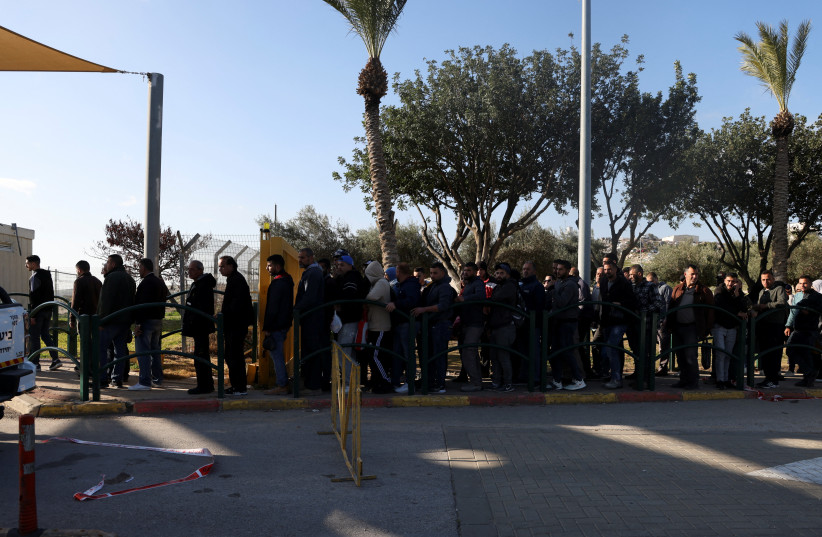
Workers cannot help the economy if they cannot move
Permits alone are not enough.
A worker needs to reach the workplace predictably. A business needs employees and materials to arrive on time. A trader must know when goods can move. A factory must know whether deliveries will arrive today or tomorrow.
That makes checkpoints and road gates an economic issue as well as a security issue.
In April 2026, OCHA reported 925 movement obstacles across the West Bank, including East Jerusalem, based on a December 2025 survey. These included 89 checkpoints operating around the clock, 218 partial checkpoints and 232 road gates. OCHA also found that 459 obstacles hindered access between Palestinian communities and major roads.
For businesses, uncertainty itself becomes a cost.
A delayed worker, a truck forced onto a longer route, or raw materials arriving unpredictably can affect contracts, prices, production, and investment.
In PCPO polling, 62.8% identified restrictions on movement and mobility as a major economic challenge. Some 70.6% selected facilitating freedom of movement as an important economic measure, while 69.9% supported removing or reducing military checkpoints inside the West Bank.
Yet respondents did not necessarily see mobility and security as opposites: 68.3% said freedom of movement and security and stability were equally important.
That finding is particularly relevant when considering Eisenkot, whose career was shaped within Israel’s security establishment.
The question is not whether security considerations disappear. It is whether they can be managed in ways that also reduce unnecessary economic uncertainty.
Clearance revenues: the financial test
The same logic applies to Palestinian public finances.
According to a 2026 analysis by Israel’s Institute for National Security Studies, clearance revenues actually transferred to the Palestinian Authority after deductions fell from about NIS 8.8 billion in 2022 to NIS 7.9 billion in 2023, then to approximately NIS 4.4 billion in 2024 and around NIS 2 billion in 2025. More than NIS 4 billion was withheld in 2025.
Foreign assistance helped offset part of the decline, which is an important qualification. The PA’s fiscal crisis cannot be attributed to clearance revenues alone.
But the effects are not confined to a government balance sheet.
Behind every public budget is a household budget.
In a PCPO survey of 503 Palestinians conducted between June 24 and July 5, 2026, 83.5% said delayed or reduced salaries had changed their household spending. The impact extended to food, health care, education, utilities, loans, and debt.
Eisenkot has not announced a specific policy on clearance revenues. There is therefore no basis for claiming that he would release withheld funds or end existing deductions.
But the question remains: if the objective is to prevent institutional collapse, how sustainable is that objective when the PA’s principal source of revenue remains unstable?

Banks and the movement of money
There is another part of the same economic chain: correspondent banking.
Reuters reported on September 1 that Israel Discount Bank and Bank Hapoalim would continue correspondent banking services with Palestinian banks through the end of 2026. Around NIS 51 billion in transactions pass through these relationships annually, while approximately 90% of Palestinian trade depends on access to Israel’s financial system. Bank of Israel Deputy Governor Andrew Abir said the next Israeli government would need to find a long-term solution.
For Palestinians, this is not merely a technical banking dispute.
These channels help process payments for trade, imports, fuel, medicine, and essential goods.
Closely connected is the accumulation of surplus shekels in Palestinian banks. When cash cannot be transferred regularly, liquidity pressures rise. Electronic payments can reduce dependence on cash, but they cannot replace correspondent banking or solve the underlying fiscal problems.
This is why workers, checkpoints, clearance revenues, correspondent banking, and surplus shekels should not be viewed as separate crises.
They form one economic cycle.
When revenues fall, salaries are affected. When salaries are delayed, households cut spending. When demand weakens, businesses lose sales. When workers and goods cannot move predictably, costs rise. When money cannot move normally through the banking system, pressure accumulates elsewhere.
The real test of change
This brings us back to Eisenkot.
There is currently no evidence that he has committed himself to resolving all of these issues.
His clearest published position concerns Palestinian workers. On clearance revenues, correspondent banking, surplus shekels, checkpoints, and crossings, there is no comprehensive public program from him so far.
Nor would implementation depend on a prime minister alone. Coalition partners, government ministries, Israeli security institutions, the Bank of Israel, Palestinian institutions, and international actors would all matter.
But these issues provide measurable tests for any future government.
If preventing the collapse of the Palestinian Authority remains part of Eisenkot’s strategic thinking, the test cannot be limited to preventing the final moment of collapse.
It must also include whether Palestinian institutions and the economy around them can function before reaching that point.
Economic stability is not a substitute for political rights, nor can it replace a political settlement. But economic instability can make an already difficult political and security environment more fragile.
In PCPO polling, 83.8% said Palestinian economic stability could contribute to greater political and security stability in the region.
For Palestinians, however, the meaning of economic change is ultimately much more concrete.
It means a worker being able to reach his job, a public employee being able to rely on a salary, a trader being able to move goods and transfer money, a bank being able to settle payments, and a young person being able to plan for tomorrow with less fear that another economic bottleneck will suddenly close the road ahead.
The writer is the founder and president of the Palestinian Center for Public Opinion (PCPO).