
In 1991, an internal memorandum of the Muslim Brotherhood in North America, later entered as evidence in a US federal trial, described the movement’s work on the continent as “a kind of grand Jihad in eliminating and destroying the Western civilization from within.”
Not a bomb. Not a rifle. Jihad, waged from within, through the institutions of the very society it targets.
Almost nobody in the West has heard that sentence. What the West hears are other words: freedom, justice, liberation, resistance, human rights. Words it knows, loves, and has built its moral identity around. The question it rarely asks is who supplied those words, and to what end.
A mind does not check where a word came from. It checks whether the word fits.
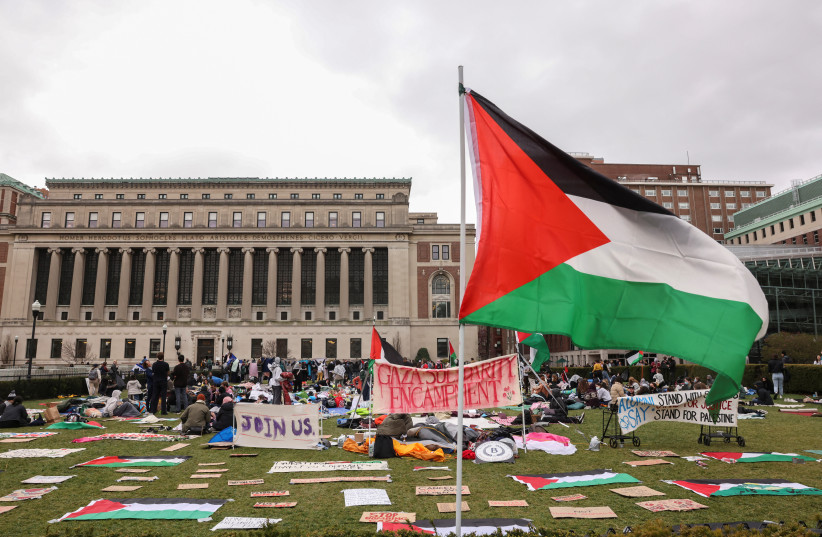
Consider a young man marching on an American campus, or through London, Paris, or Berlin, calling for the liberation of Palestine. He does not believe that he is calling for jihad. He is thinking about oppression, colonialism, and his duty to stand with the weak. He is running his own value system.
Scrutiny is triggered by foreign content, not by familiar content. A phrase that matches what a person already believes is absorbed without inspection. The most efficient way to transmit foreign content is therefore to wrap it in the familiar.
No need to say jihad. Resistance will do. No need to speak of victory. Liberation will do. No need to explain the day after. Decolonization will do.
An effective slogan does not transmit a message. It produces commitment without requiring comprehension.
Ask him which river and which sea, and very often he cannot answer – not because he is concealing anything, but because he genuinely does not know. He fills the gap with the concepts he does believe in: freedom, equality, an end to oppression.
That moment exposes the mechanism. A man who chants a sentence whose content he does not truly understand has not adopted a position. He has acquired belonging. Once he fills it with his own meaning, the sentence becomes his, and he will defend it as though he had written it.
Anyone confronting him with facts is no longer arguing with whoever drafted the line. He is colliding with the values of the man shouting it.
The line was drafted, and openly. In its 2017 document of principles, Hamas rejects in article 20 any alternative to the complete liberation of Palestine from its river to its sea, conceding no part of the land. Article 23 states that resistance and jihad for the liberation of Palestine remain a legitimate right, a duty, and an honor.
Article 25 calls resistance by all means a legitimate right under international law, with armed resistance at its heart as the strategic option. The same document grounds liberation in justice and in the right of peoples to self-determination. One document, both words, the same act. Nothing is concealed. The reader simply stopped in the middle of the sentence.
An interpretive frame is not tested against information. It organizes information.
False defense
Once an event has been filed as a struggle between oppressor and oppressed, every new fact is assigned a place inside that structure. Violence by the weak becomes resistance. The response of the strong becomes oppression. Context reads as proof that the strong control the narrative too. This is why more advocacy produces worse results.
Whoever defines first determines not the answer, but the question, and everyone who answers inside it reinforces it. Israeli public diplomacy did not lose the argument. It conducted it on terrain the other side had defined.
A system trained to recognize one pattern reads every other pattern as noise.
The West learned to identify jihad by its easiest images, the gunman, the rifle, the explosive charge, and built intelligence services, laws, and budgets against that single form. But the jihad the memorandum describes works through media, economic, legal, and educational organizations. Those forms do not evade the system. They fall outside the definition the search uses.
France now says so officially. A 2025 Interior Ministry report found that Islamism spreads chiefly through militant activism anchored at the municipal level, through associations, schools, and digital networks.
A National Assembly commission of inquiry then examined the strategies Islamist movements use to influence elected officials and parties to alter republican rules, warning of a real risk ahead of coming elections. It found no demonstrable financial or organizational links to parties. It identified a direction, not a conspiracy.
Effective recruitment does not appeal to a man’s worst instincts. It appeals to his best.
Compassion, the reflex to stand with the weaker party, outrage at the sight of suffering: these are the finest things Western culture possesses, and they generate commitment that demands no justification. Which is exactly why they are the target.
He believes he is defending Western values. The ideologues beside him regard Western society itself as the arena. The Westerner sees himself as an ally. The ideologue may see an instrument. He is useful - not despite his values but because of them.
None of this means that every critic of Israel is waging jihad, or that every Muslim is an Islamist. Most Muslims in the West are no part of this, and many pay its price first. Whoever blurs these distinctions ends up serving the very extremists he believes he is fighting.
When the word liberation appears, there is no need to reject it. It only needs to be finished. Liberation of whom, from what, to what extent, and what comes after?
What may then emerge is more disquieting than the thought that someone changed our mind.
He never asked to change it.
He only learned to use it for his own ends.
The writer is the vice president of the Jerusalem Center for Security and Foreign Affairs (JCFA).