
As I finished my most recent round of miluim (IDF military reserves) in August of 2025, just in time to move to New York and begin my final two years of the Columbia-Tel Aviv dual degree program, my officers and fellow soldiers joked that I was finishing one round of fighting to directly begin the next, only this time I would be unarmed and unable to defend myself.
While they were mostly joking, there was some truth to it; I was moving across the world to finish a degree in an institution that I wasn’t sure I still had a place in.
Then, less than a week later, standing on campus, a friend and I were approached by a group of people who told us, “We heard you guys were Israelis… Did you happen to serve in the IDF?”
I immediately braced, but gave a more tentative than I like to admit, “Yes.”
They turned out to be American veterans and were there to tell us that they thought of us as ‘true heroes’ and wanted us to feel like a welcome and comfortable part of their community.
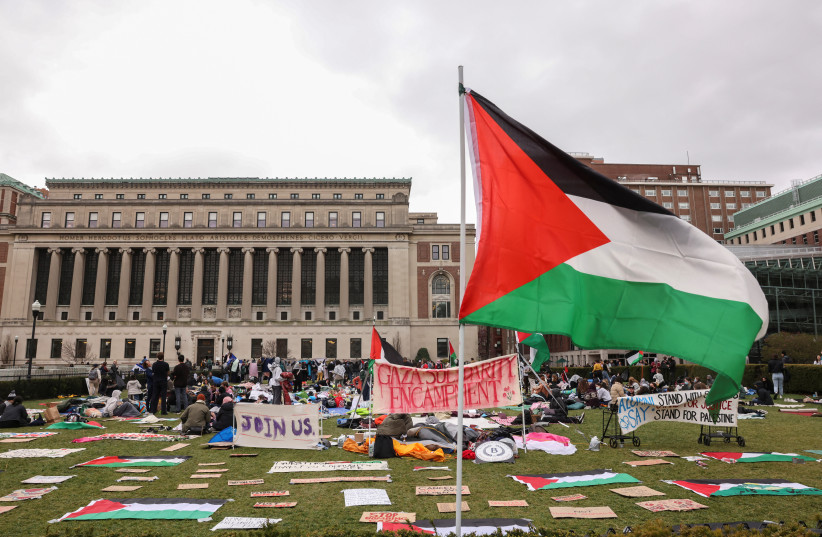
While I have had other experiences as an Israeli and a Jew on campus, this initial introduction immediately showed me that the perception of Columbia’s campus I had gained entirely from the media was only one side of the reality on campus.
This more nuanced feeling of tentative comfort and belonging is what guided my initial excitement of the opening of the Columbia Global Center in Tel Aviv as well as my restrained annoyance at yet another referendum vote, centered around Israel. The global center serves as a hub to facilitate partnerships between Columbia and Tel Aviv in areas of climate change, technology, entrepreneurship, science, and medicine.
On one hand, I greatly enjoyed the opportunity to study at two world-class institutions in two different parts of the world, spending two years devoted to Middle Eastern Studies at Tel Aviv University, and two years devoted to International Politics at Columbia; it was an incredible experience.
On the other hand, it is only one of the dual-degree programs that exist at Columbia University. Other dual-degree students split their degree between France, Dublin, or Hong Kong, and none of those programs have received nearly as much criticism or scrutiny from my fellow students, no matter how the political climate or government system of the places in question has looked.
Similarly, the opening of the Tel Aviv global center was an incredible moment when Columbia expanded its base of research, collaboration, and educational opportunities. But it also exists as only one of 10 other global centers, with other notable centers existing in Turkey, Brazil, China, and Jordan.
The existence of these other centers is similarly an accepted asset to the universities’ ability to conduct research and broaden their scope of international understanding.
The scrutiny and criticism of both these programs, due to their location, is only a continuation of the hyper-focus and double-standard criticism Israel has received since its conception.
The referendum calling for the closure of these programs needs to be understood simply as the campus equivalent of much of the international but baseless anti-Israeli rhetoric.
While the consistent calls for my campus to "divest from Israel," and the occasional on-campus keffiyeh-wearer continue to gain disproportionate attention, it is far from the reality on the ground.
Between the Columbia School of General Studies, which is home to all the dual-degree programs, and all the veterans, and the strong Jewish community that has continued to support each other throughout the war, the loud minority of Boycott, Divestment and Sanctions (BDS) supporters does not play a significant role in the life of the average Jewish student at Columbia.
Further, while in my time at Columbia, these have been quite a common occurrence, and I remember hearing about a similar vote while I was still in my first year at Tel Aviv; the administration has assured us that these calls have no weight.
Antisemitism, anti-Israel rhetoric at Columbia
This is not to say that antisemitism and anti-Israel rhetoric does not exist at Columbia, it certainly does, and I have been called more names than I can count. It is just to say that fearing them is giving them what they want, and the best path forward for the Jewish students on Columbia’s campus, and any other campus in the Diaspora, is simply to continue being proudly Jewish, and knowing there is a strength in our continued pride.
Issy Lyons is currently a senior in the dual degree program between Columbia University and Tel Aviv University. At Columbia, she serves as vice president of Students Supporting Israel and director of communications for the Military Veterans Society (Milvets). Previously, she served in the Israel Defense Forces as a combat soldier in a field intelligence unit (Isuf Kravi). She is also a published poet and author whose work has appeared in Before, During, and After: The Voice of Women in the Land of Israel, Young Zionist Voices, and other publications.