
At the Jerusalem Post 2026 New York Conference, Israel’s Tourism Ministry unveiled an ambitious campaign, seeking to present a country that must be experienced to be understood.
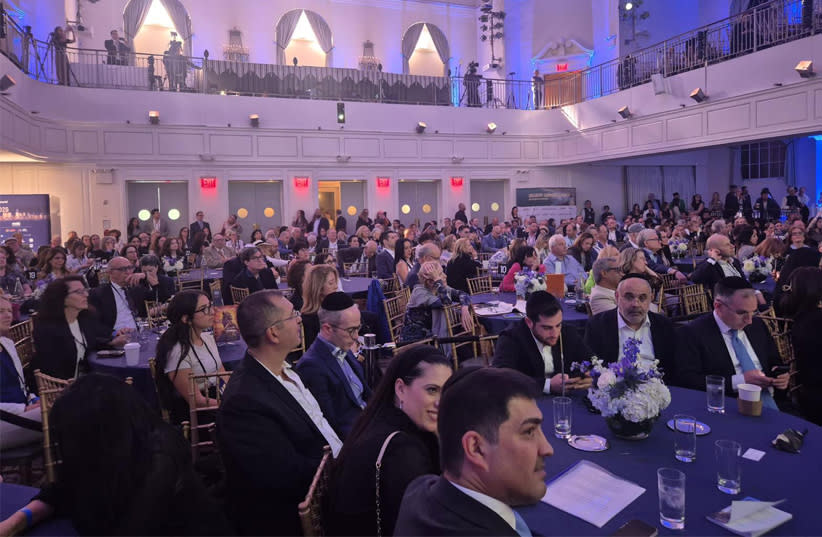
The ballroom at the conference had the familiar cadence of Israeli-American policy gatherings: tightly scripted remarks, a steady rotation of officials and advocates, and an audience accustomed to hearing Israel described in terms of strategy, resilience, and crisis management. But as the lights dimmed for the unveiling of the Tourism Ministry’s latest initiative, the atmosphere shifted.

The centerpiece was the launch of a new North American campaign titled “I Am Israel,” unveiled as part of what officials described as a broader effort to revive inbound tourism during a period of continued regional instability and reputational challenge abroad. The campaign, backed by an investment of approximately NIS 20 million, according to ministry officials, is designed to reposition Israel not primarily as a destination of sites and landmarks but as a lived experience – one mediated through people, culture, and emotional connection.
Kicking off the presentation was actor and longtime Israel advocate Michael Rappaport, who said he had visited Israel nine times in the past two-and-a-half years, and described those visits as transformative. “Tourism is not just about flights, it’s not just about hotels,” said Rappaport. “Tourism is about connection.”
The comment drew a knowing response from parts of the audience, many of whom are accustomed to Israel advocacy framed in geopolitical terms rather than personal narrative. Rappaport spoke of “gritty authenticity” and the lived texture of Israeli society – language that aligned closely with the campaign’s attempt to move away from traditional promotional imagery.
“We chose not to show only landscapes and sites,” explained Michael Izhakov, director-general of the Tourism Ministry. “We chose to show Israel through the people, through real moments, experiences, culture, and the joyful Israeli spirit.”
This shift represents a deliberate departure from the sanitized version of Israel that has characterized tourism marketing for decades. Instead of static beauty, the ministry is in a narrative of lived experience.
As Izhakov noted during his address, “For us, this connection goes beyond numbers and marketing,” emphasizing that their work aims to reach Jewish, Christian Evangelical, and pro-Israel constituencies with a message intended to be deeply personal and emotion-oriented.
WHILE THE campaign indeed leans into emotion, its grounding is firmly rooted in economic necessity, with the United States remaining the largest driver of inbound tourism to Israel.
In 2025, over 30% of all arrivals to the country originated from American soil, a notable figure compared to the 2019 peak, when nearly 1 million American visitors accounted for approximately 4.5 million total tourists. During his US tour, Izhakov has spearheaded high-level engagements with travel industry titans, community leaders, and potential investors.
As far as he is concerned, tourism is a pillar of soft international relations. “Every tourist also becomes an ambassador for us around the world,” he says. That being said, the other significant tether he referred to regarding tourism was the one that manifested between Israel and the American Jewish Diaspora.
Indeed, unlike previous efforts that focused on sheer visitor volume, the ministry is now prioritizing the development of a narrative framework in which tourism becomes a form of identity engagement.
By tapping into the historical affinity of American travelers, the ministry aims to translate personal visits into long-term advocacy. “We are meeting communities, travel agents, businesspeople, and leaders who are telling us something simple: We want to come to Israel,” Izhakov shared. This approach acknowledges that while geopolitical events fluctuate, the personal bond formed through firsthand encounters is a durable, long-term asset for the state.
Increasingly blending state-level diplomacy with the private sector’s agility, this broader outreach is bolstered by a significant structural evolution within the ministry. Departing from conventional tourism rhetoric, the ministry is integrating Israel’s technological identity into its growth strategy to ensure long-term stability and expansion.
As Izhakov declared at the conference, “In 2026, the Tourism Ministry will deepen investments in technology and artificial intelligence. Do not forget, we are the ‘Start-Up Nation.’”
This dedication to modernization is evident in internal changes like the creation of the “Lighthouse” unit, a one-stop shop overseen by the director-general that offers comprehensive support to entrepreneurs in overcoming bureaucratic challenges.
Additionally, recent government reforms permit up to 49% mixed-use development, including residential areas within hotel zones, helping developers bridge the feasibility gap and ensuring that Israel maintains a vibrant, modern hospitality sector while safeguarding its natural landscapes.
A key part of that effort, according to ministry officials, is the intentional move away from what Yoash Ben Izhak, vice president of marketing at the Tourism Ministry, described as conventional promotional language. “Our mission is not to help Israel blend in,” Ben Izhak said. “It is to ensure that Israel stands out as it has for thousands of years. We’re offering tourism with meaning.”
What comes next
The campaign’s rollout is defined by a sense of unwavering momentum that defies the cooling effect of regional instability. As Izhakov reminded the audience, the ministry refused to stand still, stating, “Even during this period, we did not stop, we did not pause our plans, we did not wait for the day after.”
The program neared its conclusion with a more somber note, briefly stepping away from the campaign presentation’s promotional tone, framing the event within the broader context of national service and conflict, and taking a moment to recognize the brave soldiers who fought to defend the State of Israel. It was the campaign itself, however, that remained the focal point of the evening.
The ministry is effectively building for the future, with Izhakov asserting, “We are not just rebuilding Israeli tourism, we are building its next generation.” Ultimately, “I Am Israel” is a strategic maneuver: that the country can be marketed not just as a destination but as an experience that must be felt.
The campaign has launched with a clear message: Israel is inviting the world to witness and interpret its narrative personally. As Izhakov concluded, “We are telling them something simple: We want you to come to Israel.”
In an era of fractured perceptions, Israel can still be marketed not just as a place to visit but as a story one is invited to enter.
This article was written in collaboration with the Tourism Ministry.