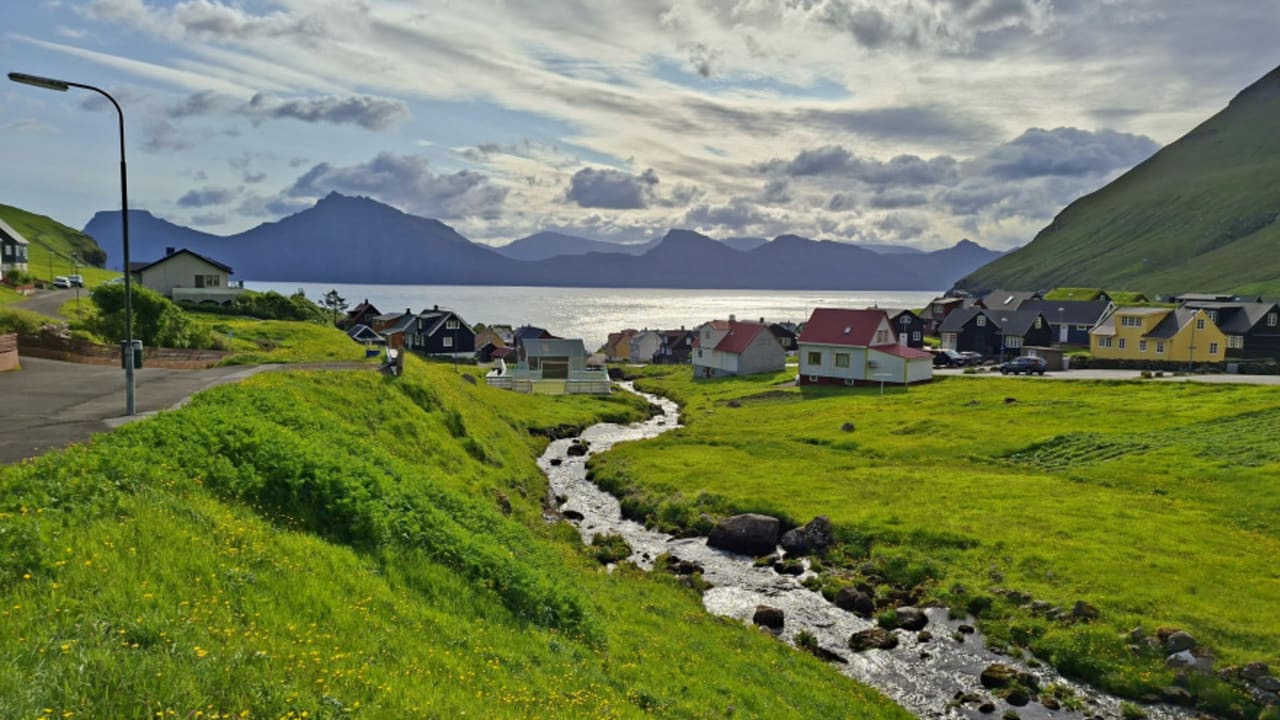
The plane taking off from Copenhagen bound for the Faroe Islands should already have landed according to the scheduled flight time. But we did not understand its true location. In fact, we saw nothing. We were flying inside an endless cloud. Suddenly, the flying iron bird began to shake from side to side as if it were a piece of paper, and a momentary tear in the cloud revealed countless hills painted green, very green. Hills that we flew so close to that it seemed we would crash into them at any moment. A second before we could scream in terror, the plane's wheels touched down on the wet and foggy runway, to the applause of the passengers, most of them locals. We landed in the Faroe Islands, literally and figuratively. Because that moment, which lasted just a few seconds, demonstrated to us the ironclad rule of the island: The weather is master. And no matter how much you plan, or think you are in control of the situation, it will have the last laugh.
When Nature Decides the Rules
The Faroese, as the island's residents are called, often say that all four seasons change every day in the Faroes. That is three-quarters true, because in the current season - also referred to there as summer - the average temperature does not rise above 15 degrees Celsius. The more accurate part of the statement is the constant changes in the weather, which led me to think. To rethink myself as an experienced traveler. Instead of making detailed plans in advance, as is customary with us, in the Faroes you need to prepare a wishlist of destinations, wait for a few reasonable hours in terms of the weather, and simply charge at the hills. From moment to moment. It is not simple, but there are two mitigating facts.
First, in the summer, the sun almost never sets. Which means, endless daylight hours that also allow for staying in place in the middle of the day. One can always travel in the evening as well. Second fact: It is simply one of the most beautiful places in the world. And I have seen the world. A breathtaking combination of tremendous cliffs dropping sharply into the ocean, endless hills painted bright green, and bluish fjords cutting through the land in a variety of shapes and shades. Countless waterfalls, some pouring with a mighty stream directly into the sea. A truly crazy variety of birds, especially sea birds. And above all, a basic feeling of the end of the world hovering overhead. With all the serenity, detachment, and connection to nature entailed.
A Paradise of 18 Islands - and Only 50,000 People
And nature, as you have already gathered, is the main event. But at the end of a 10-day trip to the Faroe Islands, we fell in love with the place for additional reasons as well. First of all, a little background. The Faroe Islands consist of 18 islands located in the North Atlantic Ocean, between Norway and Iceland. All of them, except one, are inhabited, with a total population of only about 50,000 residents. The Faroe Islands are an autonomous territory of Denmark, granted to them in 1948, and conduct themselves independently except in matters of foreign policy and defense. The islanders have been split among themselves for decades over the question of whether to demand full independence, and this is the core political issue in the Faroes. The capital of the islands is Torshavn, located geographically on one of the central islands, and home to about 15,000 residents. The second-largest city is Klaksvik, numbering about 7,000 people. Soccer fans will certainly recognize the names, and in general will know the name Faroe Islands from matches against the Israeli national team. And this is the place to clarify that soccer is almost an official religion on the islands. In every remote village, and most settlements in the Faroes fit that description, you will find a church and a soccer pitch.
And speaking of religion, the proportion of devout Christians in the population is very high. This is reflected, for example, in large families - sometimes with seven or eight children per family; in conservative views - until 1980, for instance, there was a ban on producing beverages with more than 2.7% alcohol; and also in an open and surprising love, at this time, for the few Israelis who come to visit. We encountered only warm responses, sometimes in the form of tight hugs, and almost every local we met spoke of his visits - in the plural - to Israel.

At the southernmost point, on the southernmost island in the Faroes, Suduroy, stands a tall and impressive lighthouse. At the end of a visit there, as I walked back to the car, a man in his 50s suddenly popped up in front of me and took my breath away. The place looked completely deserted and isolated, and he came out of nowhere. In the conversation that developed, I discovered his name is Sami, he lives in Sumba, the nearby village, and is on his regular evening walk. About two kilometers in each direction. Sami was born, raised, and will probably spend the rest of his life in Sumba, a settlement of 250 people that the phrase "end of the world" understates. In the summer, he makes a living painting houses - a common occupation on the islands. All the houses are painted in bright colors, and the hardships of the weather require repainting every year anew. "And what about the winter?" I asked. He smiled and said, "I'll manage." And adds that in winter people do not leave the house much anyway.
The End of the World Is Struggling to Keep Its Young People
That is how it is, in a season that has barely six hours of daylight a day. And even then, it is not exactly the bright light that Naomi Shemer wrote poetry about. The charming Sami, who had just arrived from a funeral in the village where the priest spoke of the miracle of Jesus walking on water and was moved by the sight of photos of the Sea of Galilee that we showed him, is not leaving the island. But many others are, mainly to Denmark. It is hard to keep young people in such an isolated place, with so few employment and entertainment options, and similar challenges. Especially in the internet era, which shows you in real time what you are missing (and the internet in the Faroes is excellent, just like all the digital services. It is almost impossible to pay with cash).

On another island, further north, in a village we stopped at by chance, we met 26-year-old Jans, wearing a leather jacket and fashionable glasses. He showed us the family home, which has been preserved over hundreds of years. And he recounted that he lives in Denmark with his wife, originally Faroese, who refuses to hear about returning to the islands. He actually wants to. But as a young banker, he does not have much to do there. And therefore he was forced to leave, similar to everyone who studied with him in the regional high school. The primary source of employment in the Faroes has been and remains fishing of all kinds (their salmon is considered among the best in the world), alongside sheep farming. And more modern professions have been developing only in recent decades.
The capital Torshavn manages to surprise in this sense. It has a university, art galleries, music festivals, excellent restaurants, including one holding a Michelin star, and neighborhoods of villas and BMW vehicles. But when we went to the open stage for musicians, held once a week in a sweet little club in the city, only two local artists registered to perform. And half of the audience, which numbered just a few dozen, were tourists. Because in the end, it is a small place. Very small. And also isolated. The shortest flight, and therefore the most common, is to Copenhagen. About two and a half hours. It is no wonder that the departure of young people is one of the issues that troubles island residents the most.

Between Tradition and Change: The Faroese Identity Crisis
Another burning topic, which is also connected to the generational gap, is the attitude toward whales. Historically, the Faroese used to hunt the marine mammal in large quantities, out of a real survival need. The hunting expeditions, in which almost all residents participated, became an integral part of the local culture. Hunters would drive entire pods of whales toward the shore, where locals awaited them, including women and children, who beat them to death with sticks. But in recent decades, as the need for hunting has decreased and pressure from international animal protection organizations has increased, the whale hunting that still occurs casts a heavy stain on the islands' image in the world.
Although quotas have been significantly restricted, veteran Faroese still view whale hunting as an integral, and legitimate, part of their existence. It is very easy to be shocked by the difficult sights of the sea turned red with the blood of whales. But visiting the islands also illustrates the basic value that justifies the continuation of the hunt for some of their residents - the value of survival. When you grow up on an isolated, rocky, and windswept island, where if you do not hunt you will not survive, Western ideals of this kind are perceived by you as a luxury, and even as a provoking challenge.

The Tunnels That Are Changing Life in the Middle of the Ocean
Which connects, literally and figuratively, to another critical element in Faroese life: The tunnels. Starting in the 1980s, subsea tunnels connecting the islands have been paved. In one of them there is even a roundabout. The feeling is crazy - you drive in the middle of the ocean, and need to choose whether to turn to the right island or the left island. These tunnels, alongside dozens of tunnels dug inside the mountains that connect isolated villages, are greatly changing the local ethos. They release the total dependence on the weather that prevailed as long as the only transit option was on the sea, and also turn the Faroe Islands into a single unit that is much easier to navigate within. Which enables, for example, developing the capital Torshavn as an employment center reached from additional islands. And still, when we consulted with a local guy regarding a certain driving route in the area, he recommended that we avoid it during the morning hours because of the rush hour. We ignored the recommendation, and I counted exactly seven cars on the way to the capital city.

A Hidden Paradise - Beautiful, Isolated, and Not for Everyone
This was and remains one of the magical secrets of a visit to the Faroe Islands - the glorious solitude. Even at the most famous sites you find yourself alongside only a few tourists. The remoteness, the unpredictable weather, and the prices (which are almost identical to Israel's high standard of living), and the fact that it is a destination offering mostly wild nature, keep the Faroe Islands off the global tourism map. To balance the array of difficulties and challenges, it is mandatory to note that the roads are excellent; that the guesthouses and bed-and-breakfasts we stayed in were all charming and well equipped; that most of the locals we met were exceptionally friendly; and that the extraordinary beauty combined with the serenity of the end of the world produce a trip that resembles almost nothing else. It is not suitable for everyone, really not. But for those it is, a lifetime experience awaits.