
There is an Italian expression that is hard not to fall in love with: Dolce far niente – "the sweetness of doing nothing." But contrary to what one might think, Italians do not mean laziness or idleness. It is almost an art: Sitting in front of a beautiful view, drinking good coffee without checking the time every two minutes, opening a bottle of wine in the middle of the day, and simply being there.
Ahead of the summer vacation, we decided to test the theory in the place where it feels most natural – Italy. After visiting the southern part of the country last time, around Naples, Sorrento, and Positano, this time we turned north to one of the regions most identified with the Italian dream – Tuscany.
Seven days, a rental car, two countryside hotels, several towns that look as if they came off a postcard, and a great many stops along the way just to say: "Wait, we have to take a picture of this."
The feeling changed as soon as we left the airport in Rome. We picked up the car, headed north toward Tuscany, and with one push of a button on the radio found a station broadcasting hits from the '70s and '80s. When Tears for Fears' "Shout" began playing in the background while the road passed between vineyards and fields, there was a fairly clear feeling: Sometimes you really do not need much more than this.
First hotel: Three days of quiet, vineyards, and a pool that saves the summer
We chose to spend the first three days at Villa Curina Resort, an isolated country estate in the heart of fields and vineyards near the small town of Castelnuovo Berardenga.

This is precisely the kind of place you come to in order to slow down. The hotel is designed in a rustic style, the rooms are large and spacious, the breakfast is pleasant, and the service is personal. But the real highlight is the pool – especially in August, when the temperatures serve as a reminder that even in Italy, summer is not playing around.
We spent quite a few hours there.
The great advantage of these types of hotels in Tuscany is that they allow you not just to "tour," but also simply to be. To sit with a book, look at the view, drink something cold, and realize that perhaps this was precisely the Italians' intention in the first place.
Simple food, great wine, and unforgettable views
After the first night, it was time to start exploring the region. We ate our first lunch at Pizzeria Osteria Bella Napoli, a small family restaurant in the town of Ponte a Bozzone.
This is not a place that tries to impress through culinary tricks. There are no dishes served with five-minute explanations, and there is no need for a dictionary to understand the menu. There is a family cooking simple, fresh, and delicious Italian food – exactly as one imagines.
And of course, one cannot visit Tuscany without visiting a winery.

Our choice was Castello di Ama, an impressive winery located atop a hill overlooking one of the most beautiful views in the area. We sat in the visitors' center, sampled local white and red wine, looked at the surrounding vineyards, and understood why people come here from all over the world.
Two glasses of wine cost just €22.
The view? Completely free.

A dinner that looks like an Italian movie
In the evening we drove to La Certosa di Maggiano, a restaurant located outside Siena in a spot that looks as though it was built specifically for an Italian movie.
The ancient structure, green gardens, soft lighting, and surrounding quiet create a feeling that you are not in a restaurant, but inside a scene. We sat in a room that looked more like the living room of a wealthy Italian family than a restaurant space.
The food is excellent, the service meticulous, and the atmosphere magical. While the price is higher than that of a small family restaurant, sometimes you do not pay only for the plate – but also for the story around it.

Montepulciano: The place we did not want to leave
If there is one town that must not be missed in Tuscany, for us it is Montepulciano.
The ancient town, built on a hill, combines stone alleys, small squares, cafes, shops, and wineries. It is almost excessively beautiful – the kind of place where every turn in the street makes you stop, pull out your phone, and take a picture.
Important to know: You cannot enter the town by car, so it is advisable to park in one of the lots outside the walls and continue on foot.
Yes, there are uphills.
Yes, in August it is hot.
But after a few minutes, you realize this is precisely the right way to experience it.
We spent several hours there, and honestly – it was hard to leave.

Siena is beautiful, but...
After a few days of villages, vineyards, and quiet, it was time to visit one of Tuscany's most famous cities – Siena.
The old city is certainly impressive. It is built on three hills, surrounded by ancient walls, and at its center lies Piazza del Campo – one of the most beautiful squares in Italy. Narrow alleys lined with cafes, restaurants, and small shops branch out from it.
However, here we also discovered one of the most important things about traveling in Tuscany: Sometimes the most famous places are not necessarily those that are the most exciting. Siena is very beautiful, but as happens in many tourist cities, the crowds somewhat detract from the magic. After a few hours of wandering, we felt we had had our fill.
Our recommendation: Come, see, enjoy – but leave enough time for the smaller towns, where the real Tuscany is still hiding.

Three nights at a hotel with a spa, in a place where time stands still
After the first three nights, we moved to the Palazzo San Lorenzo Hotel and Spa in the town of Colle di Val d'Elsa.
This was an interesting change of pace: Less of a small country estate and more of a large, pampering hotel. The breakfast was varied, the service efficient, and the rooms comfortable, but the property's main advantage is the spa.
After a day of walking through ancient alleys in the Italian heat of August, there are not many things better than getting into a cool pool, sitting in the sauna, and remembering that resting is also part of the trip.

San Gimignano and Monteriggioni: Two mandatory stops
The next day was dedicated to two towns that appear on almost every list of "must-sees in Tuscany" – and rightly so.
The first was San Gimignano, one of the most picturesque and famous towns in the region. Its medieval towers, ancient walls, and narrow streets create a feeling as if someone pressed a pause button centuries ago.
Even though it is a very touristy place, the magic is still there. It is worth arriving relatively early, walking through the alleys before the crowds arrive, and sitting in one of the restaurants with a panoramic view.
We chose Bel Soggiorno, a restaurant with one of the most beautiful viewpoints in the region. Sometimes the view that comes with the dish is almost as important as the dish itself.
From there we continued to Monteriggioni – a small, fortified village that looks as if it was taken out of a fairytale book.
The entire village is surrounded by walls, containing a few stone streets, a small central square, and cafes where you can simply sit and stare. This is the kind of place where you do not need a special attraction – being there is the attraction itself. You can also go up on the village walls and walk along the viewpoint for a few euros. Recommended.

A meal of a lifetime
We saved the evening before our last day in Italy for something truly special – Arnolfo, a two-Michelin-starred restaurant in the town of Colle di Val d'Elsa. This was no longer just another good Italian meal, but an experience in its own right.
Dishes that looked more like works of art than food emerged from the open kitchen. Every detail was calculated – the ingredients, the presentation, the service, and the pace at which the evening unfolded.
A large team of chefs worked in the kitchen, each with a precise role – from the sauces to the final plating before the dish went out to the guests.
Toward the end of the evening, Chef Gaetano Trovato came out to the diners, spoke with them, and shook hands.
It was a small gesture, but one that fits the Italian spirit perfectly – great professionalism alongside humanity.
It was one of the most impressive meals we have experienced.
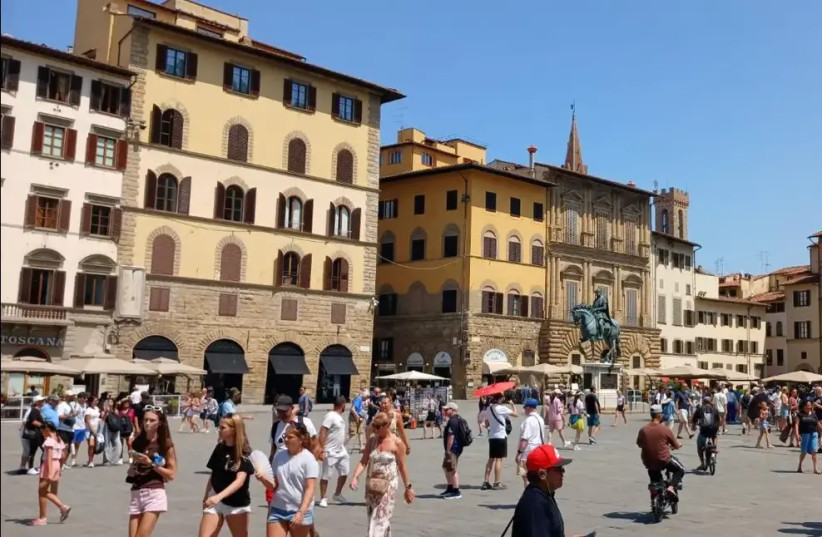
Florence? Maybe another time
On the last day, we decided to finish in a big city – Florence.
The city, of course, is full of treasures: Art, historic buildings, museums, and some of the most beautiful architecture in the world. But our visit came after several quiet days in villages and towns, making the transition too sharp.
The heavy heat and large number of tourists made wandering through the city less enjoyable for us. After just a few hours, we returned to the car.
Our conclusion: If you have limited time in Tuscany, it is better to spend it on the small towns, vineyards, and country roads. That is where the real magic lies.

So what should you really not miss?
After a week in Tuscany, our recommendations are quite clear: Montepulciano, San Gimignano, and Monteriggioni are mandatory stops.
Siena is worth a visit, but is a lower priority. Florence, despite its greatness, is perhaps better suited for a separate city trip.
And above all – do not rush to check off every location.
In Tuscany, it is precisely the slow drives, the unplanned stops, and sitting in front of a view with a glass of wine that form part of the experience.
Ultimately, we drove more than 1,000 km. between vineyards, olive trees, and cypresses, ate excellent food, slept in special places, and above all managed to do the thing that Italians are so good at: Slowing down.
Or as they say in Italy: Dolce far niente.