
For three and a half years, Boaz Yosef, CEO of the Population and Immigration Authority, headed the appointed committee in Tiberias. This happened after the colorful and controversial mayor, Ron Kobi, was ousted from his position. At the end of a term in which he succeeded in rehabilitating the damages from long years of failed management, Yosef sought to run in the mayoral elections, which were scheduled to be held in October 2023.
However, according to the law, a member of an appointed committee cannot run for mayor of the city in which they served, except after a three–year cooling–off period. In order to legitimize his run for office, the "Tiberias Law" was enacted, which canceled the cooling–off period and was supposed to pave his path to the mayor's office. However, a petition submitted to the High Court of Justice by a number of civil society organizations and a female candidate for the mayoral position thwarted the plan, which was aggressively promoted by Aryeh Deri and Shas. The judges ruled that the law would only apply to the next elections, leaving Yosef out of the race.
Anyone who thinks the former chairman of the appointed committee mourned the missed opportunity is mistaken. "I was called up to the Torah at the synagogue on Shabbat and recited the 'Hagomel' blessing," he surprises. "Being a mayor is a very difficult chore. I did it out of a sense of mission, and when it didn't happen, a stone rolled off my heart. I wanted to finish a few things we started in Tiberias, but I left detailed development plans that just need to be executed. I do not intend to run and compete in the future, because I have no passion to be a mayor."
In January 2024, he competed for the position of CEO of the National Insurance Institute, and was even recommended for the role, but his candidacy was not approved. In March of that year, he was appointed chairman of the Northern District Planning and Building Committee, where he still serves today, until a replacement is appointed for him, and in September 2025, he was appointed acting CEO of the Population and Immigration Authority. Half a year later, he was permanently elected to the position, and today he heads one of the largest and most influential government authorities in Israel.

"We Want to Create Competition"
Since October 7, the foreign workers sector has been undergoing a structural upheaval that affects the employment market and immigration policy into Israel. Following the Hamas attack and the government's decision to almost completely freeze the entry of approximately 80 thousand Palestinian workers, alongside the immediate departure of thousands of foreign workers who returned to their home countries due to the security situation, the construction and agriculture sectors fell into an unprecedented functional crisis.
To prevent a collapse, the government adopted an emergency policy, which included raising the ceiling of the permitted foreign workers quota to approximately 336 thousand, more than double the situation prior to the war. This step led to the number of foreigners actually staying in Israel crossing a historic threshold of 200 thousand workers. However, the implementation of the policy encountered complex bureaucratic and logistical difficulties, which slowed the pace of the economy's recovery.
In mid–April 2026, State Comptroller Matanyahu Engelman published a report reviewing government activity from January 2024 until mid–2025. The report determined that the dramatic leap in quotas was approved without organized staff work, without examining the long–term implications, and while creating a growing dependence on foreign labor. While the agriculture sector managed to partially stabilize its ranks through the return of workers from Thailand, the construction sector remained bleeding.
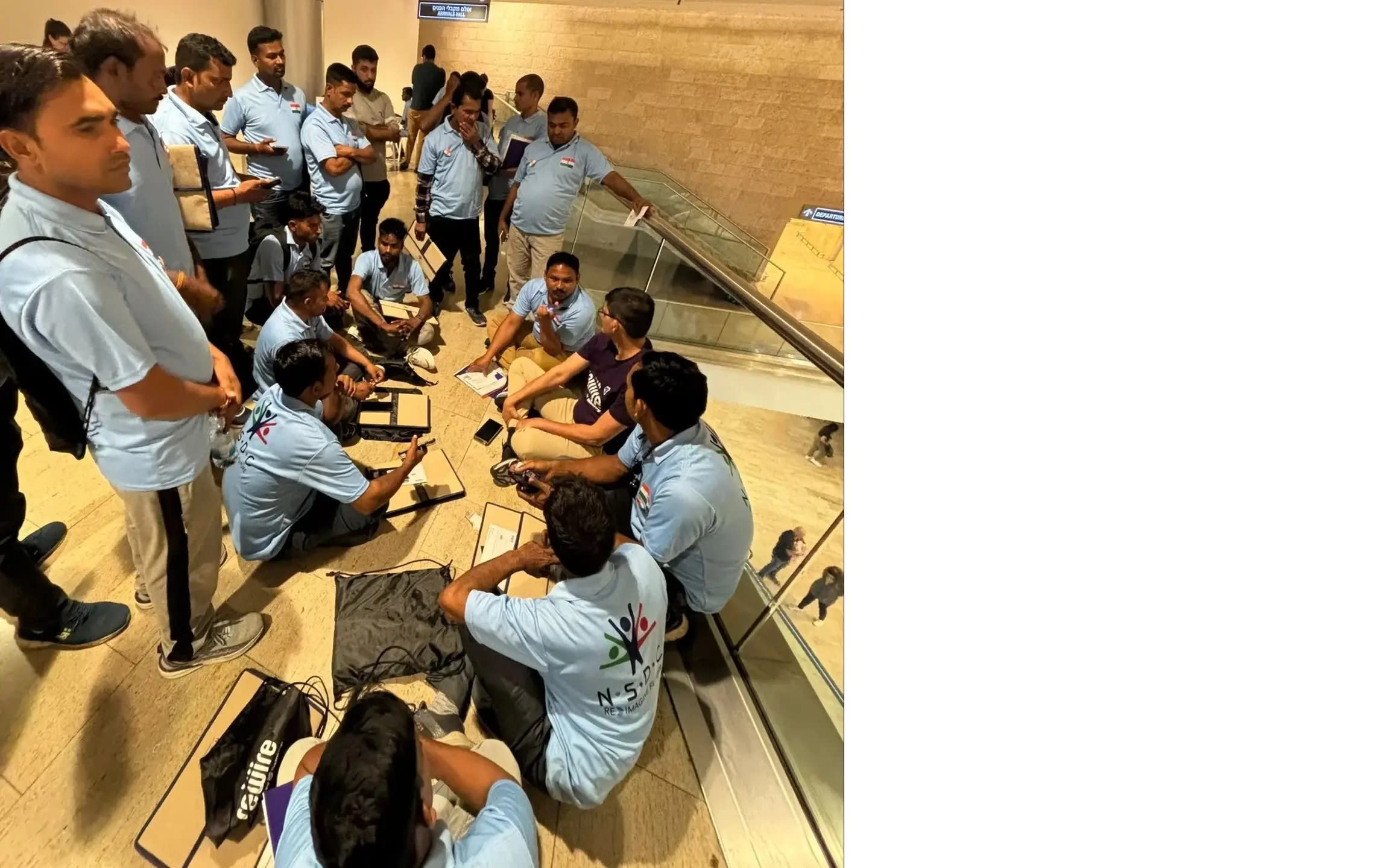
The attempts to replace the Palestinian working hands with workers from countries like India, Sri Lanka, Uzbekistan, and Moldova proceeded very slowly, illustrating the gap between government decisions and the ability to implement them on the ground.
One of the central claims heard in the sector is that the G2G route (a route under which foreign workers are recruited through agreements between countries) did not provide the desired results. Many contractors and manpower corporations claim that some of the workers who arrived through this route do not possess the professional skill required for work in the construction sector, something that harms productivity and slows down the pace of work at sites.
Concurrently, criticism is being voiced that some of the workers who arrived in Israel were actually reassigned to other sectors, while the state continues to suffer from a severe shortage of manpower in the construction sector. According to sources in the sector, the gap between the data on paper and the situation on the ground complicates recovery, and delays the return to the work pace required to meet the high demand for housing and infrastructure.
Yosef rejects the claims and says that the State of Israel is committed to upgraded bilateral agreements, which are intended to prevent human trafficking, and therefore it is committed to preferring the import of workers between countries over the import of workers privately. "The more agreements there are, the higher we rise in this ranking, whereas with private agreements there is also a concern regarding high brokerage fees along the way, over which we have no control."
Meanwhile, you are not succeeding in signing additional agreements. The agreement with Vietnam, for example.
"Our goal is to open as many agreements with as many countries as possible, in order to create competition. If a country closes its gates because of this or that war, or due to political considerations, we want to have more options. In construction, the majority are workers from China, and there is a need to open additional countries so as not to be dependent only on them."
Part of your failure in bringing workers to the construction sector, which began before your entry into office and continues today, is bringing unskilled workers for the purpose they are supposed to arrive here for. I previously published a case about a worker from India who urgently called his boss and complained that there was a problem with the shower in his residence. It turned out he thought the kitchen sink was the shower.
"We learn, draw conclusions, and search for professional workers. We found that in Vietnam there are workers who are no less good than the Chinese. There is nothing to be done, you cannot replace the Palestinians in one day. To say that we failed in bringing workers is incorrect. Before the war there were 140 thousand foreign workers here, and today there are 240 thousand. In the past, workers did not arrive at such a pace. When you are in a war and you bring in such a large quantity of workers all at once, it is clear that there are also mistakes. On the other hand, you cannot indulge yourself and be too picky, when there is such an acute need."
But it turned out that corporations paid money in advance for unsuitable workers and they were forced to transfer them to other sectors, and their quota was harmed because of a failure by the state. They could not bring other workers in their place.
"For unsuitable workers we look for another place of work, and whoever is not suitable for construction is simply not there. Regarding the quotas, we sat down with the employers and some of them were credited."
Another 100,000 foreign workers by 2027
One of the most painful points in the sector is the phenomenon of "runaways" – workers for whom high fees were paid and in whom many resources were invested, who disappear from their place of work shortly after their arrival in Israel and move to the unregulated labor market. The Population and Immigration Authority, through the immigration police, is supposed to locate them and return them to their country of origin, but this hardly happens. The number of inspectors is low and the phenomenon, which causes economic damage to both the corporation and the employer, is expanding.
"This phenomenon exists all over the world," Yosef cools down the tone. "They either work, in the best case, for another employer, or they work under the table. It happens that you bring a Chinese worker to construction under a specific corporation, and after a week or two months he says that the salary and the extra conditions are not enough for him and he can get NIS 500 per day, and he starts working under the table. There is a dedicated team that deals only with this and looks for them."
150 inspectors is not enough.
"And we will absorb another 120, some of whom have already been absorbed. There is a price you have to pay. 45 thousand illegal workers are currently in Israel, and they will not stay here. On the other hand, remember that they also contribute to the economy. Each of them does not constitute a burden on us, unlike asylum seekers, for example, from Eritrea and Sudan. These are foreign workers, runaways indeed, but not those who sit back with their legs crossed."
Sources well–versed in the details say that there is a significant gap between the decisions made in Jerusalem and the reality in the various sectors. One of them told us this week: "They continue to approve bringing additional foreign workers, foreign executing companies, and new quotas when thousands of foreign workers are in Israel without full regulation – those who were abandoned by the system or who moved to work in the unregulated market, and many workers who are not employed in the sector they arrived for.
"Instead of continuing to bring more and more workers from abroad, why not perform an organized mapping of the workers who are already here, examine regulation options, and match them to the sectors where there is a real shortage?". By the way, in the past, the Histadrut offered to assist in sorting, training, and referring workers to workplaces according to their skills. The offer encountered a refusal.
Boaz, have you done a re–evaluation on whether it is even necessary to import so many foreign workers here? After all, there are workers here who can be trained. Why enter the "revolving door" saga again?
"The target for this moment is to reach approximately 330,000 foreign workers, and this is even before the addition intended for the construction of the Metro. Another 100,000 workers by 2027, plus another 26,000 dedicated workers for the Metro, where there will be a directorate that will employ them under our close supervision."
These numbers illustrate the scope of the strategic change that the foreign workers sector in Israel is undergoing. Today, approximately 225 authorized manpower corporations operate in the construction sector, each of which has the capacity to employ between hundreds to approximately 1,000 foreign workers. In addition, 11 foreign executing companies operate, each of which is permitted to employ approximately 1,000 workers. These data refer to the construction sector alone and do not include the renovations and infrastructure sectors.
Concurrently, the state is promoting the arrival of approximately 24 thousand additional workers for the Metro project, which is defined as a national project.
As part of the preparation for the project, demands are heard to again allow the direct employment of workers by large contractors, even though this model previously aroused severe criticism and led to the establishment of the corporation mechanism, which was designed to ensure supervision, safeguarding of workers' rights, and prevention of centralization. The concern in the sector is that some of the large contractors, who already hold corporations of their own, will further strengthen their power in the market, and the fragile balance that the sector reached in recent years will be broken.
"There Are Not Enough Workers"
A sharp debate is also taking place around the foreign executing companies. The Ministry of Housing is promoting a significant expansion of the model, and there are even initiatives heard to bring dozens of additional executing companies. Unlike a foreign worker who is employed through a manpower corporation, an executing company arrives as a complete unit, with workers, managers, equipment, and sometimes also additional professionals.
The meaning is that this is not just about bringing construction workers. Such a move has broad implications for the Israeli economy, for the local labor market, and for professionals along the production chain, including engineers, practical engineers, foremen, suppliers, and service providers. Critics warn that expanding the model could increase dependence on labor from abroad and harm Israeli professionals.
To this criticism, Yosef replies: "This is a government decision, we only bring them. There was great pressure regarding the construction issue, prices soared and it was necessary to flood the market with workers. Therefore, there was a thought to bring executing companies whose outputs are higher, who work together. It must be emphasized that we do not bring experts. If out of a thousand workers there are three foremen, that is part of the team, but there is no Israeli construction engineer who will be unemployed because of this. There are also no local authorities in the country reporting an architect or an engineer who has no work. There are simply not enough workers in the field."
And what will be the model in the Metro? Government against government?
"Since this is professional work, the representatives of the Ministry of Labor will examine and bring all the dedicated manpower. It will be governmental, but with an option of choice."
You are insisting on a model that failed. The private route proved itself in importing workers who fit their professional designation.
"In agriculture, did this model fail? No. In nursing care and restaurants? No."
In construction, yes.
"We are talking about a very few. If there are a thousand Indians who arrived in one batch, you cannot say it is a failure. If you bring only through the private route, you drop in the human trafficking ranking, and then Israel will be considered a backward country. We balance between the forms of transfer. Out of 240 thousand workers, there could be ten extreme cases that become a tool for head–butting. In any case, whatever we bring, there will always be a certain percentage who will not be satisfied with it."
Why do you collect high fees from the corporations for construction, agriculture, and nursing care, which are vital professions for the economy?
"In this case I am not asked, it is in the Ministry of Finance. Just like I do not complain about them collecting 35% income tax from me. I am not the address and the money does not transfer to us. But let's talk about other things. Let's talk about the passports."
Please. People are still waiting months for an appointment. You did not succeed in overcoming the gap from COVID–19.
"This is actually divided between the center of the country and the rest of the state. In the center of the country there are long lines, because there are more residents. In the north and south it is shorter. Every person needs to know when their passport expires, let everyone set a reminder for themselves to renew a passport, there is no need to arrive at the 90th minute. If you set an appointment in advance, then you shouldn't care about waiting even three months. We are currently working on a number of solutions simultaneously, in order to reduce the lines. We are adding digitization, where the goal is that you will be able to renew a passport from home, fill out the forms from home, and photograph yourself from home."
Why hasn't this happened until today? The technology exists, after all.
"But we are dependent on approvals due to information security matters, and we will overcome them. Concurrently, we have digital stations for self–issuance of passports. There are clients who utilize them, and in addition we plan to open two additional offices in the center that will be digital only, with dozens of stations that will be open from eight in the morning until ten at night and there will be no public reception there. Something similar to a digital branch of a bank. We are looking for a place in the center of the country, like a mall, with available parking and foot traffic. In addition, we also opened two dedicated offices for issuing visas."
You are working without a serving Minister of Interior.
"It is not simple. There are matters, like signing authority or a certain validity extension, that are under the authority of a minister only, and you need to transfer authority to the Prime Minister, with the approval of the government and the Knesset, which complicates processes."