
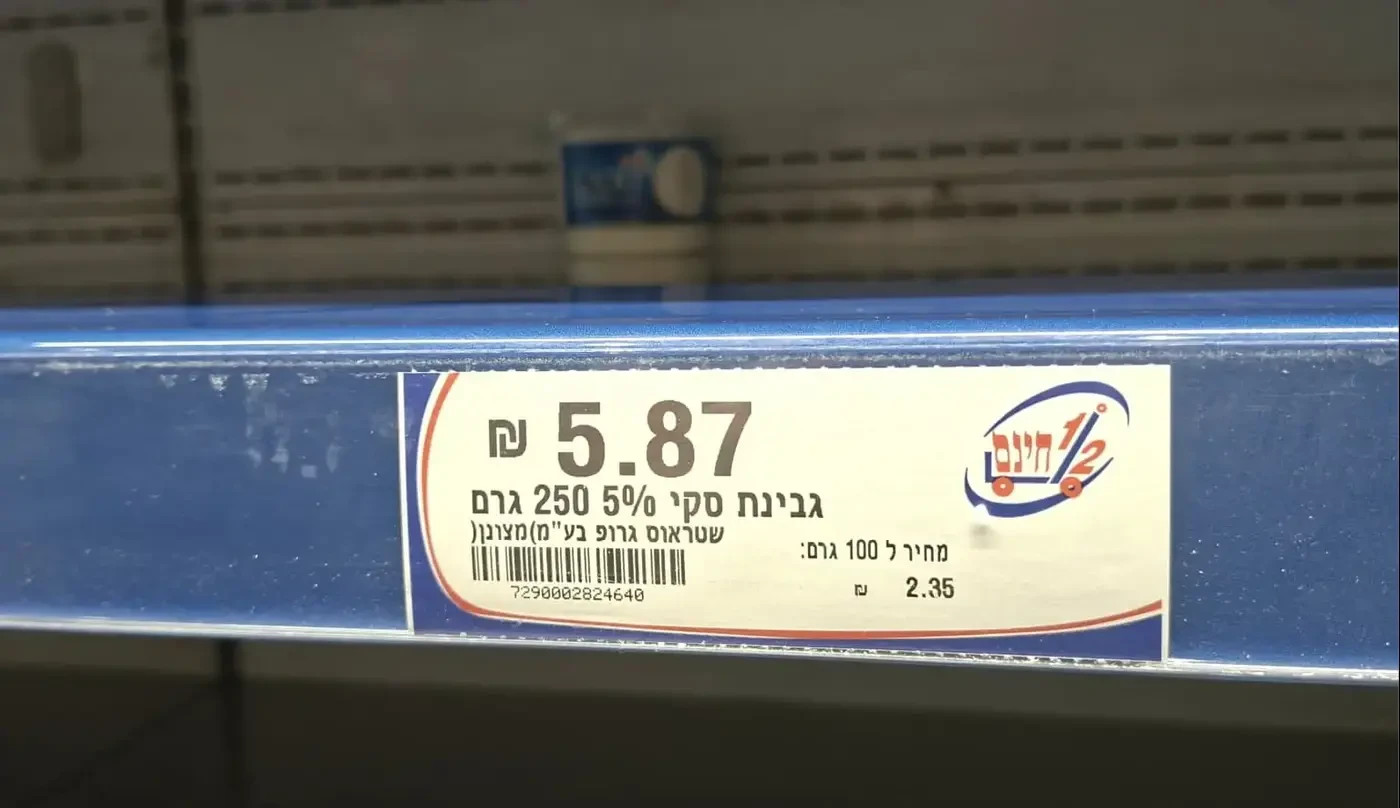
Customers entering retail chains in recent days discovered that the shelves usually holding cottage cheese and white cheese look completely different. Instead of the familiar plastic tubs, there lay packages of labneh, sour cream, and other dairy products to fill the void left behind. We have almost grown accustomed to the cottage cheese shortage, which can barely be found. Now, however, the dairy supply crisis is expanding to the white cheese category.
While until a few days ago it was difficult to find mostly cottage cheese, in recent days the phenomenon has expanded to white cheese shelves as well. "I was at branches of three different chains we have in the neighborhood," a frustrated consumer told Walla, "and not a single one of them had even one tub of white cheese. And I am not talking about price-controlled cheese, but 9% white cheese, 3%, even smooth and low-fat cheeses and creams that reach a price of NIS 15, you cannot find. Someone here has gone crazy. How did we get to a state where you cannot give a child a sandwich with white cheese, and nobody cares."
Food market sources explain that the shortage of white cheese stems from the shortage of cottage cheese, with one eating into the other. "The cottage cheese shortage started weeks ago, and it is getting worse," he says. "Retailers order 10 crates and receive barely half a crate, and in peripheral areas they sometimes make do with only one tub, which is inconceivable.
"When there is no cottage cheese, the public switches to white cheese and starts hoarding at home, creating a shortage due to heavy demand. This is an escalating tailspin that must be stopped. I do not understand where the agriculture minister, the economy minister, the finance minister, or any regulator is to address this matter already. If there is no choice, then please, open quotas and start importing."
The Germans try to assist via Zoom
The root of the white cheese panic begins, as mentioned, with a computer malfunction at Tnuva's cottage cheese production plant in Alon Tavor.
The problem is not in the production line, but in the automated warehouse that is supposed to dispatch the pallets to the distribution trucks. The cottage cheese is produced, packaged, and ready for marketing, but a large portion of it simply fails to leave the dairy and reach the shelves of retail chains.
According to sources familiar with the details, disruptions in the automated warehouse system have been ongoing for over two months. It is a system that manages the movement of pallets inside the warehouse and their dispatch to trucks.
However, it turns out that technicians from the German company Dematic actually arrived in Israel in recent weeks for a scheduled maintenance visit at the Osem plant. So why didn't they stop by Tnuva as well? According to them, it is a different team, with different skills, whose visit dates are scheduled months in advance. The visit that was supposed to take place at Tnuva during Operation Lion's Roar was canceled following the war. The next date is set only for a few months from now, and its occurrence also depends on the geopolitical situation.
Meanwhile, Dematic personnel are trying to assist Tnuva teams remotely via phone calls and Zoom, and at the same time, Tnuva employees are operating some of the systems manually. This is a limited solution that does not allow a return to the normal rate of supply.
At the same time, since the beginning of the year, demand for dairy products has risen by about 4%, partly because fewer Israelis traveled abroad due to the security situation. Dairies explain that the high demand and the gaps created since the Shavuot holiday make it difficult to replenish stocks, and therefore any logistical delay is immediately felt on the shelves.
In contrast to periods when there was suspicion of an artificial shortage due to the update of the target price mechanism, which affects all dairy product prices, this time it seems the situation is different.
"What interest could Tnuva have in not selling cottage cheese?"
The ongoing shortage also raised allegations against Tnuva, according to which it allegedly has an interest in creating an artificial cottage cheese shortage to increase demand for other dairy products it produces. The industry rejects these allegations completely.
"What interest could Tnuva have in not selling cottage cheese?" says a source familiar with the details. "After all, she makes money on every tub, and when the cottage cheese isn't sold, she loses. The company has nine plants across the country, and malfunctions can happen every day.
"This is a computer malfunction, and Dematic – the company that operates it – refuses to send a technician to Israel due to the security situation. Since the dairy is mostly automated, it is not possible to bypass the system manually, otherwise they would have done it long ago, so a situation has arisen where there is no problem producing the cottage cheese, it is just impossible to supply it."
The shortage is particularly noticeable because Tnuva is the largest white cheese producer in Israel, while Strauss holds about 30% of the market. Both companies are responsible for most of the white cheese sold in Israel, so any change in demand is felt almost immediately on retail chain shelves.
Tnuva and Strauss claim that white cheese production and supply are operating as usual and have even been boosted to meet the demand.