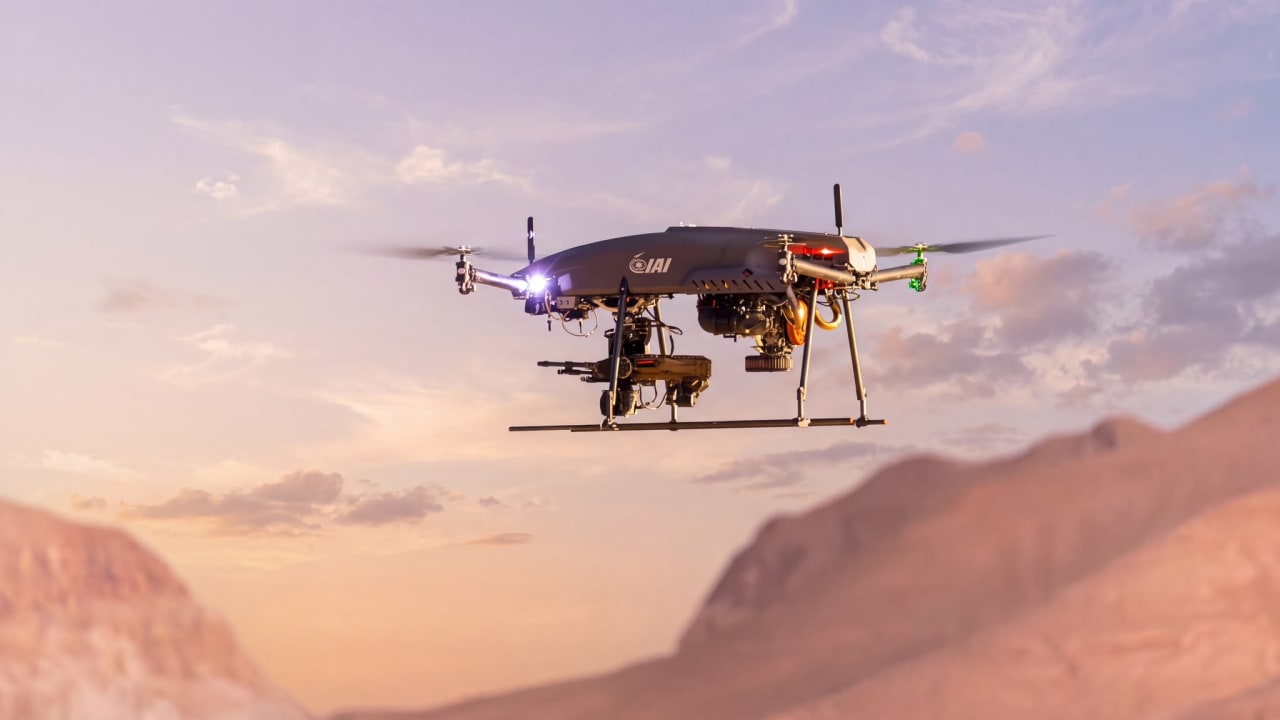
WASHINGTON - Israel Aerospace Industries (IAI) and SIG SAUER have completed a live‑fire demonstration of the FIRE STORM 250, the Apus 60 VTOL tactical unmanned aircraft equipped with SIG SAUER’s MICROLIGHT Remote Controlled Weapon Station (RCWS) and the new M250 machine gun.
Defense & Tech by The Jerusalem Post understands that the test, conducted ahead of the AUSA 2026 exhibition in Washington, took place in Israel and showed the platform’s ability to detect, identify, and engage targets while hovering over a simulated battlefield.
During the trial, the UAS loitered over the test area and used its onboard camera to identify targets before it fired in both single‑shot and semi‑automatic modes. Engagements were carried out from different altitudes and ranges to assess accuracy, stability, and safety under varied conditions.
While it is still a functional prototype, the companies said the live-fire test validated the system’s core concept of pairing airborne surveillance with stabilized, remotely controlled firepower to give small units organic close‑support capability.
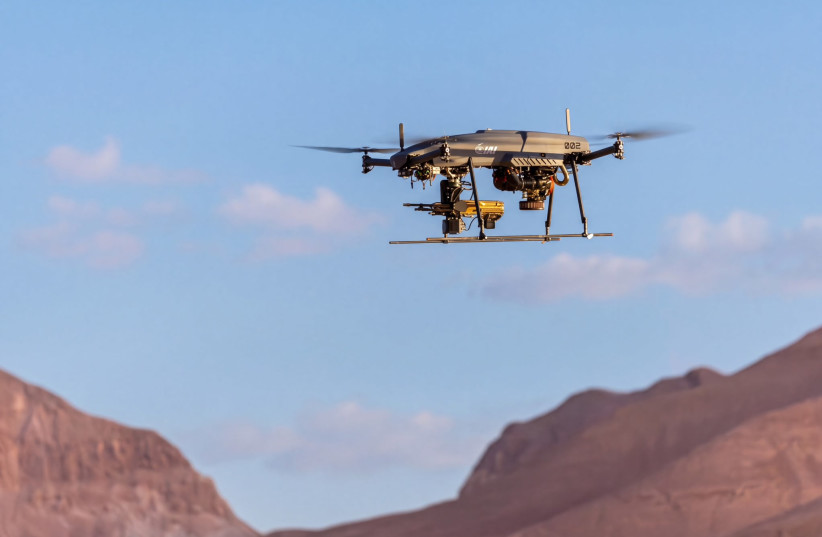
The FIRE STORM 250 is built for long‑duration overwatch and armed reconnaissance. Powered by a multi-fuel internal-combustion engine, it can remain airborne for up to three hours and be refueled in the field, avoiding battery‑charging delays and specialized logistics. Its vertical take-off and landing (VTOL) configuration allows launch and recovery from forward positions without runways or aviation support.
200 rounds at 200 meters
SIG SAUER’s M250 airborne light machine gun can be configured to carry 200 rounds of either 7.62×51 millimeters or 6.8×51 mm. ammunition, depending on customer requirements. It has a targeting range of 400-600 meters at an altitude of 200 m. The MICROLIGHT RCWS brings the system’s total combat weight to 53 pounds, including the gun and ammunition.
Sensor feeds and fire‑control data are fused into a single targeting picture, giving operators real‑time imagery, tracking information, and engagement options. Operators control the platform by using advanced control algorithms that maintain shooting accuracy even while hovering and moving.
“One of the most dangerous positions is in a turret, and the main idea is to keep the soldier out of the line of fire,” Mike Joslin, defense product manager at SIG SAUER, told D&T at AUSA. “Rather than the soldier holding the gun, he holds the interface that controls it.”
Nevertheless, the platform’s architecture keeps a human in the loop, with operators receiving real-time sensor imagery, target-tracking data and engagement options, and authorizing each use of fire.
Sali Okanin, SIG SAUER’s Israel general manager, said the test highlights how lightweight weapons can expand what small unmanned aircraft can do.
"FIRE STORM 250 brings together the most advanced technologies in the world, including IAI’s drone platform and SIG SAUER’s MICROLIGHT RCWS mounted with the M250 machine gun to deliver a new level of operational flexibility,” he said, adding that the platform has “greater range than legacy systems and weight savings that not only provide squad-level benefits but also make drone capabilities possible."
It is intended to be deployed with small tactical units and support missions including persistent overwatch, intelligence gathering, force protection, border defense and special‑operations surveillance.
Joslin explained to D&T that multiple FIRE STORM 250 aircraft can operate together to maintain continuous day‑night coverage, provide advance observation along movement routes, and support maneuvering forces during operations and extraction.
“Our concept of operations is that with the platform’s flight time, you can have loitering support with more en route to provide constant support,” he said.
Moshe Levy, executive vice president and head of IAI’s Military Aircraft Group, said the demonstration reflects a shift in how tactical unmanned systems are being designed.
“The next generation of unmanned systems will be defined not only by autonomy, but by how effectively they integrate sensing, decision-making and action within the operational environment,” he said.
“FIRE STORM 250 brings these capabilities into a single operational loop, enabling tactical forces to extend their reach and maintain continuous awareness while retaining human control over engagement decisions,” he added. “The firing test demonstrates the potential of this approach in a realistic operational scenario."
The future
The collaboration between IAI and SIG SAUER, one of the world’s largest weapons manufacturers, comes as it expands its line of unmanned aerial platforms.
“Drones are the future,” said Ryan Scott, director of Advanced Concepts at SIG SAUER.
Scott, a 22-year US Army Veteran with over a decade in unmanned systems with the Army, explained that the 250-year-old company has been investing in drone design and development for the past several years.
The company’s new direction “shows our innovative capabilities to support our troops.”
Along with FIRESTORM, SIG SAUER displayed its fixed-wing SCYTHE platform, the SABER quadcopter with the M-HORNET 22 LR payload attachment. It also displayed the prototype XRAY-9 counter-UAS platform.
According to Scott, “If Israel wanted our drones, we would sell them.”
Joslin echoed Scott’s feeling towards Israel, telling D&T that “there is no same amount of passion as Israel defense tech companies. Serving is embedded in the culture.”