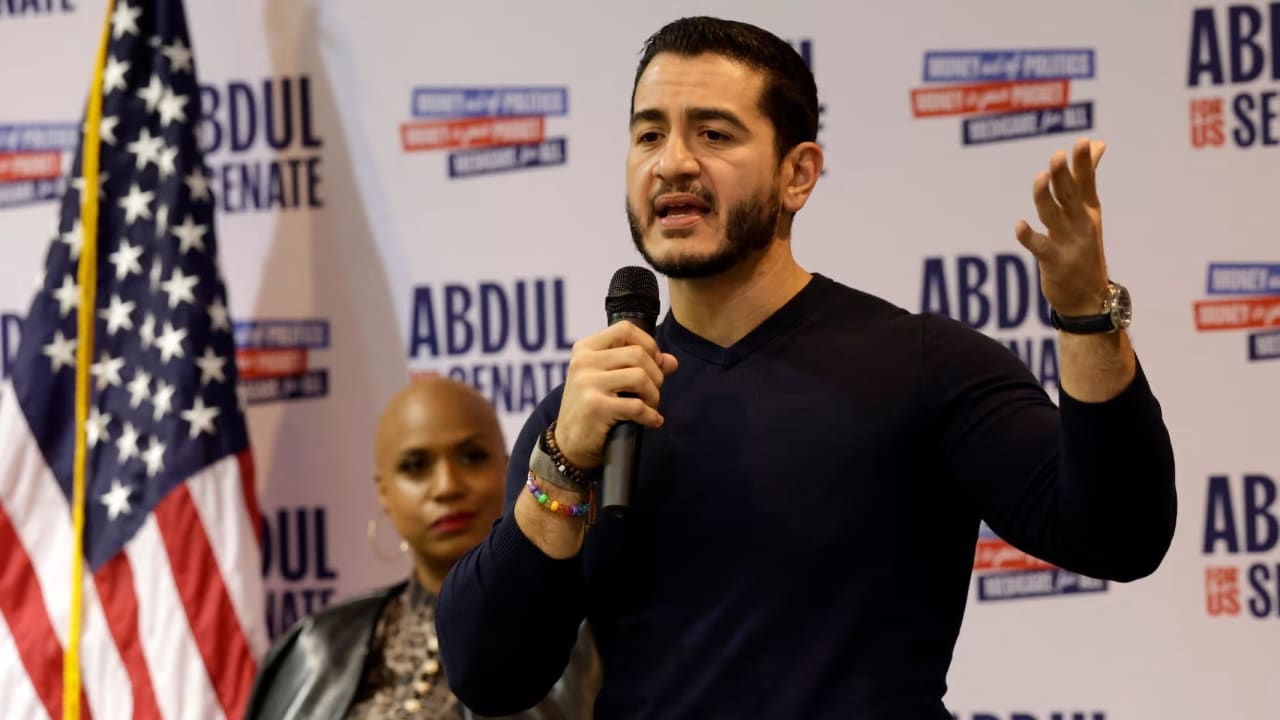
An 11th-hour public feud between Michigan Democratic US Senate candidate Abdul El-Sayed and his pro-Israel former primary rival is further exacerbating tensions between Jewish voters and the nominee ahead of Tuesday’s midterm elections.
US Rep. Haley Stevens, who narrowly lost the race for the Democratic nomination to El-Sayed this summer, had previously endorsed her former competitor and was set to join him at a rally Sunday in the crucial final days of campaigning. Michigan is locked in a tight race that could help determine which party controls the Senate.
Instead of a show of unity, Stevens is now forcefully criticizing El-Sayed for his recent criticism of Israel and for not condemning a PAC ad, made by an outside group to boost his campaign, that blamed Israel for rising grocery prices. El-Sayed has shot back, invoking Stevens’ close relationship with the pro-Israel lobby AIPAC.
Stevens, who represents a large Jewish district in suburban Detroit, unloaded on El-Sayed Friday in a series of interviews with The New York Times published early Saturday morning.
On social media Friday, Stevens said she expected El-Sayed to condemn the ad soon, paid for by Rebellion PAC, a project of far-left commentator Cenk Uygur. El-Sayed had earlier distanced himself from the ad but had not commented on its content.
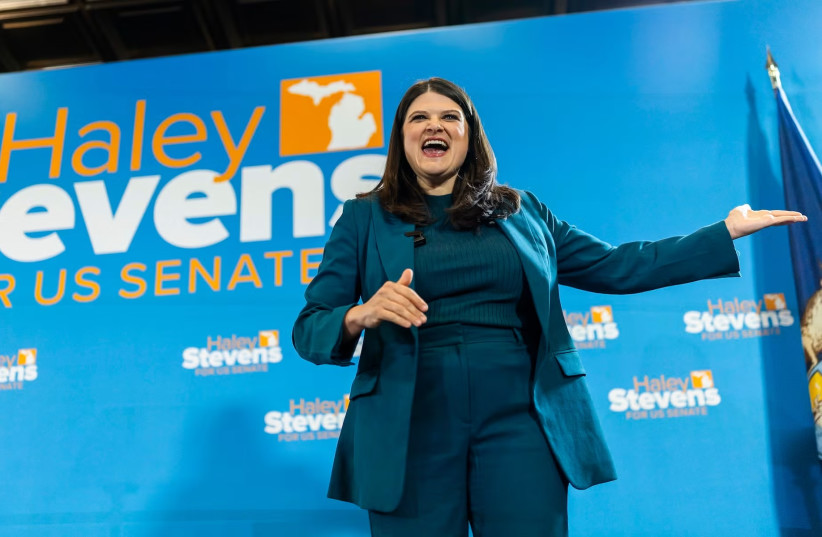
“We are not going to say that the cost of groceries is because of Jews and the Jewish state,” Stevens told the NYT, adding, “Maybe it is what you want people to believe.” She stopped short of formally rescinding her endorsement of El-Sayed.
Much of Democratic establishment coalesces behind El-Sayed
The feud comes at a moment when much of the Democratic establishment has coalesced behind El-Sayed in the key Senate race, even as deep concerns remain among many traditionally Democratic Jewish voters. Stevens’ fiancée, Jewish Democratic megadonor Jason Turkish, said this week he would vote for Republican nominee Mike Rogers. Stevens told the NYT she met with a rabbi before their wedding and is mulling converting to Judaism.
In a statement sent to the Jewish Telegraphic Agency and other outlets Friday, El-Sayed accused Stevens of “relitigating a primary that ended three months ago.” He also said he had already “defeated” spending “from outside corporations and AIPAC” on Stevens' behalf.
El-Sayed did not mention the Uygur ad, nor another ad - this one produced by his campaign - that featured a brief clip of far-right commentator and anti-Israel voice Tucker Carlson announcing he wouldn’t vote for Rogers. Stevens had publicly urged El-Sayed to take down the Carlson ad, which the campaign had aired on conservative TV channels.
The El-Sayed campaign has dropped Stevens’ name from its description of Sunday’s planned Detroit church event, which is now scheduled to feature Rep. Jim Clyburn of South Carolina. USA Today and other outlets have reported that El-Sayed’s campaign has asked Stevens to stay away from all future events.
Stevens and Turkish did not return a JTA request for comment.
In her social media statement Friday prior to El-Sayed’s response, Stevens had outlined Jewish constituent concerns about El-Sayed, noting that he himself has used rhetoric akin to blaming Michigan’s financial ills on Israel.
“The ad did not invent its argument; it dramatized one Dr. El-Sayed has made in his own words throughout this campaign: that Israel is the reason Michigan cannot afford schools, health care, and child care,” Stevens wrote. “Abdul promises to get money out of politics. He can begin by getting Israel out of his explanation for everything Michigan cannot afford.”
Both Turkish, in an earlier JTA interview from a Rogers event, and Stevens, to the NYT, said their final breaking point with El-Sayed came after a recent debate in which the nominee had declined to say whether Israel or Iran posed a bigger threat to the United States.
El-Sayed condemns Hasan Piker comments
El-Sayed on Friday did condemn a separate comment from anti-Israel streamer and former campaign ally Hasan Piker, who is Uygur’s nephew. In a stream this week, Piker had compared the heavily Jewish Detroit suburb of West Bloomfield to a “KKK neighborhood,” adding, “The supremacist attitude underlying their worldview is identical.”
In a statement to Jewish Insider about Piker’s comments, El-Sayed noted he grew up near West Bloomfield and stated, “Comparing Jewish Michiganders to the Ku Klux Klan is utterly inappropriate and flat-out wrong.”
Meanwhile, Republicans are jumping at the Jewish divide. Rogers, a former congressman, has seized on the intraparty feud to appeal to Jewish voters who had supported Stevens in the primary. Earlier this week, US President Donald Trump called Jews who back El-Sayed “crazy,” leading to condemnation from some Jewish leaders.