
When US president Franklin D. Roosevelt signed the Social Security Act in 1935, age 65 became more than just another birthday; it marked the point at which Americans qualified for full old-age benefits. Although the number had no biological significance, this administrative threshold gradually became society’s dividing line between working life and old age. Medicare reinforced that perception in 1965 by making 65 the age of eligibility for federal health insurance.
The presentation of an engraved gold watch to a longtime employee at age 65 was long a staple of movies and television, symbolizing the moment when the retiree received his parting gift and was figuratively put out to pasture.
And while even in Israel today, men are eligible to receive pension benefits at 67 and women between ages 62 and 65, most experts in the field say that age is not only measured by one’s chronological age, but by other factors as well, including biological age, functional age, cognitive age, psychological age, social age, and subjective age.
Prof. Tzipi Strauss, director of the Sheba Longevity Center at Sheba Medical Center in Ramat Gan, says that age is dependent on several different factors. “There is, of course, physical performance. You can see people who have great vitality. They walk fast, they are strong, and they have strong muscles.”
But, she adds, it is also related to one’s mental condition as well. “There are many studies about optimism and how you perceive yourself,” says Strauss. “If a person feels that they are young, they will actually live longer. If you feel that you are old, it’s a risk factor, like smoking. Looking at your life with a positive way of thinking that you are young is good for longevity.”
Strauss says that while modern medicine is not capable of extending the human lifespan, it can enable people to live better lives and narrow the difference between the human lifespan and what she calls the “healthspan,” which is defined as the length of time that a person lives in reasonably good health, free from serious illness, disability, or loss of independence.
Overall life expectancy in Israel is 83.8 years, ranking fourth among OECD countries. Strauss explains that the current difference between one’s lifespan and healthspan is 9.3 years. By making positive lifestyle changes, including better nutrition, increased sleep, and other improvements, this gap can be decreased. While making these changes earlier in life can be most effective in narrowing the lifespan-healthspan gap, Strauss says it is never too late to begin.
Leah Abramowitz, MSW, co-founder of Melabev, which provides community care for people living with dementia and Alzheimer’s, says that it is important for older people to remain involved in life. “Don’t take it easy,” she says. “The best thing to do is do something that has a little bit of stress – not too much, but a little bit.”
Running to bomb shelters adversly affected lives of elderly, doctor says
She qualifies her remark about the benefits of stress, and emphasizes that too much stress is not good for anyone. “You can’t imagine how many elderly people that I keep running into who tell me that running to the shelter or being under stress that they’re going to be bombed has really affected their lives adversely.”
Abramowitz, who has been one of Israel’s leading geriatric social workers for decades, adds that while health is uppermost, equally important is social involvement and retaining purpose in living. “Everyone needs to have something in the morning to get up for, whether it is for their own ambitions, or to be of importance to others.”
Nearly seven decades after making aliyah in 1957, Abramowitz remains active and engaged – an exemplar of the philosophy she advocates. She has written numerous books and articles on geriatrics, continues to counsel individuals, organizes family support groups, runs courses, trains student social workers, serves on various public committees, swims twice weekly, and is writing her life story through the Life Stories Project at Yad Sarah.
Israel, she says, has a more positive attitude toward older people than many Western countries. “We still have something about respect for the elderly, even though we’re two generations removed from the time that people actually practiced it, but there’s something there that isn’t always in an urban society, like the Western world where people have no contact with the elderly and they’re a little bit afraid of the elderly or even not keen to be involved with them.”
Chuckling, she notes that everyone – regardless of their age – should realize that they are getting older day by day. “We should realize that we have something to gain from the elderly.” In that context, Abramowitz paraphrases a remark often attributed to Mark Twain. “When I was a boy of 14, my father was so ignorant I could hardly stand to have the old man around. But when I got to be 21, I was astonished at how much the old man had learned in seven years.”
Older people can not only continue to thrive in their later years, but can greatly expand their knowledge. Examples of highly successful older individuals abound: Moses was 80 when he confronted Pharaoh and led the Israelites out of Egypt. The well-known American folk artist, Anna Mary Robertson Moses, better known as Grandma Moses, didn’t begin painting seriously until her late 70s. John B. Goodenough received the 2019 Nobel Prize in Chemistry at 97 for his role in developing lithium-ion batteries, making him the oldest Nobel laureate.
Individuals can learn new languages, technologies, and professional skills in their later years, because the human brain retains neuroplasticity, the ability to form and reorganize neural connections throughout life. Sherry Picker, MSW, a veteran geriatric social worker who practices in Deerfield Beach, Florida, says, “We used to think that whatever you went into old age with is what you had. It turns out it’s not true. The brain can forge new pathways, and it has to be challenged, and to work, it has to actively learn. If you like knitting or like to watch Jeopardy, that’s great; it’s better than not doing anything, but it’s not accomplishing what the brain needs.”
Explains Prof. Strauss from Sheba, “We are always suggesting is, first of all, to always intrigue your brain. You always have to think what you can do better. Do things that you are not used to doing, like learning a new language, or learning to play an instrument.” Strauss recommends that people try to do little things like performing mathematical calculations while they walk. “If you don’t use it, you lose it,” she says.
One of the most daunting areas for seniors today to keep “using it” is technology. People who grew up in the era of the rotary dial phone and who used to send actual handwritten letters in the mail to friends and family now have to manage in a world in which WhatsApp is the preferred mode of communication for many, and in a time when smartphones can make many users feel anything but smart.
Computer technician teaches elderly how to use smartphones, note AI-generated information, avoid scams
EZRA SHAPIRO, a Jerusalem-based computer sales and repair technician, teaches technology at Jerusalem’s Beit Tovei Ha’ir assisted-living facility weekly to both Hebrew speakers and English speakers. The goal, he explains, is to help residents become better acquainted with their smartphones and empower them to do more than make phone calls and play solitaire.
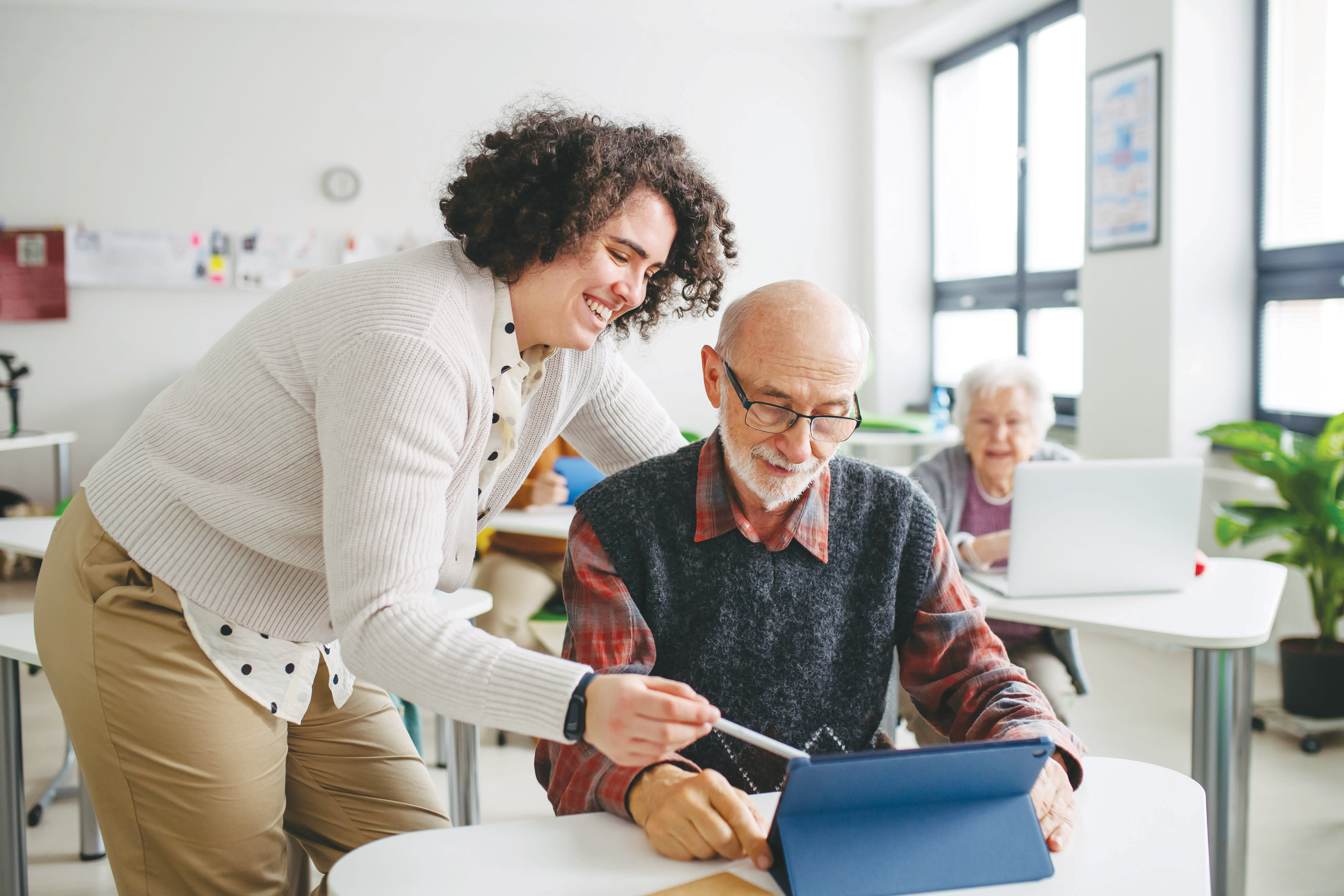
Shapiro teaches residents how to avoid scams and phishing schemes that prey especially on older people, and imparts other basic skills. “We’ve talked about artificial intelligence a lot. We’ve done extensive exposure to ChatGPT and Gemini. I encourage them to use those things when they have questions that they can’t ask a family member, if they’re up at two or three in the morning and they don’t feel like going back to bed, but they also don’t want to bother a family member.” He helps users learn how to use WhatsApp and teaches them the meaning of digital signposts such as three dots or three horizontal lines.
Modern technology, he asserts, was not designed with the elderly in mind. “The people designing modern interfaces are young people who like subtlety, and these people grew up without subtlety.” Shapiro explains the intricacies of using apps, and teaches them what they need to know and what they can ignore.
Older people, says Shapiro, learn technology differently than those who are younger. “Younger people will just pick something up and start playing around with it. They might get the hang of it, but they’re a lot less inhibited with fear. Older people like to know what they’re doing ahead of time. They got used to reading instruction manuals when they were younger, and they even ask for an instruction manual. I encourage them that they’re the instruction manual. Your fingers do the talking; you’re not going to make any catastrophic mistakes.”
Shapiro notes that for the participants in his class, using smartphones challenges their minds.
“Their brains are constantly being stimulated by what they have going on around them. They’re WhatsApping among themselves, and they’re WhatsApping with their families. That’s stuff we spent almost a year learning how to do. They do video calls. A few of them are even making artificial intelligence greeting cards to send out on the holidays.”
He refuses to treat the residents differently than younger students. “I tell them that I’m not going to accept their age as an excuse why not to learn. I treat them like they’re young people. They’re coming to a lesson not to waste time. They’re coming to learn something, and I give them the benefit of the doubt that they have that ability.”
Shapiro shares that his weekly sessions at Beit Tovei Ha’ir are inspirational. “I don’t even dream right now about sitting down and learning something new. But here I have a couple of dozen people who come every week to learn technology. They sit in on other lessons, too. In their old age, they’re very active. You can keep learning, you can keep growing, and it keeps you sharp. I love going there, and it’s one of the best days of my week.”
Beyond the need to learn and grow, older adults, like everyone, need love and intimacy. Tel Aviv-based sex therapist Ronit Aloni, who heads Ha-Edna Center – Intimacy and Sexuality in Later Life, says that one of the goals of human longevity is improving the quality of life and health even in the later, more fragile stages of life. Within that context, she says, “When we talk about quality of life, one of the things that causes the greatest harm—and what people complain about most – is loneliness, even within a relationship, as well as a lack of physical touch. I have patients who tell me, ‘The lack of touch actually hurts physically. No one touches me.’ This is true of both women and men.”
Aloni asserts that loneliness among the elderly is a significant issue, even among all of the community activities, classes, meetings, lectures, and trips that they may take with friends. “These do not completely dispel the feeling of loneliness, because loneliness is connected to a lack of intimacy. It means having no one to talk to – no one I can tell what is in my heart, what I am feeling inside, at the deepest level. That can happen only in one-on-one conversations.
“People often lack this even within a long-term relationship. Over the years, couples become accustomed to no longer talking to each other or sharing their experiences. It can also be found outside a romantic relationship, with a same-sex friend – a kind of soulmate people need. This is not something that receives enough attention.”
As people age, Aloni adds, they lose friends who pass away. Even when they remain alive, illness, mobility problems, or other circumstances prevent them from seeing them. “People then find themselves literally facing four walls, with no one they can speak to as an equal. Old age itself often involves disintegration, because aging takes away some of our functions. We therefore need to activate and use the functions that remain, rather than saying, ‘If I cannot do everything, I will do nothing.’ We need to look from an entirely different perspective at how we view older people and how we improve each individual’s quality of life.”
What are the most important factors in ensuring a successful aging process? Summing it up, Naomi Aziz-Rosenbaum, BSW (full disclosure: she is my daughter-in-law), a gerontologist and the coordinator for Social Belonging, Social Services, Jerusalem, says, “It’s the financial aspect, it’s the health aspect, and it’s the social aspect. They all come together. Sometimes, the social aspect can be stronger than the financial aspect. Some people don’t have a high income, who live on bituach leumi [National Insurance Institute stipends], but are still very connected, and they come to their senior citizen center every single day. People want to continue being meaningful where they are.”