
On the night between October 24 and 25, Israel will switch back to winter time. At 02:00, the clock will turn back one hour, and seemingly, we received an extra hour as a gift. But while the clock hands adjust within a few seconds, our body works at a slightly different pace. Our body does not set itself solely by the time displayed on the clock. It is strongly influenced by light and darkness, sleep and waking hours, and our daily routine. Therefore, a one–hour change can be felt by some people, even if, in terms of the clock, it is a very small adjustment.
Studies examining transitions between summer time and standard time indicate that the change may temporarily affect sleep, feelings of alertness, and daytime sleepiness. A recent review study published in 2025 found that the effects are not identical for everyone, and that in certain cases, they were more prominent among people who naturally tend to fall asleep and wake up later, known as evening types.
Some hardly notice, while others’ bodies respond immediately
For some people, the transition to winter time will pass almost without them noticing. Others may feel in the days following the change that they are more tired, waking up earlier than usual, or finding it difficult to fall asleep at their habitual time. Sleep is not only a question of how many hours we slept, but also when we slept. Each of us has a personal biological rhythm. Therefore, one person might feel that the transition went smoothly, while another person might feel for a few days that they are simply out of sync with themselves.
Children can also feel the change. Young children are accustomed to a very fixed routine, and a one–hour shift in bedtime, mealtimes, or sleep can be felt more noticeably by them. Thus, in the first few days, it is advisable to try to maintain a familiar daily schedule as much as possible and not turn the clock change into a comprehensive overhaul of the entire daily routine.
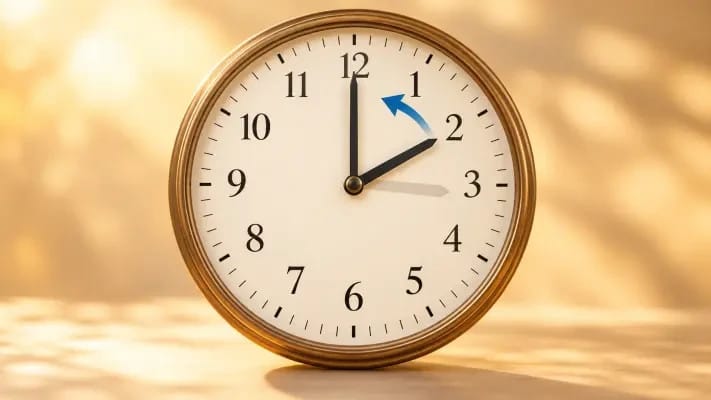
And what about the extra hour we got?
There is good news here as well. On the first night of winter time, we really do get an extra hour. But the question is what we do with it. If we stay awake an extra hour because we gained an hour anyway, scroll on our phones until late, or continue the evening routine without change, it is not certain that we will gain that hour in sleep. The shift to winter time can actually be a good opportunity to check our sleep habits. Are we sleeping enough? Are we going to sleep at a fixed hour? Are we getting into bed tired, or continuing to delay sleep?
Morning light can help
One of the most important signals for our biological clock is light. Therefore, exposure to natural light in the morning hours can help the body understand that it is time to start the day. Opening blinds, stepping out onto the balcony, or taking a short walk outside are simple actions that can be integrated into the morning routine. In the evening, too, it is worth helping the body gradually transition to a state of rest. Bright lighting, intense activity, and screens up until the moment we get into bed can make it difficult for some people to fall asleep.

So what should be done in the first few days?
There is no need to stress about the transition, nor to turn it into a project. In most cases, the body adapts to the change. It is advisable to maintain relatively fixed sleep and wake times, try to be exposed to natural light during the day, avoid caffeine as much as possible in the late hours of the day, and give the body time to settle into the new routine. Above all, do not panic if you feel a little different in the first day or two. Mild fatigue or a temporary shift in feeling alert can be part of the adaptation period.
On the other hand, if sleep difficulties, fatigue, or daytime sleepiness are significant and persist over time, it is best not to attribute them automatically to winter time. Sometimes a clock shift simply causes us to notice sleep habits or a problem that existed beforehand, in which case it is advisable to consult a family physician.
Ultimately, the clock hands move back one hour within a few seconds. Our body is a bit more complex. Therefore, perhaps the best way to transition to winter time is not to fight the clock, but simply to give the body good conditions to synchronize with it.
The writer is Dr. Kay Alkara, family physician, Maccabi Healthcare Services Northern District