
On a small ranch in California’s Central Valley, below the foothills of the Sierra Nevada, an orchard grows an ancient and sacred fruit: the etrog, or citron.
At just 7 acres, the etrog grove at Lindcove Ranch in Exeter is a speck in Tulare County, where about 40% of California’s citrus crops are grown. But by another measure, the grove is giant: Lindcove Ranch is the only major commercial grower of kosher etrogs in the United States.
“This is my life — I really feel a calling to do this,” said Greg Kirkpatrick, 65, whose family has owned and operated Lindcove Ranch for more than 60 years.
The fruit looks like a strange lemon, with a knobby exterior, thick rind, and oblong shape. It exudes a sweet, fresh, lemony fragrance. It’s not a fruit you find in grocery stores. But for Jews, the etrog is crucial for fulfilling the commandments of Sukkot. During the holiday ritual, which includes a blessing, an etrog is held in the left hand while a bundle of palm, myrtle, and willow, called a lulav, is held in the right. Brought together, they are shaken in the four directions as well as upward and downward.
The Kirkpatrick family, who are not Jewish, began growing etrogs 46 years ago, when an Orthodox distributor from the East Coast reached out looking for a domestic grower. He wanted to avoid the costly import process of bringing in etrogs from any of the three major growing regions around the world: Israel, Italy, and Morocco.
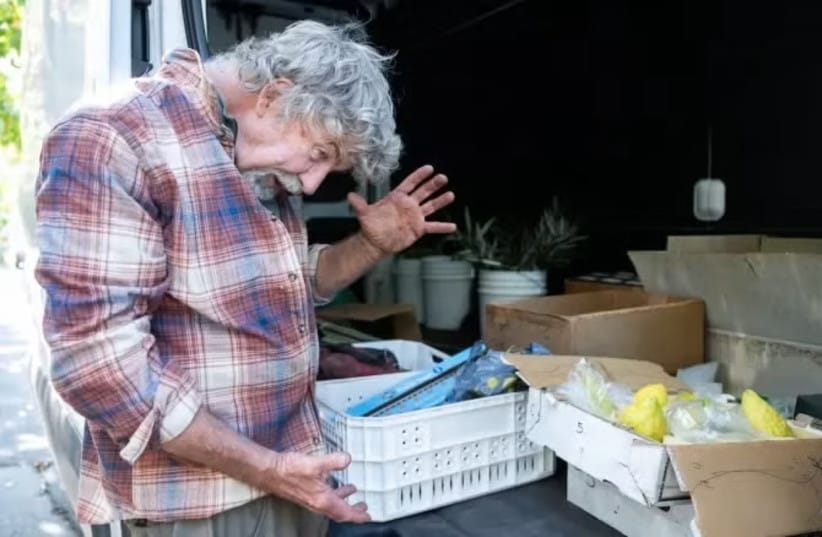
Greg’s father, John, who was already a successful citrus farmer, decided to give the specialty crop a chance, and soon citrons became an important part of the ranch’s annual income. Its citron orchard is part of a larger specialty-citrus operation, which includes yuzu, finger limes, makrut limes and sour oranges on about 30 acres. The citron, however, has been the ranch’s top-earning crop.
The citron business is a difficult one that Kirkpatrick likens to the diamond industry, with single pieces of fruit selling for hundreds and sometimes thousands of dollars.
“It’s not so much how many we can grow. It’s the quality of the fruit,” he said.
An etrog must meet stringent requirements to be considered kosher for ritual use. It must be largely unblemished, retain its natural stem, called a pitom, and come from a documented lineage of trees that have never been grafted or crossed with another variety.
The requirements make growing them different from growing ordinary citrus, according to David Karp, a pomologist, citron expert and citrus researcher at UC Riverside.
“Many people have tried to grow citron in California,” Karp said, noting the financial allure of an etrog’s price tag. “But just because you can grow a lemon well doesn’t mean you can grow an etrog that’s right for Jewish ritual use. You can grow them, but you’ll end up selling them for $5 each, or feeding them to the cows.”
Karp said little in horticulture can compare to the scrutiny that etrogs undergo for physical appearance, all for the sake of religious ritual.
'Nothing remotely like this,' Karp says
“There’s nothing remotely like this,” Karp said. “In Japan and perhaps other countries in Asia … there’s a cultural predilection for perfect, extremely expensive fruit that would be given as a gift. But there’s nothing quite like the citron for Jewish ritual use.”
A typical crop may begin with 10,000 to 15,000 pieces of fruit, but perhaps only half will be suitable to bring to market, according to Kirkpatrick. His harvesters are trained to pick citrons carefully after inspecting them on the tree.

“Being able to judge on the tree if the fruit’s good enough to bring into the packing house or not is important, so we don’t have to spend hours wading through and washing and dealing with fruit that’s not going to make it to the market,” Kirkpatrick said.
Once picked, each fruit is placed in its own spot in a foam tray. The citrons do not touch one another through the picking or packing process because even minor bruising or scratches can reduce their value.
There are multiple grades of etrog, ranging from cheaper, wholesale stock sold in mail-order sets to exceptionally large and blemish-free fruit sought by elite buyers.
For decades, Kirkpatrick mostly sold his etrogs through a specialized marketing network to Orthodox Jewish customers on the East Coast, who seek citrons that are not only kosher but exceptional in size, shape and color.
“My partner sells to a very select group of Orthodox Jews in Lakewood, New Jersey, by appointment only,” Kirkpatrick said. “And if you don’t have appointment-grade fruit, they won’t come to buy your fruit.”
In 2023, the ranch received about 22 inches of rain and failed to get much of a crop. That same year, John died, leaving the grieving Kirkpatrick family to navigate the business without him. Then, in 2025, the ranch produced what Kirkpatrick thought was a successful crop, but his marketing partner was unable to sell enough of the fruit to recoup the $250,000 it cost to produce. Those years were the two worst for etrogs in the ranch’s history.
Distributors simply want more top-grade etrogs than the Kirkpatrick operation is able to supply.
Rabbi Menachem Sirota, a longtime etrog distributor based in Lakewood, New Jersey, who has purchased Lindcove Ranch citrons in the past, said he has opted to buy from larger growers who can supply more of the highest grade of the fruit.
“Personally, as a wholesaler, I need a very large quantity of nice ones,” Sirota said. “For a while I was getting them from California, but in recent years I was not so satisfied with the quality.”
As a result of the huge financial loss from this shift, one of the family’s homes on the ranch ended up in foreclosure earlier this year, Kirkpatrick said. With labor being one of the ranch’s biggest expenses, Kirkpatrick has had to cut back from eight full-time employees to five part-time workers.
One of the Lindcove Ranch etrogs that was delivered to Chochmat HaLev. (Aaron Levy-Wolins/J. Staff/Report For America)
The family is even thinking of selling the ranch.
But for now, Kirkpatrick is trying to save his business by becoming more of his own wholesaler.
“We’re reinventing ourselves,” he said.
The ranch is focused on selling bulk orders directly to congregations. Just before Sukkot began on Sept. 25, for example, Kirkpatrick delivered a shipment to Congregation Beth Emek in Pleasanton and Chochmat HaLev in Berkeley, California.
Etrogs grown without pesticides, chemicals
Kirkpatrick is also courting a new customer base with a pitch built on a genuine difference between his etrogs and those grown abroad. His etrogs are grown without pesticides or other chemical treatments, so after Sukkot they can be eaten or made into jam, candied peel or liqueur.
That sets them apart from etrogs grown overseas, according to Karp.
“Because a citron is of little worth unless it’s cosmetically perfect, they spray the heck out of these trees and fruit,” he said, adding that he wouldn’t advise eating etrogs grown outside the United States. “It wouldn’t be my first choice for a marmalade, let’s put it that way.”
Whatever Kirkpatrick’s hopes, the fate of Lindcove Ranch, and of California-grown etrogs, will depend on several factors, including the weather and how the next growing season plays out.
“I’m a farmer, I’m always optimistic,” he said. “You have to be in the farming business.”
This story was first reported by J. The Jewish News of Northern California and is reprinted with permission.