The official state ceremony to remember the victims and heroes of the October 7 massacre was held at the monument for fallen terror victims on Mount Herzl on Monday, following the national memorial ceremony for the massacre.
Prime Minister Benjamin Netanyahu and President Isaac Herzog were among the key political figures present at the event.
Noam Bettan, Israel's 2026 Eurovision representative, and Yuval Raphael, Nova music festival survivor and Israel's 2025 Eurovision representative, performed at the event.
Speaking at the ceremony, Herzog called on Israelis to preserve the solidarity and mutual responsibility displayed during the October 7 massacre, telling bereaved families that the country’s shared covenant must endure even amid political division.
Herzog focused on Route 232, the road running through the Gaza border communities that became both an escape route and a killing ground as Hamas-led terrorists attacked southern Israel on October 7, 2023.
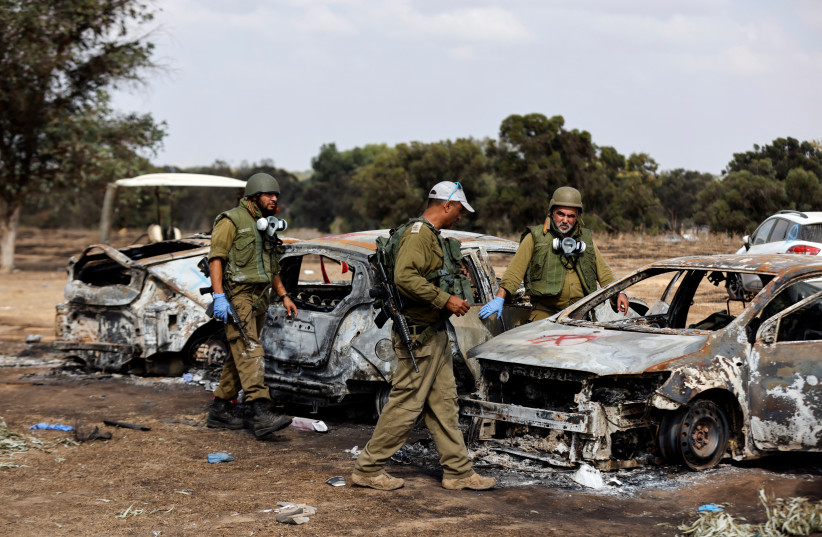
October 7 on Route 232
The road, Herzog said, became a symbol not only of the failures and horrors of that morning, but also of the civilians, soldiers, police officers, and rescue personnel who drove toward the danger to save others.
“On the map of grief of October 7 there are communities and towns, kibbutzim and moshavim, fields and bomb shelters. And there is also one road. Route 232,” Herzog said.
The highway, which connects communities along the Gaza border, became one of the central sites of the massacre.
Survivors of the Nova music festival described fleeing along Route 232, while terrorists moved through the area and attacked vehicles, shelters, and communities.
Herzog contrasted those fleeing for their lives with Israelis who drove in the opposite direction, toward the attack, to rescue strangers.
“Private citizens whom no one had called raced into the inferno, some of them for people they had never met,” Herzog said. “They dropped the survivors off in a safe place, then turned around. And went back in. Into the danger.”
He also said that rescuers did not ask whom they were saving, which community they belonged to, how they prayed, or whom they voted for.
“In those hours, Route 232 was a picture of Israel as a whole,” Herzog said. “There was the terrible failure and its horrifying consequences, but there was also the strength and responsibility that arose in the face of those failures.”
Route 232 became closely associated with the devastation of the massacre, with burned vehicles, bullet-riddled cars, and roadside memorials marking the route in the years since the attack. A Jerusalem Post visit to the Gaza border area two years after the massacre described how the road and surrounding communities had been transformed by both destruction and commemoration.
Herzog said that while Israelis remembered Route 232 as “the road of blood,” it should also be remembered by another name: “the road of heroism.”
That heroism, he said, belonged to civilians, IDF soldiers, police officers, and rescue teams who “looked danger in the eye” and entered the fighting because other Israelis were still there.
“From their heroism, we discovered one of the great truths about Israel: When someone is left by the side of the road, there are Israelis who are incapable of simply driving on as though they had not seen them,” Herzog said.
October 7: Deeper 'covenant' binding Israeli society.
He then broadened the theme from the events of October 7 to what he described as the deeper “covenant” binding Israeli society.
“A state is built from laws, institutions, and borders. But the society that lives in a state thrives together because of a covenant,” Herzog said.
That covenant, he argued, did not require Israelis to agree politically or live in the same way. Rather, it required them to recognize a continuing obligation toward one another despite their differences.
The appeal came just over three weeks before Israelis were scheduled to vote in the October 27 general election, a date formally set earlier this year.
“In a few weeks, we will go to elections,” Herzog said. “Many issues are at stake, and I call on and urge all the citizens of Israel to exercise their democratic right and duty on Election Day.”
He acknowledged that the campaign would bring disputes and arguments, while urging Israelis to remember what he called the “simple covenant between us” that emerged during the massacre.
“This covenant is greater than all the disagreements between us. It is greater than all the arguments and differences. It belongs to all of us, all Israelis,” Herzog said.
“Israelis leave no one behind. Not on the battlefield and not in bereavement. Not in rehabilitation and not in the hospital.”
Israel marked the third anniversary of the massacre with state ceremonies at Mount Herzl and remembrance events across the country. Some 1,200 people were killed in the Hamas-led attack, and more than 250 people were kidnapped into Gaza.
Herzog closed by telling the bereaved families that Israel would continue to remember those murdered and the communities devastated on October 7.
“We will forever remember what happened that day,” Herzog said. “We will forever remember the homes that became graves, the terrible atrocities we might wish to forget, but will remember forever. All of them.”
“And in the words of the lament, we will know that our tearful eyes are the ones watering the fields of Be’eri. We will remember, and we will continue for their sake.”