
In the heart of Jerusalem, where the ancient stones of King David Street meet the bustling modern pulse of Israel’s capital, lies Huvy’s Gallery at 22 King David Street. For more than four decades, this landmark of the Jerusalem art scene has welcomed collectors, visitors, and art enthusiasts from Israel and abroad. Yet, to step inside is not merely to view art; it is to encounter a unique spiritual heritage.
The late Huvy Elisha, known globally simply as "Huvy," is regarded by many admirers and collectors as one of Israel's most compelling and distinctive artistic voices. Today, her artistic legacy as a premier Israeli contemporary biblical art painter is preserved and championed by her family. To understand the depth of her artistic vision, we sat down for an exclusive interview with her grandson, Ishai Nachman Elisha, who serves as the Managing and Marketing Director of Huvy’s Gallery.
The gallery's enduring legacy is meticulously managed by a dedicated multi-generational team: Huvy Elisha’s son, Rafael Elisha, a veteran of the high-end Israel art market with more than four decades of experience, alongside her grandsons.
Through Ishai’s recollections, we gain a deeper understanding of the woman behind the canvas, her radical life transition, her unique technical mastery of light and tone, and her ability to unite fragmented worlds through the universal language of biblical themes.
"Every original painting is not just a composition; it is a tangible piece of her soul left behind," Ishai reflects.
From European Fashion Studios to Jewish Biblical Art in Jerusalem
To fully appreciate Huvy Elisha’s work, one must understand the dramatic tapestry of her life. Born into a traditional world, she spent her formative years developing her aesthetic sensibilities within European art circles, graduating from the prestigious Saint Martin's School of Art in London. However, at the age of 55, the renowned artist underwent a profound spiritual awakening, returning to her Jewish roots and embracing an orthodox lifestyle.
"It was a complete paradigm shift," Ishai reflects. "She moved from the ultra-chic environment of European fashion and art scenes straight into the deeply traditional neighborhood of Mea Shearim in Jerusalem. It was a journey from the expression of modernity to the preservation of ancient spiritual heritage."
Yet, rather than suppressing her creative drive, this dramatic transition catalyzed it. Huvy Elisha began to channel her classical European training, including the fluid lines, the bold color theories, and the emotional raw expression, into Jewish biblical paintings, Zionist landscapes, and scenes of communal celebration.
Ishai believes that even before her formal return to religious observance, her work reflected a deep spiritual sensitivity. Her early works frequently depicted the Western Wall and the rugged landscapes of Jerusalem, suggesting that her subconscious was already saturated with the imagery of the Holy Land.
The Visionary Process Behind Her Fine Art Israeli Paintings
A central revelation shared by Ishai is the framework behind Huvy Elisha’s creative process. Her art was never a mere replication of the physical world, but rather a seamless synthesis of three distinct dimensions: Imagination, Dream, and Visual Reality.
"My grandmother didn’t just sit down to paint what she saw," Ishai explains. "She painted what she experienced in her spirit. Many of her most iconic pieces were born from vivid dreams. She would dream of a biblical event, a historic returning to the Land, or a specific light, and then translate that nocturnal vision onto the canvas. She blended her imagination with real-world landscapes, creating a visual language that feels both grounded and entirely ethereal."
Masterful Oil Paintings with Jewish Themes: Light, Tone, and Kinetic Motion
Her work has been described by collectors and admirers as combining elements of expressionism and romanticism, yet her technical approach defies easy classification. While much of her power lies in her rich narrative, Ishai notes that her impact is deeply rooted in a highly sophisticated mastery of the medium of oil paints.
"My grandmother had a singular relationship with color," Ishai explains, gesturing to a massive canvas depicting a traditional wedding ceremony. "She worked primarily with oils, but she achieved a unique level of luminescence and rare tonality."
According to Ishai, she developed a highly distinctive approach to layering tones and colors so that they resonated against one another. The most striking characteristics of a Huvy Elisha original lie in three technical pillars:
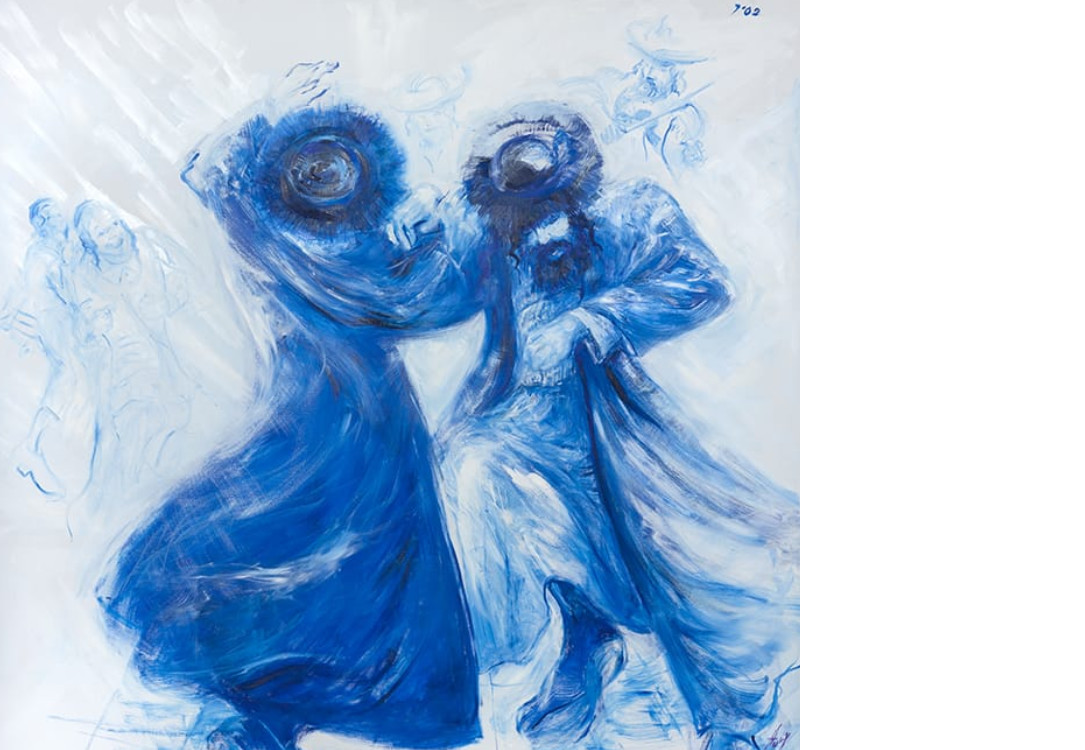
The Internal Switch (Illumination): In classical art, light usually originates from an external source. In Huvy Elisha’s paintings, the light emanates from within the canvas itself. Ishai states that her technique creates the impression that a light source exists within the painting itself, making the figures seem to glow from within.
The Precision of Tone: She avoided flat colors. A single white robe worn by a Hasidic dancer in her painting contains subtle shifts of cerulean blue, soft violet, and warm amber, capturing the dynamic nature of light through her masterful oil formulas.
Kinetic Movement: Huvy Elisha utilized a distinct impasto technique that gave texture and a rare, kinetic motion to her subjects. According to Ishai, few artists have been able to replicate this specific movement, drawing viewers in so deeply that they feel like active participants in the scene rather than passive observers.
Expressionism Biblical Art as a Vision of Universal Unity
According to Ishai, one of the defining aspects of Huvy Elisha's worldview was her rejection of social labels and divisions. In a world often fractured by religious and secular divides, Huvy Elisha’s canvas was a space of absolute unity, making her a celebrated religious art Israel painter who bypassed cultural boundaries.
"She detested stigmas and labels," Ishai notes with a smile. "She never looked at a person and judged the size or color of the skullcap on their head, or whether they wore one at all. She saw the spark of the Divine in everyone. This philosophy spilled directly onto her canvases."
Nowhere is this more evident than in her famous dancing circles. Even when painting ecstatic celebrations in the absolute heart of Mea Shearim, Huvy Elisha intentionally wove orthodox, secular, traditional, and modern figures into the exact same dance, holding hands as equals.
This universalism is precisely why her work appeals so deeply to a diverse international audience. Today, her expressionism biblical art is highly sought after across the globe. Her works can be found in private collections, hotels, public spaces, and institutions in Israel and abroad.
"We have had atheists, Evangelical Christian collectors, and ultra-orthodox sages stand before the exact same painting, all moved," says Ishai. "They are connecting with the artwork, bypassing modern theological friction to touch upon timeless realities."
Collector Demand in the Global Jewish and Israeli Art Market
Today, original Huvy Elisha paintings continue to attract strong interest from collectors of Jewish and Israeli art around the world. Reflecting their rarity and enduring appeal, original works have achieved significant prices, with some pieces selling for tens of thousands of dollars.
"It is difficult for us to part with these pieces," Ishai admits candidly. "Every time an original sells, it feels as though a piece of our grandmother is leaving the gallery. But we recognize that these paintings belong to the world. They represent a legacy that alters the atmosphere of whatever room they inhabit."
Preserving the Legacy of a Renowned Jerusalem Based Artist
Years after her passing, Huvy Elisha's work continues to attract visitors from around the world to the Jerusalem cultural scene. Whether viewed as spiritual expression, cultural documentation, or masterful oil painting with Jewish themes, her canvases remain a testament to a life that bridged tradition and modernity, faith and creativity, Jerusalem and the wider world.
Through the ongoing dedication of her family at Huvy’s Gallery in Jerusalem, Israel, her paintings continue to reach new audiences while preserving a distinctive, luminous chapter in Israeli artistic history.
To explore the exclusive collection online, view available original works, or coordinate a private visit to the Jerusalem gallery, visit the official Huvy’s Gallery website.
This article was written in cooperation with Huvy’s Gallery