
For many, summer is a time for travel and discovery. I encourage readers of this column to visit galleries and museums and to immerse themselves in art while traveling in Israel. Local artists have so much to offer.
This month, I decided to feature multidisciplinary artists whose ongoing exhibitions in Beersheba, Bat Yam, and Tel Aviv can create an alternative reality for the viewers.
Artists who build an experience and encompass the space, whether by theatrical light structures that have taken over the entire museum area, or an intimate, very moving installation, in just one tiny room. I also spoke to an artist who paints additional space on canvas, symbolically adding lines, as if it were another truth.
These three artists agreed to answer my three questions:
What inspires you? What do you call art? What, in your opinion, makes your artwork different from that of other artists?
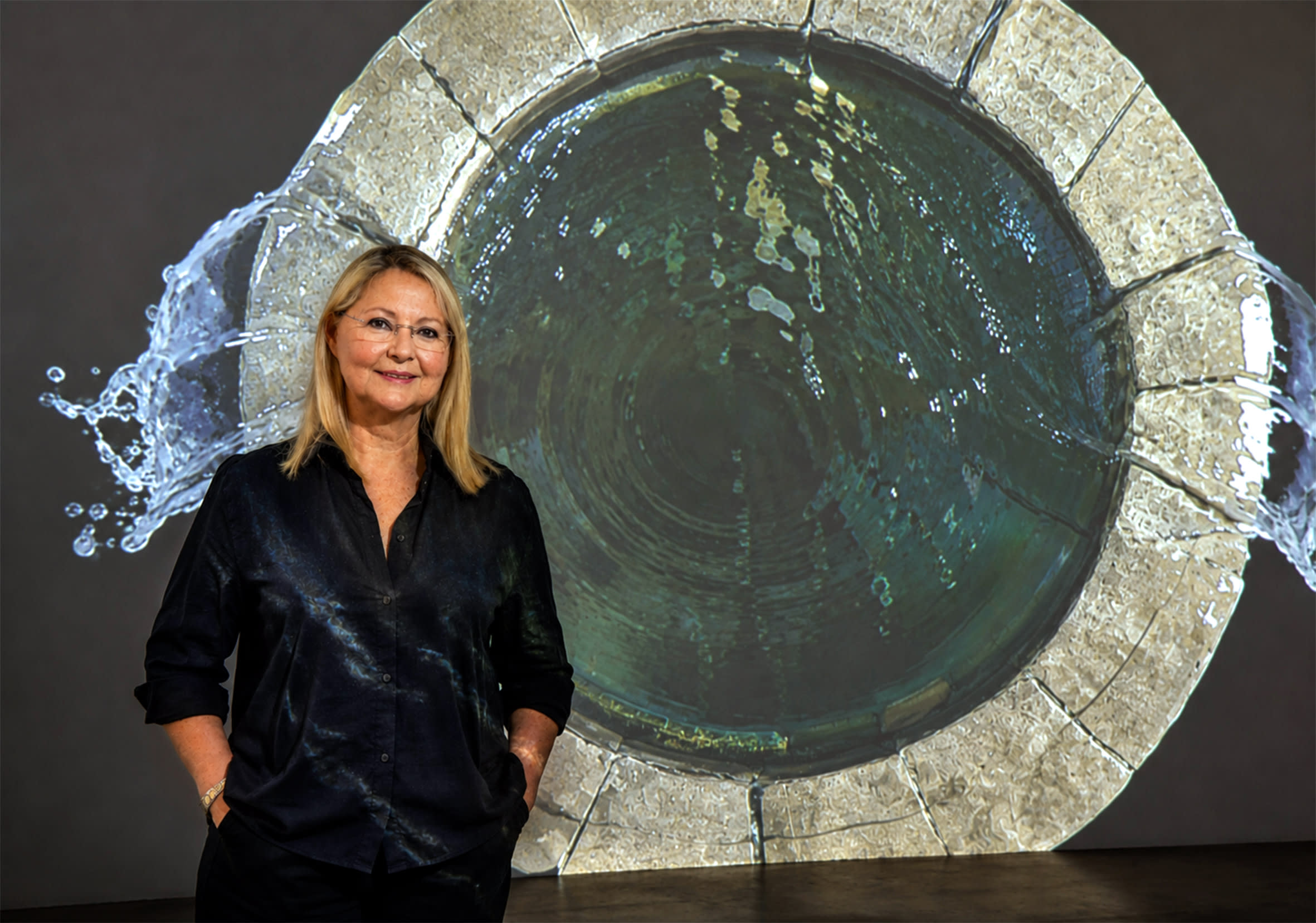
Anna Fromchenko, widely exhibited artist, both solo and as part of a group
Anna Fromchenko is a multidisciplinary artist, born in Bucharest, Romania, in 1952. At the age of eight, she made aliyah with her family and moved to Givatayim in central Israel, where she grew up. She now lives and works in Tel Aviv.
Fromchenko studied painting at the Kalisher School of Arts in Tel Aviv (1969-1971), and then art history, film, and television at Tel Aviv University, graduating with a BA in 1976. Her work can be found in numerous private collections and the Petah Tikva Museum of Art. It has been widely exhibited in solo and group exhibitions in Israel and abroad.
Her work spans painting, photography, video, and site-specific installations. She explores memory, identity, and the human condition, transforming complex social issues into multi-layered visual experiences. The artist shows contemporary social and political realities through visual narratives.
Fromchenko seems to remove objects from their original context and imbue them with new, poetic meaning, just as in the case of her latest exhibition, The Wishing Well, on display at the Negev Museum of Art in Beersheba.
The Wishing Well, a site-specific work, combines video, sound, and sculpture. When we met at the museum, Fromchenko told me that this work, despite being rooted in biblical traditions and being physically in Beersheba, is not connected to the biblical well of Abraham [there].
The video is placed on the museum’s floor among stones on which visitors can sit, in a small, dark room, behind a black curtain, where the lights change, and the sound of water creates the impression of an authentic well, but it is an illusion. The sound of water rising and falling, in rhythm with breathing, is almost meditative.
In addition to the sound of water, there is also recited, whispered poetry with the repeated line: “You cannot see the water / through the water.” Fromchenko created a very moving and intimate space.
Inspiration: My inspiration emerges from a dialogue with reality. It begins with a phenomenon or a figure that compels me to respond, transforming it through artistic action into a dialogue with the viewer.
My artistic practice is about conveying an experience that triggers a chain of responses around conceptual themes, generating an ongoing conversation with the audience. I also draw inspiration from literature and poetry.
Meaning of art: For me, art is the sublimation of reality, both for the artist and for the viewer. It is a language beyond language – a means of connecting people.
The dialogue that unfolds between the viewer and the artwork creates the metaphysical dimension of the piece. The richer and more meaningful that dialogue becomes, the more powerful the work’s metaphysical presence.
Fromchenko’s art: Because my practice is conceptual, the subject changes from one project to another, and with it the technique and artistic medium. This is how my multidisciplinary approach finds expression through painting, sculpture, photography, video, and writing.
For example, in a project titled Iran, Iran, I first painted the ejection seat of a fighter jet as a metaphor for our condition of risk and rescue within the geopolitical space we inhabit. I later transformed it into a monumental sculpture, as well as a smaller sculpture produced from a 3D-printed model, among other iterations.
In another project, I photographed the interiors of abandoned beehives and transformed the images into immersive video installations, inviting viewers to experience the sensation of entering a gigantic beehive.
In my current work, The Wishing Well, which emerged from an inner dialogue about how to lift myself out of a dark pit on my own, I constructed the rim of a real well and created a video of water slowly rising and falling within it, accompanied by the sound of prayers, supplications, and singing.
As a deep and hidden space, the well can become a pit of falling, entrapment, and death, while simultaneously representing an inner realm of memory, the subconscious, and hidden layers of the psyche. This duality lies at the heart of the work. Across many cultures, the idea of the “wishing well” recurs as a metaphysical gateway of hope, faith, and enchantment – a place where people cast their longings and prayers beyond the visible and the present.
Omer Sheizaf, internationally recognized lighting design expert
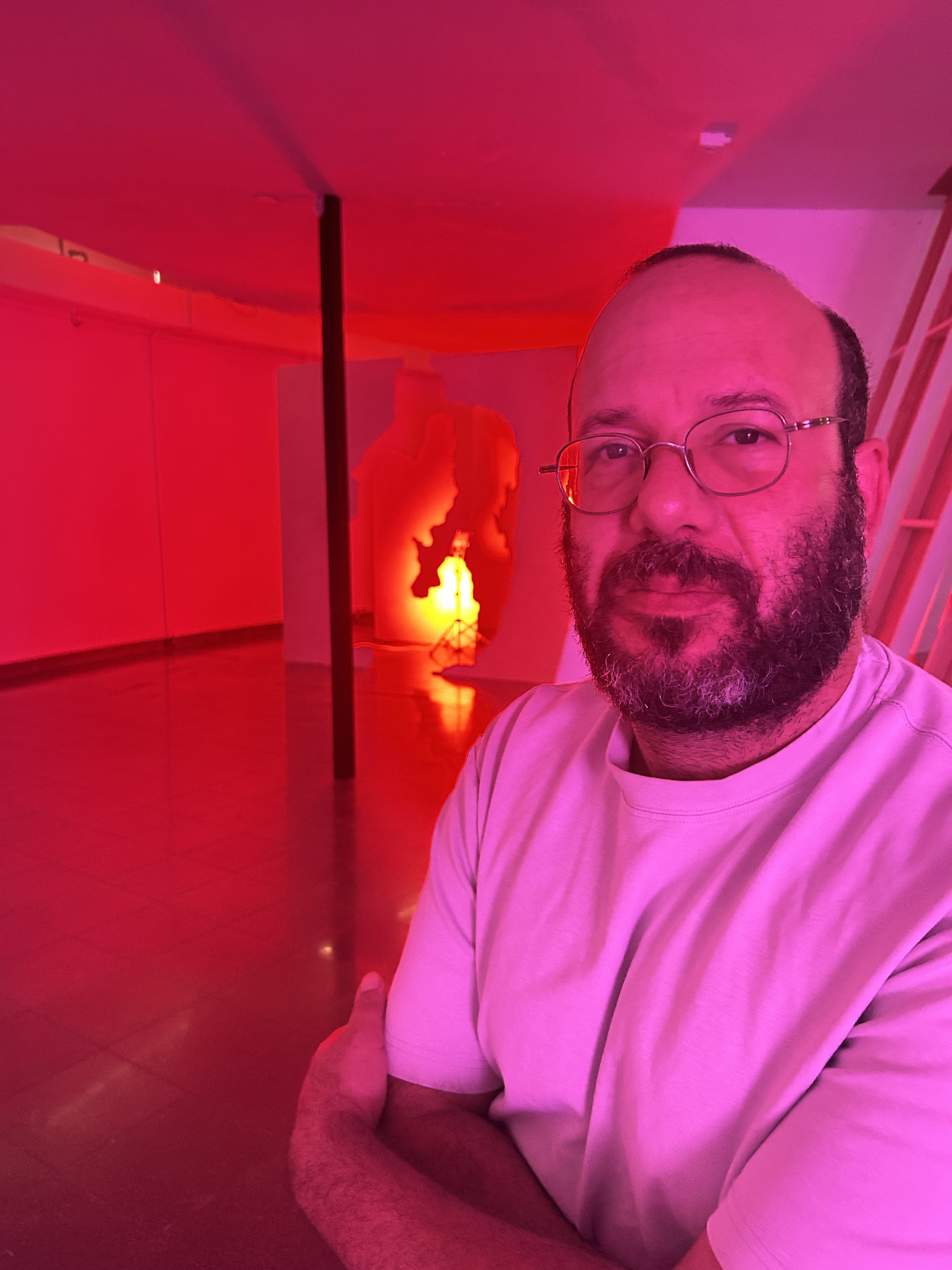
Born in 1982 in Ramat Gan and today based in Tel Aviv-Jaffa, Omer Sheizaf holds a BA in Literature and Philosophy from Tel Aviv University (2012) and an MFA from Bezalel Academy of Arts and Design (2018). He is a multidisciplinary artist with expertise in lighting design, which has earned him international recognition.
He has designed for the LA Dance Project, Batsheva Dance Company, and others. Among his numerous awards, he won the 2009 Israel Fringe Award for Best Lighting. Sheizaf teaches at the School of Visual Theater in Jerusalem.
His artwork has been exhibited in various museums and galleries, including the Tel Aviv Museum of Art, Holon Digital Art Center, Muza, and more. Through sculpture, installation, and audiovisual performance, Sheizaf explores the relationship between the performative and the environmental areas.
In the exhibition Redden, which opened this month at the Bat Yam Museum of Art, the installation designed specifically for the museum, Sheizaf created large-scale lighting on the circular ceiling and in theatrical spaces upstairs, including a disassembled motorcycle and urban-themed dioramas.
In my eyes, the artist transforms the exhibition space into a stage where light, sound, and sculpture play equal roles, and visitors become additional actors in the performance, each in their own unique way. In this show, Sheizaf creates an alternative reality that also alludes to the play on words in the exhibition’s Hebrew name, Maadim, which can be translated into English as “becoming red” and “Mars.”
During our conversation, Shaizaf explained that he isn’t interested in planets or observing the sky as much as he is in the possibility of an alternative place for refugees, for humanity. Entering Redden, we get a taste of it, for sure.
Inspiration: I find my inspiration in observing different elements of the urban landscape. This is what I did most of my childhood, and in many ways, not much has changed since then. I grew up among the grey streets of Ramat Gan, wandering around in search of something interesting or imagining distant worlds.
Sometimes I would discover an old sculpture abandoned in a pile of trash, a strange light coming through a window, or a neglected electronics shop selling records. These were my moments of excitement.
Meaning of art: Art is the ability of something to become new, to become different, to open a new path that does not follow a predetermined plan. It is essentially a liberal force, one that liberates us from old structures and fixed perspectives. Art clears the mind when it becomes trapped within patterns that have remained unchanged for too long.
It is the opposite of cliché and the opposite of conservatism. It is closer to madness than to culture, and the origin of them both.
The artwork is not only the object, but the entire situation around it: the atmosphere, the movement, the sound, the light, and the experience that unfolds in front of the viewer.
Sheizaf’s art: I work with light, sound, and effects that come from the world of theater. I believe that the connection between theatre, sculpture, and installation is a central element in my work. My installations contain dramaturgy and a sense of time; they unfold through sequences and transformations.
I came to visual art through theater. I grew up on stage and around it. I learned how to tie ropes and fabrics, climb high wooden structures, and release hidden mechanisms at the precise moment required in a performance. I bring this knowledge into my sculptural practice. My material is the effect itself, and it is built from my personal history, from the things that have fascinated me throughout my life, and from the place I come from.
I am deeply interested in theatrical effects and old forms of magic. The aesthetics of my work are often drawn from worlds of illusion and ancient mysticism, a kind of secular mysticism that exists within the theatrical realm.
I [also] come from an alternative culture, and I believe that the worlds and characters that emerge in my work are, in many ways, rooted in those places. The worlds of darkness, otherness, and queerness connected to a distorted, imperfect, and unconventional sound.
Tali Navon, painter, video and installation artist
Tali Navon, a painter, video and installation artist, was born in Givatayim in 1964 and lives and works in Tel Aviv. She studied textile art at the Shenkar College of Engineering and Design (1991), fine art at the Kalisher School of Art (1995), and film at Tel Aviv University (2000).
Her work has been presented in solo and group exhibitions abroad and in Israel, including at the Israel Museum, Petah Tikva Museum, Ashdod Museum, Haifa Museum, Beit Reuven Museum, Mana Katz Museum, and the Wilfrid Israel Museum of Asian Art and Studies in Hazorei.
Her video works have been presented at the Jerusalem Film Festival, Middlebury College in Vermont, the Total Museum of Contemporary Art in Seoul, and other art venues worldwide.
She has gained recognition for her interdisciplinary exploration of local and global cultural phenomena and historical narratives. Navon explores themes of contemporary culture, urban planning, identity, motherhood, and the fragility and innocence of childhood. She incorporates elements of drawing into her minimalist paintings, which are often indistinguishable from drawings.
In her latest exhibition, Study Room, recently opened at the Rothschild Art Gallery in Tel Aviv, the artist explores workspaces as places of creation.
The works are created in a conservative color palette, but unconventionally, as Navon explained, painting on a lying-flat canvas (not standing or hung) allows her to add more water to the oil paints, dilute the paint, penetrate it, and give it a watercolor effect.
What caught my attention were objects – just their contours, painted in white lines, as added on top of the painting. She told me they are, in a sense, metaphysical; the artist explores the future of the book when we can no longer touch it.
In Study Room, Navon also shows a series called Readers, 10 small oil works on glass. Again, the technique the artist uses, in effect, reminds one of watercolors. “The choice of technique is a matter of feeling,” noted Navon.
The exhibition traces the act of painting and writing to propose a parallel between them. The artist, who also placed her chair and table in the gallery, invites viewers into her very intimate creative world.
Inspiration: I love observing and looking at my environment. I love humanity and wonder about the human condition. What inspires people to act within an existing reality? I also love to examine the past and place it in the present: what has changed and what will always remain the same.
A lot of my work is based on archival items, diaries, and archival films. I treat the archives not as a static graveyard of facts, but as a living archive, like the regional history of [for example] Petah Tikva, the literary and cultural weight of Beit Bialik, or the deeply personal, humanitarian legacy found in Wilfrid Israel’s diaries at the Wilfrid Museum [solo exhibition there in 2025].
Meaning of art: I call art [what] works that make you think. That point to a topic, that raise questions, that wonder and investigate. If I reflect on the art world, I find a lot of apocalyptic art. I think it’s more challenging to create art that offers solutions for existing situations, that marks a future that can exist. Art that dares to build a tangible, alternative future. That requires an entirely different level of rigorous intellectual and creative heavy lifting.
Navon’s art: I create within my own world. The loyalty to myself is very important to me. I am aware that the urge to create is inherent in me, and I cannot ever tell myself to stop. I am very true to myself, and the art I make is me; my art is part of my identity. It is a private sanctuary. I am actually the sole architect of that world, and I keep it entirely mine.
By injecting my own impressions, interpretations, and contemporary artifacts into the mix, I create a dialogue [with archives]. I am giving a voice to the silent spaces between the official records. My new archive becomes a subjective, deeply human response to an objective history.