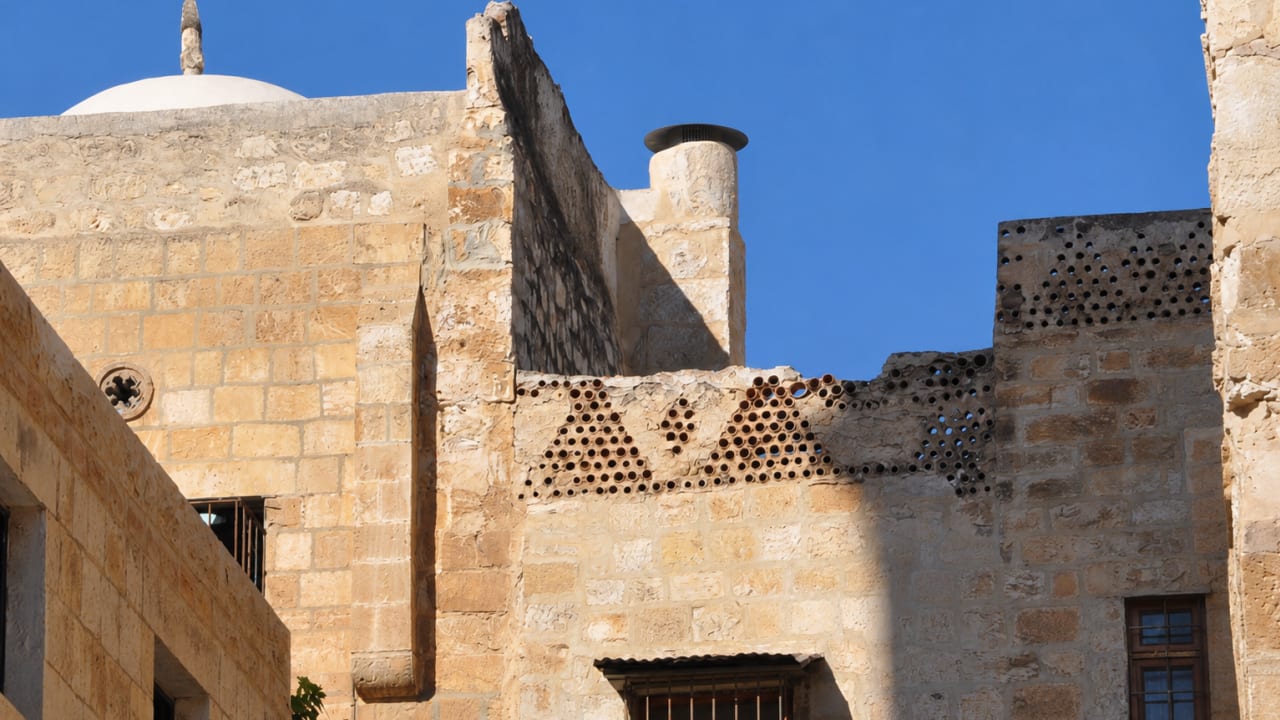
Anyone who has ever visited the Old City of Jerusalem doesn’t need to be told that it is a special place. Fine, so it’s a walled hilltop spot that countless civilizations have fought over for millennia, and it continues to spark political-ethnic frictions.
But the payback for the swinging-door history is that each culture left some kind of aesthetic imprint there.
Tzafi Shelef will do her best to ensure that as many of us as possible are aware of some of the delightful, often time-worn, decorative items that can be seen as one makes one’s way through the alleyways and broader thoroughfares that crisscross the ancient compound.
Catching the details
Shelef is an architect who serves as the Jerusalem district manager of the Council for Conservation of Heritage Sites in Israel.
As such, she has the professional and street-level collateral for leading the God of Small Details tours on October 15 and 22. Both start at 3 p.m. from the New Gate near the southeastern corner of the walled city and are part of the expansive roll-out of this year’s Open Houses festival.

The forthcoming edition, overseen by perennial manager Aviva Levinson and curated by Omri Zilka and Or Haklay, offers no less than 171 tours, encompassing a multitude of beautiful, striking, historic, futuristic, and significant sites across the capital over two weekends, October 15-17 and October 22-24.
The majority of us probably, in these tension-strapped times, visit the Old City infrequently, if at all. If that is indeed the case, at least from a purely visually pleasing and intriguing standpoint, with the implied depth of historical subtext, more’s the pity.
There is so much to explore and enjoy on even the briefest of forays as one leaves the bustling, traffic-laden western part of Jerusalem into the multilayered tapestry of humankind, and its fascinating detritus dotted around its four quarters.
For our pre-festival jaunt, Shelef took me primarily through the Christian section, which is littered with ornamental vestiges of the quarter’s long-storied past. But you need to take your time.
If you’re heading, say, to the Western Wall or to chow down on some hummus at Lina’s in the Muslim Quarter, the edifices you pass by may just be a blur as you stride purposefully, navigating your way across the pockmarked flagstones.
The Old City really is another world, a sort of parallel universe to the 21st-century pace of life outside.
“You really have to make a point of looking at the things here,” says Shelef, “and maybe the next time you walk around here, you’ll also notice this beauty.”
Interdenominational coexistence
The architectural fixtures and fittings you may espy comprise a storyboard of the backdrop to the unique urban space. They provide glimpses of the folks that populated the place, their physical and cultural milieu, and the way they viewed the world around them.
For example, you may catch the sign above the Knights’ Palace of the Latin Patriarchate, which sports a shield with a cross with a crosslet in each quadrant. This is a Christian heraldic symbol of the Jerusalem cross, aka the Crusader’s cross, which served as the coat of arms of the Crusader Kingdom of Jerusalem from 1099 for almost 200 years.
Soon after she began regaling me with some ins and outs of the fetching historical elements in clear view, Shelef referred me to the extensive bibliography lovingly compiled by late Jerusalem-born architect and architectural historian David Kroyanker, who passed away last year at the age of 86.
Having met and interviewed him on several occasions, usually following the release of yet another wonderfully crafted tome documenting Jerusalemite structural gems, quite a few of which have sadly fallen prey to the city’s frenetic redevelopment axe, I am somewhat familiar with his invaluable, painstakingly accrued output.
Shelef recommends a perusal or two of some of his books – not only to take in some local architectural knowledge, but also to gain a handle on some pertinent professional jargon.
“All his books have explanations of the terminology used in them. He also included illustrations and photographs relating to them,” she notes.
That’s handy, and kudos to Kroyanker, but there’s nothing like getting out there and seeing the architectural facts on the ground with your own eyes, particularly in this increasingly computer algorithm-based (dare I say AI-created) virtual world of ours. Then again, you might care to pop over there armed with the relevant Kroyanker volume.
“He mentions so many styles and elements, many of which we will see on my tours,” Shelef advises. “There are eclectic architectural styles, Byzantine, Baroque, Mamluk, and Classical. You find them here all jumbled up.”
Apses, cornerstones, atrium, basilica, pediment, pier, and hachkar are also in the Kroyanker index of useful terms. With my archeological background, I was familiar with all the aforementioned except for the last one.
“That’s a memorial stone in Armenian,” Shelef enlightens me. “You’ll see that in the Armenian Quarter.”
That makes total sense if one considers that the Old City is probably the richest and best-delineated archeological tell in the world. Often, conquering civilizations built over the previous lot’s buildings and facilities, culling stones and other constructional features into their own structures in “secondary usage” style.
But they also tended to spread out. There was little room for maneuver within the confines of the ancient walls and, hence, the city’s man-made stratigraphy generally evolved neatly and strictly vertically.
Community aesthetics
We eventually set off from our perch near the New Gate, from where, amazingly, I espied several foreign tourists. Shelef first drew my attention to the multifarious assortment of masonry employed by various artisans and builders during the course of the city’s history.
“We examine the type of stone, the cut, the shade, and the way it was set,” she explains. “And you can tell the Christian denomination or ethnicity by the style.”
One of the darkly jocular observations about the Jews riffs on our tendency to squabble or, at least, endeavor to have our individual say on whatever matter happens to come up.
Shelef says that is not a uniquely Jewish trait, and that Christians also have their differences of opinion and challenging interfaces. We catch the symbol of a cross, which appeared to come from Orthodox Christian climes.
“That’s right,” Shelef confirms my stylistic observation. “That’s Greek Orthodox, although it’s on the wall of the Latin monastery.” How come? “The monastery operates under the aegis of the Greek Orthodox Patriarchate.” The interdenominational plot thickens.
We came across an abundance of symbols, ornamental vignettes, and others of a more political-religious nature. It is truly astounding and compelling to find such subtle, charmingly fashioned building augmentation, with the differently shaped crucifixes, coats of arms, crests, and other aesthetically pleasing shapes.
It was all made by hand, with nary a 3D printer in sight. Oh, for times gone by when we had time for everything, when we got on with things rather than constantly seeking online amusement and/or thrills.
That may, of course, be something of a Hollywood-esque faux nostalgia-laced view of gentler times, when it took months to travel across Europe or to get to the New World, on the other side of the pond, or when you communicated with loved ones by writing letters.
It may have taken an eternity to get to New York, but at least you got there without jet lag. And you had the pleasure of anticipation before getting the lowdown on how your friends or relatives were doing in relatively distant domains.
Daydreaming aside, the results of those less technologically-aided times will make for delightful viewing as Shelef guides her wards along the God of Small Details circuit.
Armenian by design
My next stop in the Old City was a rendezvous with Arek Kahkedjian, a Jerusalemite member of the local Armenian community who earns a crust as a guide in the Quarter.
His Open Houses contribution includes six tours: three on October 17 and three the following Saturday, starting at the entrance to the Armenian Museum at 9:30 a.m., 10:30 a.m., and 11:30 a.m. on each of the two days.
The imposing edifice originally served as a hostel for Armenian pilgrims. It was built in the mid-19th century and also provided accommodation for priests and monks, as well as for orphans whose parents had been murdered in the Armenian genocide in 1915-16.
Here too, in the adjacent monastery inner courtyard, there was plenty that caught the eye. High up on one of the building walls I saw, in the masonry, a rectangular frame dominated by a cross with curve-ended arms that produced the shapes of three rounded tips.
“That represents the Holy Trinity,” Kahkedjian explains. “You’ll see that a lot in the Armenian Quarter.”
Lower down the wall, within arm’s reach, a whole flurry of crosses had been etched into the stones. They were clearly not the work of practiced artisans.
“They were made by pilgrims,” our guide notes. Graffiti? I venture. “You could say that,” Kahkedjian chuckles. “It has a name in Armenian – hachkar.”
Thanks to David Kroyanker and his literary work, we’d already come across that term.
The monastery has been around since Crusader times, nigh on a full millennium. The spot is a kind of ethnic bubble, surrounded by 500-year-old walls.
“They precede the [outer] Turkish walls, and you hardly hear any Arabic here,” says the guide. “You hear the language the people that live here brought with them: Armenian.”
Apparently, local school students are taught the language, although Kahkedjian says he only speaks Armenian and can’t read or write it.
More’s the pity, but the efforts to keep the language a going communication concern, in the absence of an independent national homeland, are impressive. No doubt a certain Eliezer Ben Yehuda would have approved.
There are inscriptions about the monastery complex which, to my British-born eyes, looked a little like Thai or Hindi lettering. But it was Armenian, which, I learn, is not a Semitic language and miraculously came into existence in the fifth century CE, making it a relative newcomer to the regional linguistic mix.
The alphabet and its 36 letters arrived engraved in stone, hence the rough, hand-hewn “graffiti crosses” on the monastery’s interior layout.
The yard also sports a couple of large stone monuments to important historical Armenian figures, including St. Jacob of Nisibis, a third-century ascetic and bishop. He is also known as St. James, and there is a street by that name nearby.
It was fascinating to gain a little knowledge about one of the Old City’s principal but lesser-known ethnic groups.
Tours all over the place
As we made our way back to the New Gate, we reemerged into the rat-race dynamics of the modern city, and my thoughts turned toward the plethora of Open Houses items on offer later this and next weekend.
Artistic directors Zilka and Haklay seem to have covered just about every base, taking in fresh-out-of-the-wrapper spots such as the brand new Hebrew University dorms at the Givat Ram campus and the Jerusalem Gateway Quarter at the western entrance to the city, with its planned skyscrapers and state-of-the-art facilities.
Naturally, you can’t have a Jerusalemite version of Open Houses, celebrated in more than 50 cities worldwide, without digging into history – ancient and more recent alike.
The latter is addressed by, for example, guided tours of the former National Library building on the Givat Ram university campus and the charming Sergei’s Courtyard.
There are more educational/enlightening items, such as a visit to the Food Rescuers’ HQ at the Wholesale Market and the Light, Angle and One Good Moment smartphone photography workshop in Talbiyeh.
The Israel Museum and Bloomfield Science Museum are also on the festival’s roster, and there are plenty of al fresco tours, such as visits to Rupin Park and the intriguingly named First Living Structure in Israel at the Nili and David Jerusalem Bird Observatory.
Quite a few of the events require prior registration. For more information: batim.itraveljerusalem.com/all-tours-2/