
The stabbing of a pilot aboard a flydubai flight from Dubai to Israel on Wednesday, which prompted the activation of a distress signal, set Israel's aviation and security systems in motion and illustrated the chain of procedures designed to deal with a suspicious aircraft approaching Israeli airspace.
Every pilot entering Israeli airspace encounters two designated points at set distances from Israel's borders that serve as stages for clearance and monitoring. The first, farther point allows a pilot to approach Israeli airspace, while the second permits the aircraft to continue toward a landing inside Israeli airspace.
At these points, the pilot must identify the aircraft to Israeli air traffic control using a known, agreed-upon code, allowing authorities to verify that the plane has valid authorization and the necessary permits.
The first point an aircraft reaches is sufficiently far from Israel and, from the IDF's perspective, at a safe enough distance to allow fighter jets to be scrambled in the event that the pilot fails to identify the aircraft or does so but is experiencing an unusual incident for any number of reasons. Scrambling fighter jets does not necessarily mean they are being sent to shoot the aircraft down. In some cases, an aircraft's communications system may malfunction, and the crew may be unable to establish contact.
In such an extreme scenario, fighter pilots try to establish contact through procedures familiar to both sides, with particular emphasis on visual contact.
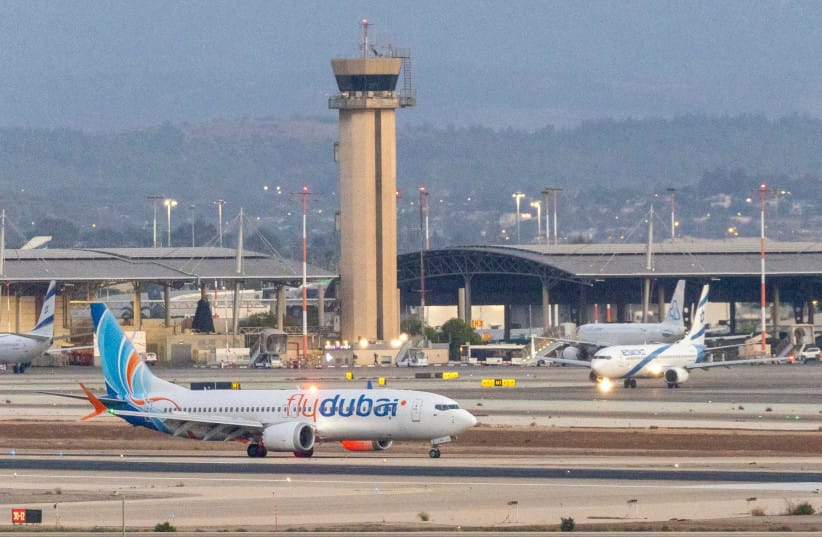
Pilots may communicate visually with fighter jets in emergencies
For example, there is a procedure under which, before a flight, the captain asks passengers to open their window shades. This allows fighter pilots flying alongside both sides of a passenger aircraft, if necessary, to see what is happening throughout the plane, including inside the cockpit. Unusual activity visible from outside can provide the fighter pilots with indications about what is taking place on board.
Pilots aboard the passenger aircraft also know how to communicate what is happening using agreed-upon visual signals, in addition to radio communications and distress buttons.
It is important to emphasize that these procedures take place over a period of time and at a distance that allows the Israel Air Force to scramble aircraft and carry out several stages of checks, providing flexibility in the decision-making process. That process ranges from monitoring, identification, examination, verification, and interception to, in the most exceptional case, shooting the aircraft down.
In the case of the flydubai aircraft, the distress signal was activated while the plane was still well outside Israeli airspace. Nevertheless, such an alert automatically activates Israel's aviation and security systems, enabling authorities to prepare an appropriate response.
"All the organizations, bodies, and officials involved are drilled for a scenario of this kind down to a matter of minutes, in order to carry out a precise process in response to an airborne terrorism scenario," a former senior Israel Air Force officer said.
Prime minister sole authority in question of shooting down civilian plane
The former senior officer further explained that in such a scenario, Prime Minister Benjamin Netanyahu, the defense minister, the IDF chief of staff, and the Israel Air Force commander are brought onto a conference call within a very short period.
The available information is presented briefly during the call, and the prime minister is the sole authority empowered to decide whether the aircraft should be shot down.
The former senior officer stressed that the call is not conducted through aides or intermediaries. "The prime minister has to be on the line. He makes the decision..."
In an extreme scenario in which a civilian aircraft reaches the first designated point, continues toward Israeli airspace, and does not respond to signals from the fighter pilots, a stage is reached at which the prime minister must make a decision, potentially including an order to shoot the aircraft down.
"There is a difference between shooting down a passenger aircraft with 175 passengers and a civilian aircraft with 175 civilians crashing into the Azrieli Towers with a thousand people killed. That is why, from the moment the planes are scrambled, the prime minister is on the line, along with the defense minister, the chief of staff, and the Air Force commander," the former senior officer explained.