The humanitarian situation in the Gaza Strip has remained stable throughout the ceasefire period between Israel and Hamas, the Coordinator of Government Activities in the Territories (COGAT) announced on Thursday.
In its report, COGAT stated that the amount of food and other humanitarian supplies entering the Gaza Strip between October 2025 and June 2026 had “significantly exceeded” the amounts that the United Nations had identified as necessary for the population.
According to COGAT, approximately 1.78 million tons of food entered the Gaza Strip during that time period, which is over three times more than the requirements set by the World Food Programme.

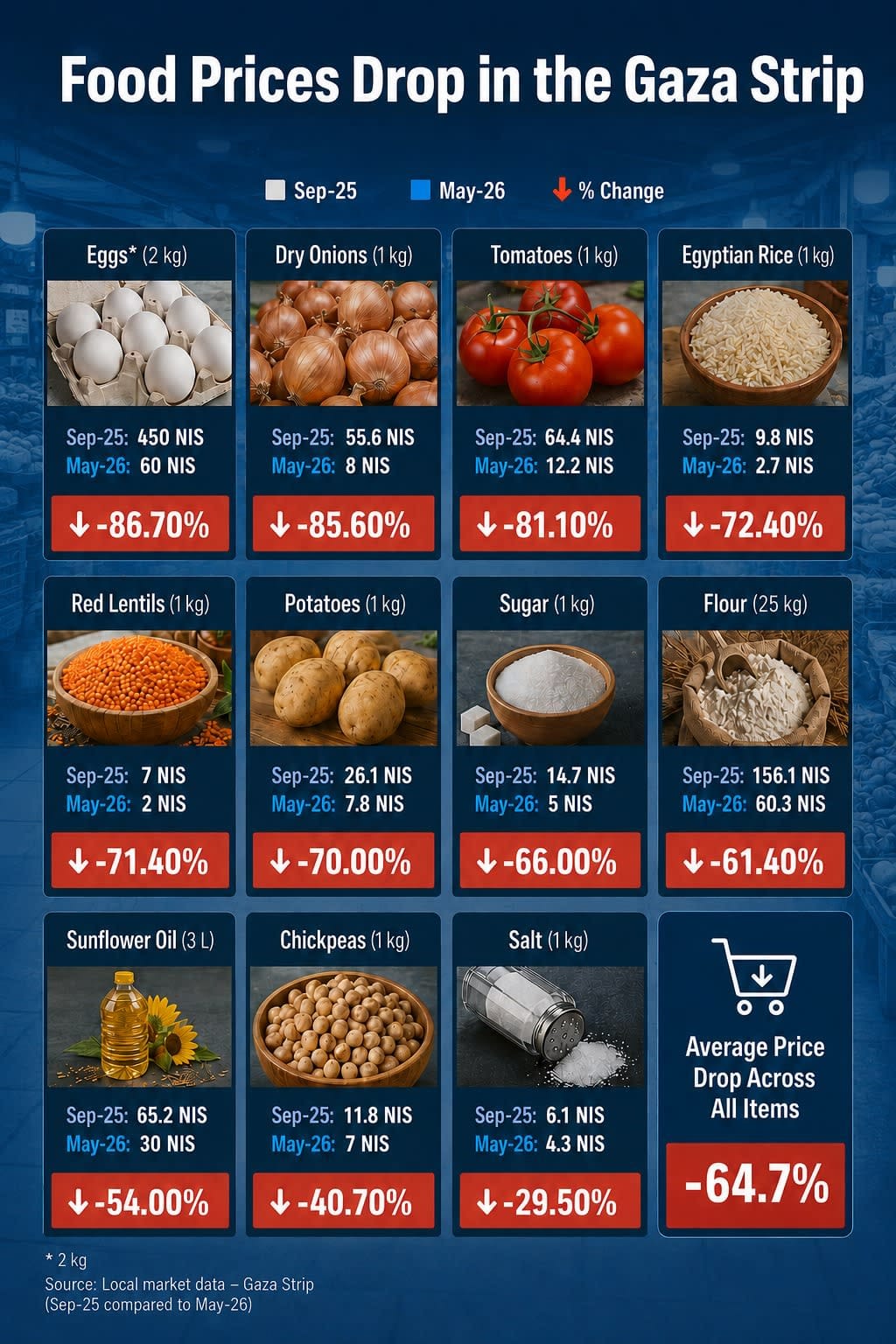
COGAT also reported that food prices in Gaza had declined by 72% between September 2025 and May 2026, reflecting the amount of food entering. Price levels, COGAT’s report also stated, are mainly influenced by taxes imposed by Hamas and other internal market conditions.
The report also examined the field of water, sanitation, and hygiene in the Gaza Strip, concluding that the amount of water supplied exceeded 70,000 cubic meters per day, which COGAT stated was more than sufficient by international humanitarian standards.
In addition, over 18,000 tons of medicine and medical supplies entered Gaza since the beginning of the ceasefire, and hospital bed capacity increased by over 55%.
Hamas attempting to distort humanitarian picture, COGAT says
COGAT Chief Major-General Yoram Halevy stated that the report had been published due to attempts by Hamas and other actors to “distort the humanitarian picture in the Gaza Strip.”
The data are clear, Halevy stated, adding, “Anyone who ignores these facts is amplifying Hamas propaganda, which exploits the humanitarian space for its military and governing purposes.”