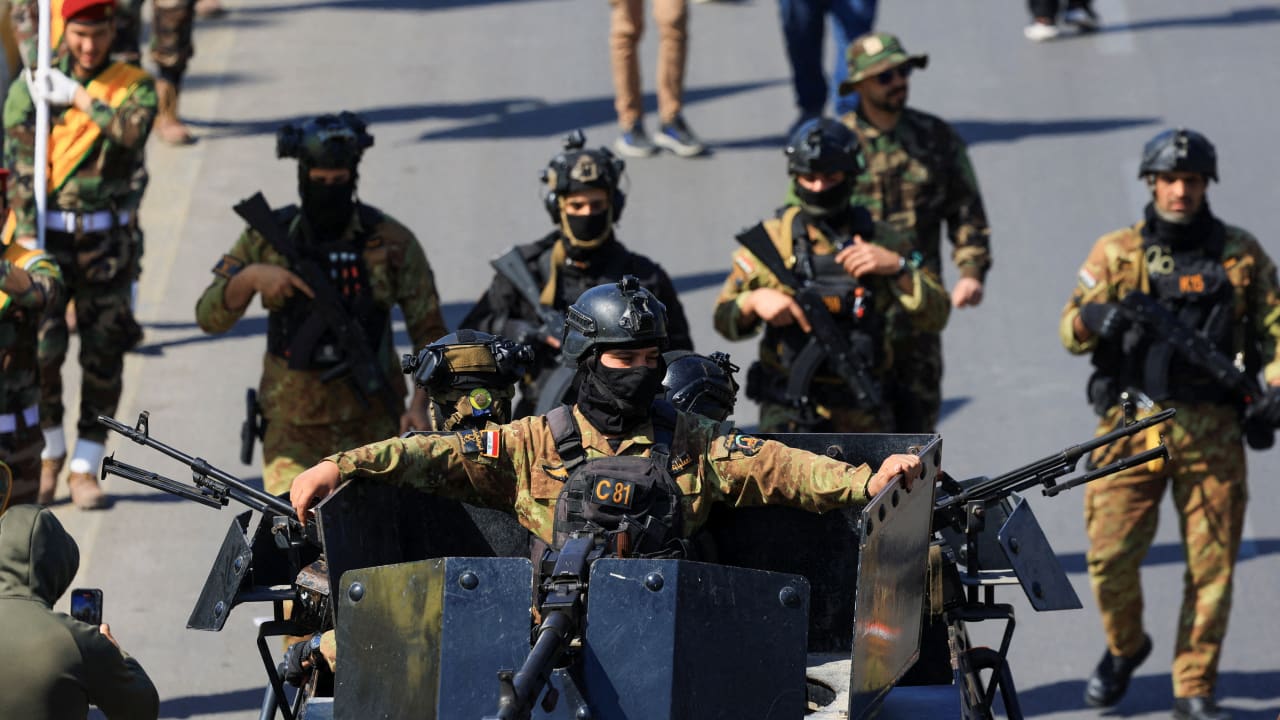
Iranian-backed militias in Iraq were responsible for an attack on a key oil pipeline in Saudi Arabia. The Iraqi government confirmed on Saturday that the attack came from Iraq’s Maysan province. A local commander has been dismissed, the Rudaw media channel in Iraq said. Iraq has sought to prevent Saudi Arabia from retaliating by admitting the attack came from Iraq.
The attack on Saudi Arabia shows how the militias threaten the region. By cutting off energy trade, the militias are also threatening the world. The militias, such as Kataib Hezbollah, have attacked Saudi Arabia in the past. They also killed three American service members in Jordan in 2024. As part of the Islamic Resistance in Iraq, an umbrella group of militias, they have not only attacked Saudi Arabia, Jordan, and Syria, but also Israel and likely several other Gulf states. Iran’s proxy militias in Iraq are growing in their threats.
The militias in Iraq were supposed to be reined in by the new Iraqi prime minister Ali al Zaidi. He had vowed that they would either be disarmed or have their arms put under state control. However, the militias are trying to play for time. They know that US forces are leaving Iraq by September 30. US air defenses are also reported to be moving out of key areas such as the Kurdistan Region of northern Iraq. This enables the militias to fill the vacuum in some areas, increasing their potential threats and control.
US, Saudi Arabia strike Iraqi militias
Back in July, the US and Saudi Arabia carried out strikes on the militias after similar attacks on Saudi Arabia. US Central Command said at the time on July 28 that “US Central Command and the Saudi Arabian Armed Forces conducted precision strikes in Iraq, July 28, against Iran-aligned terrorists that the Islamic Revolutionary Guard Corps (IRGC) directed to attack US forces and Saudi energy infrastructure.”
CENCOM said in July that “US and Saudi fighter aircraft struck multiple terrorist logistics and weapons sites across eastern Iraq in a strong response to over 30 IRGC-directed aerial drone attacks in the last 72 hours. The unwarranted attacks against US forces were not successful. From February through April 2026, there were more than 600 attempted attacks on US citizens and facilities by Iran-aligned terrorist militias in Iraq.”

The attacks have not stopped. In fact, it appears the militias are working closely with Iran’s IRGC and the Houthis to spread havoc. The attack on the pipeline came as the Houthis also seized islands in Yemen that enable them to threaten the Bab al Mandeb Strait.
Rudaw media said “Iraq has previously denied Saudi claims that attacks on the kingdom's energy infrastructure originated from Iraqi territory, making Saturday's confirmation a rare acknowledgment by Baghdad that its territory was used as a launchpad for an attack on a neighboring country.” Now Iraq’s prime minister has "directed the formation of an investigative board concerning the Maysan Operations Command.”
Rudaw noted that Zaidi also "ordered that the Operations Commander be relieved of his position, following confirmation that the attacks targeting our brothers in the Kingdom of Saudi Arabia were launched from a location within the province.” Rudaw added that “the announcement came shortly after Saudi Arabia said drones launched from Iraq had struck its East-West oil pipeline, causing casualties and damage. Baghdad condemned the attack and announced an urgent investigation to identify those responsible.”
Riyadh faces threats from multiple fronts
Iraq has asked Saudi Arabia not to respond. Riyadh has a problem in that it now faces threats from multiple fronts. The Houthis have also attacked Saudi Arabia. Riyadh faces threats from Iraq and Yemen. Riyadh has been in touch with the US. It has also received some verbal support from its Mecca Pact allies, Pakistan and Turkey. However, military support is lacking. US President Donald Trump has also mentioned the Houthis but appeared to make it seem that they have been in touch with the White House and are trying to de-escalate.
According to Arab News in Saudi Arabia, “Saudi Arabia temporarily shut down its East-West Pipeline after it was targeted in several drone attacks in the Riyadh and Madinah regions, the Ministry of Energy said on Friday.” It said several people were injured. “Emergency and specialized technical teams were deployed immediately following the attacks to secure the pipeline and assess its safety in coordination with the relevant authorities, the ministry added.”
The Kingdom will “give the brotherly Iraqi government an opportunity to take the necessary measures to prevent attacks launched from Iraqi territory against the Kingdom and neighboring countries,” the ministry said. Saudi Arabia appears to be giving Iraq time to show it can deal with the culprits. Riyadh is also taking a wait and see approach on Yemen.
Iraqi militias, a growing threat to the region
The attacks by the militias in Iraq illustrate how they are a growing threat to the region and the world. The world, because the energy issues in the region affect the world. Iranian-backed militias have become one of the most powerful groups in Iraq since the fall of Saddam Hussein in 2003. Many trace their origins to earlier organizations created during the Iran-Iraq War in the 1980s, when groups such as the Badr Organization were established with support from Iran's IRGC.
After 2003, Iran expanded its influence by supporting additional militias, including Kata'ib Hezbollah, Harakat Hezbollah al-Nujaba, Kata'ib Sayyid al-Shuhada, Asaib Ahl al-Haq, and Kata'ib al-Imam Ali. Many of these groups later became part of the Popular Mobilization Forces (PMF), which were formally established in 2014 to help fight ISIS after the collapse of Iraqi army units in northern Iraq. While the PMF played an important role in defeating ISIS, several factions retained close ties to Tehran and continued to operate independently of the Iraqi state. Many of the militias are sanctioned by the US as terrorist groups.
Today, Iraq's effort to place all weapons under state control has exposed divisions within the PMF. Several factions have agreed in principle to integrate fully into the state's security structure, while five prominent Iran-aligned groups continue to resist. These include Kata'ib Hezbollah, Harakat Hezbollah al-Nujaba, Kata'ib Sayyid al-Shuhada, Ansar Allah al-Awfiya, and Saraya Awliya al-Dam.
These groups argue that they should not disarm until all foreign forces leave Iraq and the country achieves what they describe as full sovereignty. Baghdad, backed by Washington, maintains that a state monopoly on arms is essential for Iraq's stability, sovereignty, and economic development. The debate over these militias has therefore become one of the defining security and political issues facing Iraq today.
What’s important to know is that the militias continue to grow their power and show they can threaten neighboring states using the pinpoint accuracy of drones and other weapons. This illustrates their growing threat.