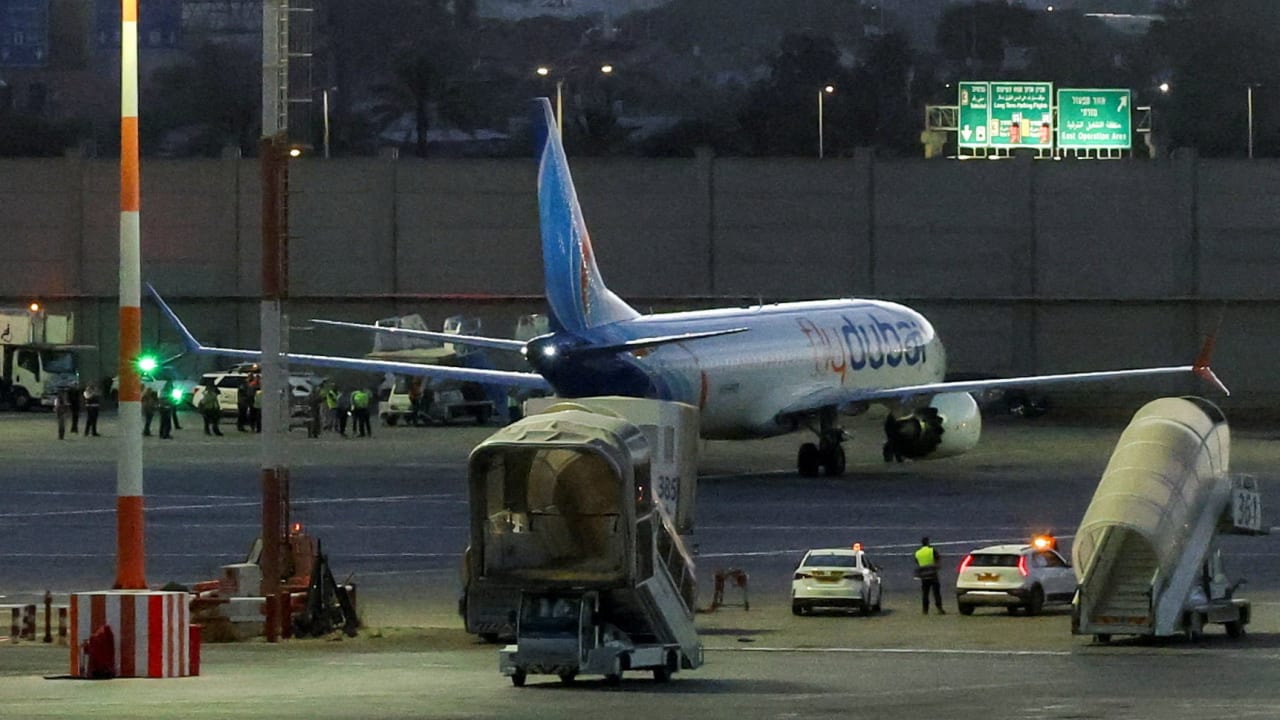
The damage to the rudder of flydubai flight FZ1073 likely resulted from the extreme speeds, angles, and G-forces the aircraft reached during its dive and subsequent recovery amid its attempted hijacking, The Wall Street Journal reported on Saturday.
According to the report, the Boeing 737 MAX reached an estimated speed of Mach 0.96, with Mach 1.0 being the speed of sound. For comparison, such commercial aircraft cruise below the "high altitude never exceed speed (MMO)" of Mach 0.82. Speeds beyond MMO can damage the aircraft, while speeds slightly below can still cause damage if flight conditions are not smooth.
The report noted that the estimated speed and other flight parameters, sourced from Flightradar24 satellite tracking data, are less accurate than the data in the aircraft's flight data recorder, also known as the "black box," which investigators will rely on.
In addition, the estimations do not take into account variables like wind speed and direction, air temperature, and pressure levels, all of which contribute to what is known to pilots as "True Airspeed (TAS)," the most accurate representation of an aircraft's speed with regard to its performance and the forces acting upon it.
With this in mind, the aircraft may have reached a TAS higher the estimated, though investigators will need more time to confirm. What is known is that the stresses suffered by the aircraft caused a large portion of the rudder, which controls a plane's yaw (side-to-side) movement, to break off.

Aircraft fell over 17,000 feet in 92 seconds, satellite tracking data shows
The tracking data also showed that the aircraft fell about 17,400 feet over 92 seconds at a 39-degree nose-down attitude, far steeper than the standard descent angle of 3 degrees.
As the aircraft was brought back under control, it sustained further stress through the return to straight-and-level flight, with the WSJ putting an emphasis on the estimated three G's of force, or three times the force of gravity. A 737 MAX is only rated to sustain 2.5 positive G's, according to its official limitations, which itself is unlikely to ever be reached over the course of a commercial flight.
The aircraft is also rated for a maximum "maneuvering speed (VA)" of between 210 and 230 knots, depending on configuration, meaning that beyond that speed, any abrupt or full-control movements can damage the aircraft. Mach 0.96 is well beyond that range.
Regardless of the cause, the damage to the rudder suggests a departure from the aircraft's limitations in at least one of the areas discussed in the report.
A second pair of flydubai pilots, who took over control following the attempted hijacking, flew the damaged aircraft for over an hour before diverting to Tabuk, Saudi Arabia. According to the report, the plane's altitude fluctuated by about 500 feet at a time as it progressed, suggesting difficulty maintaining straight-and-level flight amid the damage.
The flydubai aircraft is still parked at Tabuk Airport as of the time of writing, where teams will examine the full extent of the damage to determine whether the plane is still airworthy after any needed repairs, according to the WSJ.
Embry-Riddle aerodynamicist: 'I’m not sure it can ever be used again'
Embry-Riddle Aeronautical University aerodynamicist Tony Farina told the WSJ that the aircraft will need, "at the very least... a complete and thorough inspection.”
“I’m not sure it can ever be used again,” said Farina, who has worked with the US Air Force and NASA on aviation-related projects.
The fact that the Boeing managed to stay intact amid such extreme stresses marks a win for the US aircraft manufacturer, with the report noting the issues the 737 MAX has faced over recent years, ranging from physical cracks and software glitches to two separate fatal crashes resulting from a design flaw.
The WSJ reached out to Boeing, which declined to comment.
US President Donald Trump congratulated the American plane maker in a special media post on Wednesday following the incident, noting the 737 MAX aircraft's ability to "withstand G-forces and strain far beyond what it was designed and expected to do."
Trump further congratulated and thanked passenger Yaniv Hayoun for his role in helping save the aircraft, its crew, and its fellow passengers following the hijack attempt, with the US president describing himself asd "a fan of his," in a TikTok post on Friday.
Space-company TransAstra CEO and aerospace engineer Joel Sercel also commented on the security aspect of the incident, telling the WSJ that an aircraft's good design "will not save the airplane if a qualified person on the flight deck commands a dive and the other person cannot stop him in time."