
Now that Iran appears to have signed a memorandum of understanding with the US, the clock will be ticking toward what comes next. There are concerns in the region that there could be a return to conflict.
The nuclear file, the Strait of Hormuz, Iran’s frozen assets, and other issues remain to be solved.
At the center of what comes next will be Iranian Supreme Leader Mojtaba Khamenei. His father, the former supreme leader, was killed at the outset of the conflict. There are questions about how the new Khamenei actually holds onto power.
“For the supreme leader, surviving the war may be the easiest part, and the hardest struggle, which is transforming the title of Iranian Supreme Leader into real leadership, began as soon as it ended,” UAE-based news site Al-Ain News reported this week.
Al-Ain News has unique sources and access in some areas of the region, and it also reflects thinking in the UAE. As such, it is worth listening to what it is saying.
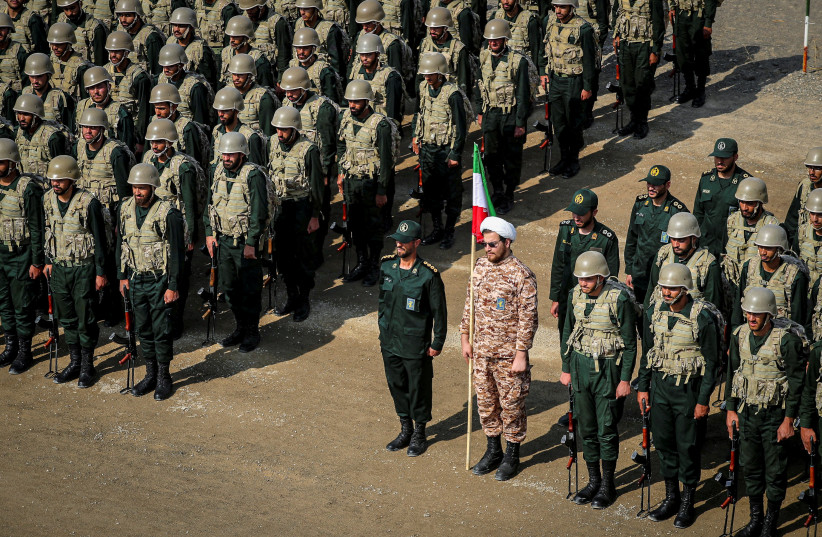
IRGC reaches unprecedented level of power, report warns
“The Iranian Revolutionary Guard and its generals have never before reached this level of power, especially given their claims that they saved the regime from collapse, which will put Khamenei’s son at risk if he does not maintain the loyalty of these generals,” said the he report, which is partly based on a separate report by UK-based The Daily Telegraph.
Mojtaba Khamenei has not appeared in public and is assumed to have been wounded in the February 28 airstrikes.
The new Iranian regime is considered to be more “militarized” than the former one. A month and a half before the US and Israeli attacks, the Islamic Revolutionary Guard Corps (IRGC) massacred tens of thousands of protesters, consolidating its power within Iran.
“In theory, Khamenei Jr. has the final say; the constitution makes him the supreme commander of the armed forces, and no important decision becomes binding until he approves it,” Al-Ain News reported. “But this authority is worthless if the leaders of the Revolutionary Guard, whose position is still unclear, do not submit to it.”
Iranian president could be 'fall guy' for Islamic regime
An Iranian official told the Telegraph Iran has seen a shift in the balance of power. In fact, a separate source told The Jerusalem Post earlier this week there were some who believed hardliners in the IRGC might carry out a coup to prevent a deal.
Iran’s president, who is considered a moderate, has been the recent public face of the deal. He could become the fall guy.
“Khamenei’s style of governance and the extent of his authority have yet to be tested, and another official described the situation as being like a ‘closed watermelon’ that cannot be judged until it is opened,” Al-Ain News reported, [and] “in order for Mojtaba to effectively govern, he must dismantle the networks built by his father, marginalize the generals, outmaneuver rivals, and place his loyalists in power, and he has already begun to do so, according to the Telegraph.”
Mojtaba has a parallel intelligence structure that includes the Ministry of Intelligence and the IRGC’s intelligence arm, the report said, adding that the younger Khamenei will do what his father did in 1989 when he assumed power.
“There is a possibility of getting rid of Gholam Hossein Mohseni Ejei, the head of the judiciary,” the report added. “Loyalists like Ahmad Vahidi, the Revolutionary Guard commander who is considered close to Mojtaba, may also be eliminated in the end despite their seniority.”
“Mojtaba is in a much weaker position than his father, who had years ahead of him to consolidate his power and had the blessing of the founder of the revolution, and his status as a first-generation revolutionary who spent time in the Shah’s prisons,” Al-Ain News reported.
That uncertainty could lead to innovation in policy or internal conflicts.