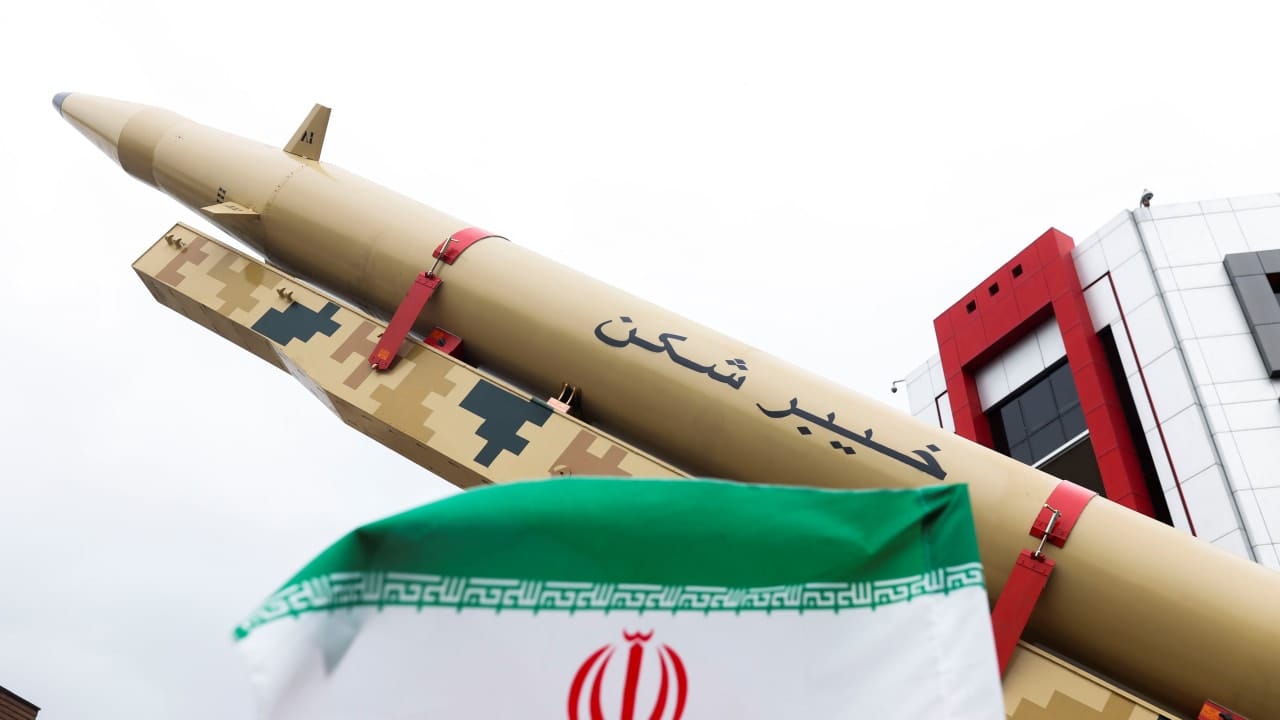
Iran's Islamic Revolutionary Guard Corps (IRGC) announced on Wednesday that it was preparing to unveil a new weapon, which it dubbed the "Father of All Bombs," in response to US threats to use the most powerful conventional bomb in the American arsenal against Iran's nuclear facilities.
The announcement comes amid rising security tensions between Tehran and Washington and the possibility of renewed US strikes on Iranian territory.
IRGC spokesperson Hossein Mohabi told the Iranian Young Journalists Club news agency that "We are in the preparatory stages of unveiling the 'Father of All Bombs.' This is something new for the enemy."
However, the spokesperson declined to provide details on the weapon type, its power, operational capabilities, or when it would be unveiled to the public, according to Turkey's official Anadolu Agency.
US reportedly preparing plans to use Mother of All Bombs
The Iranian announcement follows US media reports that the Pentagon had prepared plans to use the GBU-43/B bomb, known as the "Mother of All Bombs" (MOAB), against targets in Iran. Weighing approximately 9.8 metric tons (20,000 lb.), the bomb is considered one of the most powerful conventional weapons in the US arsenal.

The bomb was first used in April 2017, during US President Donald Trump's first term, against an ISIS tunnel complex in Afghanistan. It is designed to generate an exceptionally powerful blast wave over a wide area but is not intended to penetrate deep underground like specialized bunker-busting bombs.
In an interview with Newsmax last Thursday, Trump addressed the possibility of using the weapon, emphasizing that it was not a nuclear bomb. The president ruled out using nuclear weapons against Iran but did not rule out a strike using the conventional bomb.
Alongside the announcement of the new weapon, Mohabi claimed that Iran's missile stockpile had increased by 50% since the 12-day war against Israel in June 2025.
According to Mohabi, Iran has also significantly improved the quality of its missiles, their operational ranges, destructive power, and targeting accuracy. However, the spokesperson provided no figures that would allow the claims regarding the expansion of Iran's arsenal to be independently verified.
Strait of Hormuz is not open, IRGC spokesperson says
Mohabi also discussed the Strait of Hormuz, denying US claims that it was open.
"If, under the cover of darkness, a few small vessels manage to slip past us - by switching off their tracking equipment and bribing shipping companies or crews - this does not mean the Strait is 'open'; rather, it signifies piracy and smuggling," he said.
At most, he said, the US had been able to smuggle one or two million barrels of oil, at what he claimed was a very high cost.
"The Strait of Hormuz is definitely closed; however, we must clarify what 'open' and 'closed' mean in this context," he said. "An 'open' Strait of Hormuz implies a waterway where any vessel - regardless of its origin or destination - can freely enter and exit, much like the situation that existed prior to the '40-Day War' [operations Epic Fury and Roaring Lion]."
The announcement follows the war that broke out between the US, Israel, and Iran in February, during which Tehran attacked targets in Israel and US military bases in Arab countries.
Despite a memorandum of understanding signed between Washington and Tehran in June, negotiations between the two countries collapsed over disagreements concerning freedom of navigation and security in the Strait of Hormuz.
The latest Iranian announcement adds to the ongoing exchange of threats between Tehran and Washington.
Jerusalem Post Staff contributed to this report.