
This is the third of a three-part series. In Part I, I suggested implementing broad parameters to create a truly representative government by doubling the size of the Knesset to 240 members, with MKs elected by district rather than by political party, while imposing a two-term (8-10 years) limit on all Knesset members.
Part II discussed the structures of government needed to reflect the requirements of a population that is now 15 times larger than when Israel was established, with a citizenry that has roots in over 100 different cultures.
This last part is devoted to addressing the social challenges in Israeli society that must be tackled if we are to successfully make it to our 100th anniversary of independence.
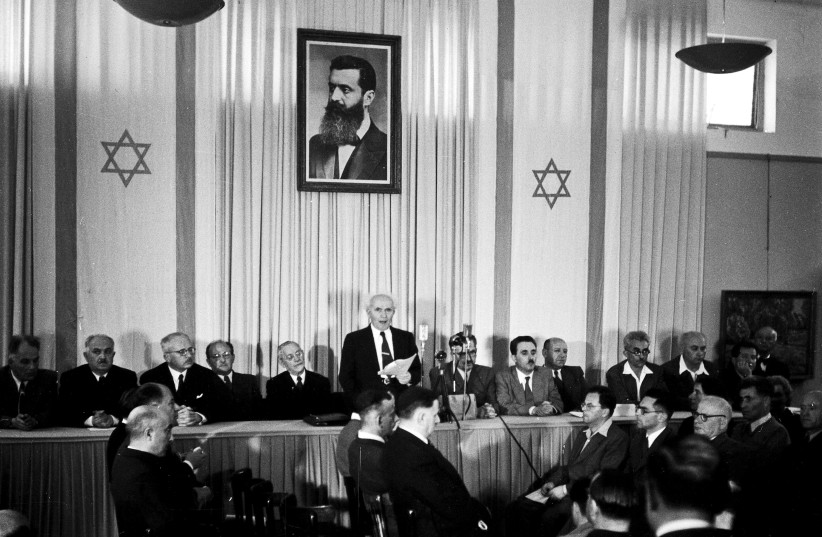
Israel’s Declaration of Independence
The section of the Declaration of Independence that provides the guideposts to creating a productive society for everyone is the following:
“The State of Israel… will foster the development of the country for the benefit of all its inhabitants; it will ensure complete equality of social and political rights to all its inhabitants irrespective of religion, race or sex; (and) it will guarantee freedom of religion, conscience, language, education and culture.”
The key words which I chose to highlight, “all its inhabitants,” are a clear statement that everyone is to reap the benefits of living in Israel while, concomitantly, by inference, everyone is obligated to share the pro rata burden as well, the same as every other person living in the country who enjoys the benefits.
Given that logic, a whole series of issues need to be addressed to ensure the longevity of the country.
Equality of infrastructure and services
Everyone living in Israel should be provided the same basic infrastructure as everyone else in the country. Roads, schools, access to medical care and social services should be at the same level throughout the country, whether it be in north Tel Aviv or in overcrowded Umm el-Fahm.
It is unconscionable in a modern society for there to be any differential in the quality of the infrastructure from one location in Israel to another.
Equality of justice
The words found in the Torah, “Justice, justice shall you pursue” (Deuteronomy 16:20), must be viewed as our foundational call to action for upholding fairness, equity, and righteousness in society. Everyone must be subject to the same application of the law.
For example, passing a law that bypasses the courts and summarily sentences to death terrorists guilty of murder, as was done by the Knesset earlier this year, is not in the spirit of the Torah’s command, especially when it is known that it is specifically designed to target Arab terrorists only.
This, in the face of over 4,500 settler attacks (an average of four per day) against the Arab population recorded by the security services since Israel’s current government took office in December 2022, with very few of the perpetrators ever having faced justice. A lawful society needs to address this issue sooner rather than later.
Another aspect under this rubric is crime in the Arab sector, which is widely recognized as a severe national crisis, driven largely by organized crime, gang warfare, and illegal weapons. While representing just one-fifth of the population, Arab citizens account for a disproportionate majority of violent crimes and homicides.
Even Arab leaders acknowledge that the crisis is rooted not only in policing, but in a whole series of deeper social failures along with the infrastructure inequalities mentioned above. But real change requires a national plan which seems to elude us.
Therefore, the government should establish a permanent interministerial task force to address the violence with plans across education, welfare, employment, infrastructure, policing, and local governance sectors. That is what serious states do when confronted with systemic breakdowns.
Equality of service
After living in a bad neighborhood for 78 years, and now in a world in chaos as well, it should be clear that the defense of Israel is a more critical imperative than perhaps at any time since the War of Independence. It is also obvious now that our reserve forces will continue to be required to spend more and more time on active duty than in the past, something which is approaching unsustainability.
According to military analysts here, the IDF is facing an urgent personnel shortage of roughly 12,000 to 15,000 soldiers, including approximately 7,000 to 9,000 combat troops. This deficit is the direct result of prolonged, multi-front operations and is expected to worsen significantly in the future unless immediate action is taken to address the challenge.
There can only be one reasonable response to this need, and that is that everyone eligible and physically qualified needs to serve in the IDF or participate in National Service. That means everyone, including Arabs and the haredi (ultra-Orthodox) community as well. Those who benefit from living here, prima facie, have an obligation to shoulder the defense needs as well. It is high time this issue was put to bed in the only way that is equitable to all. Everyone must serve.
Monitoring the language of dialogue
Finally, real equality and its associated societal progress will come about only with the creation of an atmosphere of mutual respect and the reflective use of non-destructive language in communication. Language used as a sign of mutual respect involves active listening, inclusive terminology, and polite phrasing. It creates safety and builds trust. By using appropriate words and tones, both parties show that they value each other’s opinions, contributions, and boundaries.
Although Israel is not what one would term a “soft” society when it comes to interpersonal relationships, habits can still be changed.
For example, on November 12, 2015, during former Mississippi governor Phil Bryant’s visit to Israel, he met with representatives of ORT in Tel Aviv. I was at the table for that meeting when a discussion ensued about the challenge presented when society tries to change long-standing habits.
Bryant interrupted, saying that habits can indeed be changed. To illustrate, he called attention to the fact that if we had been meeting in 1995 and not 2015, there would have been ashtrays on the conference table to accommodate the smokers, but 20 years later, smoking was no longer permitted in public places like ORT. Point made!
For Israel, to be the light unto the nations is as much a part of our tradition as the obligation to live here and build the land. We will need to change our habits and strive to fully live by the words of our Declaration of Independence, to “ensure complete equality of social and political rights to all its inhabitants.” Let us hope we will be successful.
The writer, a 42-year resident of Jerusalem, is a former national president of the Association of Americans and Canadians in Israel, a past chairperson of the board of the Pardes Institute of Jewish Studies, and a Board Member of the Israel-America Chamber of Commerce (AMCHAM).